
Wan 3.0 Video Prime vs Wan 3.0: Is Faster Worth the Price?
A matched Wan 3.0 Video Prime vs standard test measured 86.7s vs 141.1s. Compare current cost, request fields, limits, and best-fit workloads.
Choose Wan 3.0 Video Prime when shorter queue time has measurable value; choose standard Wan 3.0 when generation cost matters more than turnaround. On reAPI, both offer 2–30-second output at 480P, 720P, 1080P, 2K, and 4K. Text, frames, and reference media are supported; document and webpage input is limited to 1080P. Prime is positioned for faster turnaround without a fixed latency SLA. The roughly 1.7× cost ratio reported below belongs to the August 29 paired test, not today’s rate card.[1][2]
That makes Wan 3.0 Video Prime vs Wan 3.0 a queue-economics decision, not a simple quality ranking. reAPI does not document a Prime quality advantage, and the two routes use different request fields despite their aligned capabilities. In one matched five-second 480P run on August 29, 2026, Prime was first observed complete 54.4 seconds earlier and cost 138 credits more. That is an observation, not a fixed speed promise.
TL;DR
| Decision point | Wan 3.0 Video Prime | Wan 3.0 standard |
|---|---|---|
| Positioning | Faster-turnaround route | Lower-cost route |
| Fixed speed guarantee | None published | None published |
| Maximum duration | 30 seconds | 30 seconds |
| Resolutions | 480P / 720P / 1080P / 2K / 4K | 480P / 720P / 1080P / 2K / 4K |
| Input families | Text, frames, reference media, document, web page | Same capability families |
| Audio output | On by default | On by default |
| August 29 test: 5s 480P cost | 337 credits | 199 credits |
| Observed completion in one matched run | 86.7 seconds | 141.1 seconds |
| Request schema | Explicit frame and reference_* fields | Role-based/bare image fields plus size |
| Best fit | Interactive or deadline-sensitive queues | Batch, drafts, and cost-sensitive volume |
Checked September 8, 2026: these are rounded public reAPI display rates in USD per output second. Use the task estimate and settled credits for an exact charge; do not multiply a rounded card into an exact invoice. Document and webpage inputs are supported through 1080P only; 2K/4K do not accept reference_file_urls or reference_link_urls.
| Resolution | Prime per second | Standard per second |
|---|---|---|
| 480P | $0.054 | $0.035 |
| 720P | $0.110 | $0.068 |
| 1080P | $0.219 | $0.136 |
| 2K | $0.243 | $0.199 |
| 4K | $0.269 | $0.229 |
One matched 5-second test saved 54.4 seconds
We submitted one text-to-video job to each route concurrently. Both tasks were
created in the same server second and used the same prompt, seed, five-second
duration, 480P resolution, 16:9 frame, and audio setting. The API schemas use
different names for the frame shape—size on standard and aspect_ratio on
Prime—but the requested setting was identical.
| Observed result | Wan 3.0 Video Prime | Wan 3.0 standard |
|---|---|---|
| Client-observed completion | 86.7 seconds | 141.1 seconds |
| Actual task usage | 337 credits | 199 credits |
| USD equivalent | $0.337 | $0.199 |
Prime was first observed complete 54.4 seconds earlier, a 38.6% shorter observed wait. The speed lane cost an additional 138 credits, or $0.138. For this pair, that works out to about $0.152 for each minute of waiting removed.
Watch the five-second Wan 3.0 standard result
Watch the five-second Wan 3.0 Video Prime result
The prompt asked for one continuous studio orbit around a cobalt-blue glass
perfume bottle, with stable geometry, moving orange light, no cuts, and no
text. Both requests also used seed 8292026. The task endpoint was polled
every three seconds, so the measured completion times have a small polling
uncertainty.
This is a single paired run, not a latency distribution. It does not prove that Prime will always be 38.6% quicker, and the two clips were not given a blind quality score. The useful fact is narrower: for this request at this time, Prime returned first, and the exact cost of that shorter wait is known.
Wan 3.0 Video Prime costs about 70% more at 480P (2026-08-29)
In the August 29, 2026 paired test, actual usage was 337 credits on Prime and 199 on standard, a 69.3% premium. The table and 1,000-output budget below are retained as historical rounded-rate illustrations from that date, not current quotes or exact task invoices. The measured task charges above remain unchanged.
| Resolution | Prime per second | Standard per second | 10s Prime | 10s standard |
|---|---|---|---|---|
| 480P | $0.068 | $0.040 | $0.68 | $0.40 |
| 720P | $0.139 | $0.080 | $1.39 | $0.80 |
| 1080P | $0.278 | $0.160 | $2.78 | $1.60 |
At 720P, 1,000 ten-second outputs cost about $1,390 on Prime versus $800 on standard Wan 3.0 before failed-job refunds. The $590 difference buys access to the speed-oriented route. Whether that is sensible depends on what a minute of waiting costs your product, operator, or customer.
These are reAPI gateway rates observed on August 29, 2026. They are not Alibaba Cloud list prices or evidence of an upstream price change. Use the live Prime model page and standard Wan 3.0 model page when budgeting.
One fast result is not a public SLA
Prime is explicitly offered for faster turnaround, but neither reAPI nor the public route documentation promises a completion time. A 30-second 1080P job with several references is not comparable to a five-second 480P text-only request. Queue conditions also change through the day.
The paired result above establishes a concrete observation. A routing policy still needs a distribution from the work it will actually run:
- Select ten to twenty representative prompts and reference sets.
- Submit matched jobs to both routes at the same resolution and duration.
- Record median and slow-tail completion time, failure rate, and actual credits consumed.
- Repeat during normal peak and off-peak windows.
- Decide how much the saved wait is worth per successful output.
This test can justify Prime for one queue and standard for another. A live editing tool may benefit from shorter waits, while an overnight social-video batch may gain nothing from paying the premium.
The creative capability set is closely aligned
Both routes support the same broad jobs:
- text-to-video;
- first-frame and first-plus-last-frame generation;
- mixed reference images, video, and audio;
- one supported document or one public web page as source material;
- 2–30 second output at 480P / 720P / 1080P / 2K / 4K;
- optional generated audio.
Alibaba's Wan 3.0 release describes the underlying direction as an all-in-one video system that reads text, images, audio, video, documents, and web pages and generates up to 30 seconds.[3] Prime does not add a new creative mode on reAPI. Its reason to exist is turnaround.
There is also no documented basis for saying Prime produces better frames, stronger reference consistency, or better audio. If output quality differs in your workload, report it as a test result with matched inputs—not as a general property of the model name.
Do not migrate by changing only the model id
The two reAPI routes expose similar capabilities through different field names. A model-string swap can leave the rest of the payload invalid.
| Purpose | Prime field | Standard field |
|---|---|---|
| Model id | wan3.0-video-prime | wan3.0-video |
| Aspect ratio | aspect_ratio | size |
| First / last frame | first_frame_url, last_frame_url | image_urls or image_with_roles |
| Reference images | reference_image_urls | image_urls or image_with_roles |
| Reference videos | reference_video_urls | video_urls |
| Reference audio | reference_audio_urls | audio_urls or audio_url |
| Document | one-item reference_file_urls | file_url |
| Web page | one-item reference_link_urls | link_url |
Keep an internal job specification that is independent of either provider
payload. A small adapter can translate aspectRatio, firstFrame, and
referenceImages into the correct fields for the selected route. That is
safer than scattering Prime-specific keys throughout a product.
Before routing production traffic, validate two billing defaults on both
adapters: omitted resolution selects 1080P, and smart duration (-1) reserves
the 30-second ceiling on reAPI. An accidental default costs more on Prime
because every second is more expensive.
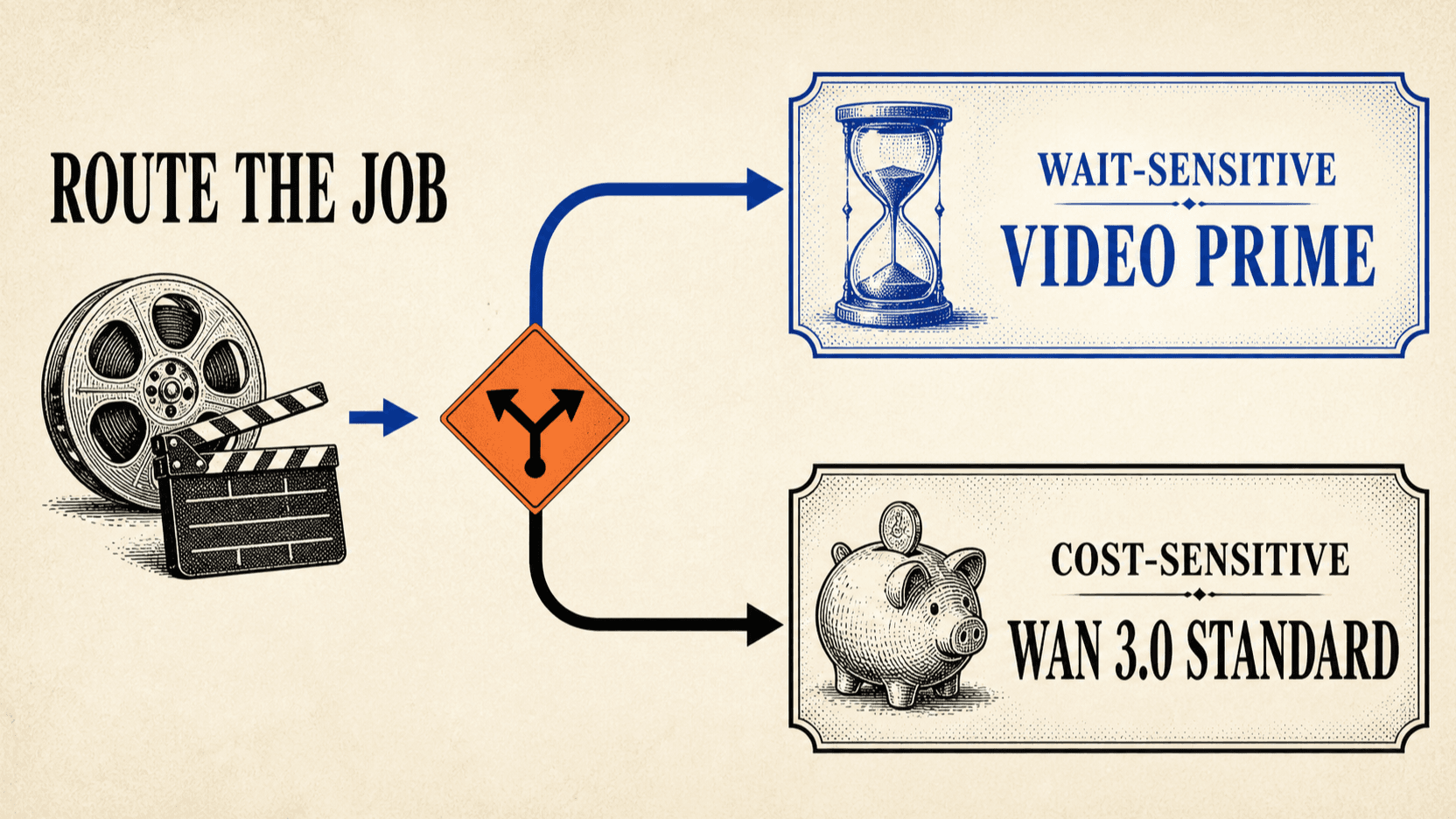
Which Wan 3.0 route fits each workload?
Use Prime for a wait-sensitive path
Prime is most defensible when users or operators are blocked by generation: an interactive preview, a live client session, a moderated publishing queue, or a deadline with a real cost of delay. Even then, benchmark it first. “High speed” is a route description, not a contractual response time.
Use standard Wan 3.0 for volume and iteration
Standard is the practical default for drafts, prompt exploration, overnight jobs, and high-volume generation. A team can also iterate at 480P on standard, then send only approved prompts to Prime at the delivery resolution when the final queue is time-sensitive.
Use both when priority changes by request
A two-lane queue often makes more sense than one global choice. Send routine jobs to standard and reserve Prime for paid priority, operator escalation, or deadline-bound renders. Rate limits, retries, and cost reporting should remain separate so a Prime fallback does not silently become the default path.
FAQ
Is Wan 3.0 Video Prime better quality than Wan 3.0?
No quality advantage is documented. Prime is positioned around faster turnaround. Run matched samples if visual or audio quality is part of the decision.
How much faster is Wan 3.0 Video Prime?
In our single matched five-second 480P run, Prime completed in 86.7 seconds versus 141.1 seconds for standard, a 54.4-second difference. There is no public fixed multiplier or latency SLA, so measure your own durations, resolutions, references, and traffic windows before setting a routing rule.
Does Prime support more references?
No. Both reAPI routes accept up to ten reference images, five video clips, and five audio clips, plus one document or one public web page.
Can I switch between Prime and standard with one payload?
Not directly. The capability families align, but the request field names differ. Translate through an adapter or build separate payloads.
Which route should I use for prompt testing?
Standard Wan 3.0 at 480P minimizes the cost of discarded attempts. Prime is more appropriate once saved queue time has a measured value.
Conclusion
In the Wan 3.0 Video Prime vs Wan 3.0 decision, Prime buys a speed-oriented route while standard buys more generations for the same budget. Treat the choice as queue routing: benchmark real jobs, translate the payload schema correctly, and reserve Prime for requests where waiting is genuinely expensive. See the Prime API guide for a complete request and polling example.
References
- reAPI. Wan 3.0 Video Prime API documentation and model rate card. Retrieved August 29, 2026 from reapi.ai/docs/wan-3-0-video-prime and reapi.ai/models/wan-3-0-video-prime
- reAPI. Wan 3.0 API documentation and model rate card. Retrieved August 29, 2026 from reapi.ai/docs/wan-3-0 and reapi.ai/models/wan-3-0
- Alibaba Cloud. Wan 3.0: 30-Second AI Video Generation from Any Input. Retrieved August 26, 2026 from alibabacloud.com/blog/wan3-0-30-second-ai-video-generation-from-any-input_603452
Further reading
Author

Categories
More Posts
Which Wan Models Run Locally? Weights and GPU Memory
Choose Wan models for local use with official 2.1 and 2.2 downloads, runtime-specific VRAM guidance, ComfyUI file paths and a way to measure generation costs.

FLUX 3 vs Seedance 2.5: Keyframes, Duration, and Cost
Choose FLUX 3 or Seedance 2.5 by maximum duration, ordered keyframes, references, editing, native audio, Draft workflow, resolution, and API cost.

GPT-6 Sol vs Astra: Price, Scores and Which Effort to Pick
GPT-6 Sol vs Astra: Sol costs one fifth of Astra per token. See published scores, effort-matched results, and why GPT-6.1 Sol is a separate question.