Mammouth AI Pricing: Plans, Limits, and API Access (2026)
Mammouth AI pricing explained: compare Starter, Standard, and Expert plans, three-hour quota resets, included API credits, PAYG access, and file limits.
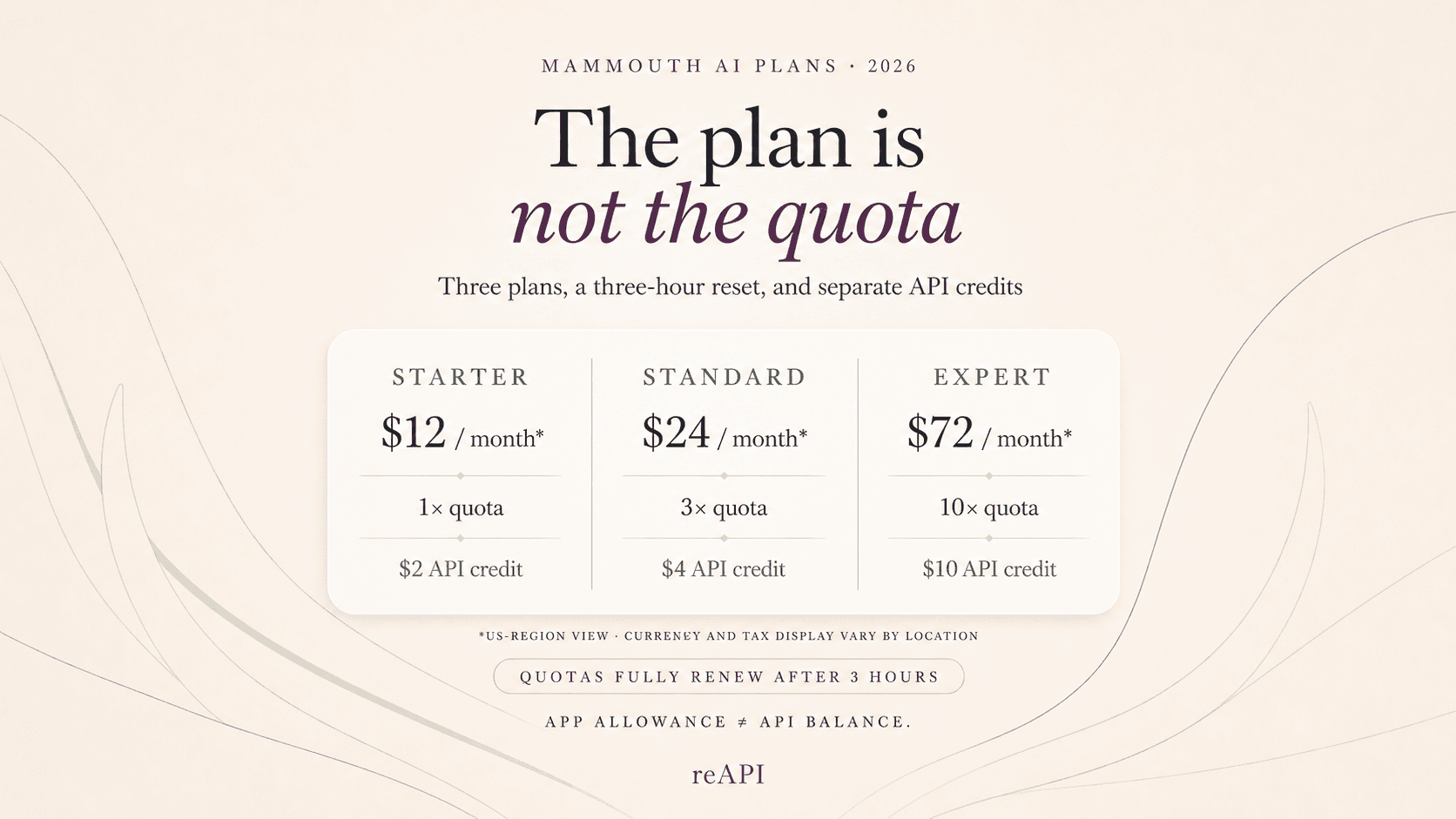
Mammouth AI has three monthly chat plans, but the currency and tax display depends on location. In a US-region view checked on July 30, 2026, Starter, Standard, and Expert appeared at $12, $24, and $72 before VAT; European visitors could see €12, €24, and €72 with VAT included. The plans are not unlimited: quotas fully renew after three hours, with Standard receiving three times the Starter quota and Expert receiving ten times the Starter quota.[1][2]
The API is a separate meter. Each subscription includes a small monthly API credit, but developers can also fund Mammouth's OpenAI-compatible API on a pay-as-you-go basis without buying a chat subscription.[3] That distinction is the key to understanding Mammouth AI pricing: the subscription pays for the Mammouth app and its renewable usage allowance; API calls consume a dollar-denominated API balance.
Mammouth AI plans at a glance
| Plan | Monthly price | Chat quota | Included API credit | Best fit |
|---|---|---|---|---|
| Starter | $12 in the checked US view | Reference quota | $2/month | Regular individual use |
| Standard | $24 in the checked US view | 3× Starter | $4/month | Frequent reasoning, document, or image work |
| Expert | $72 in the checked US view | 10× Starter | $10/month | Heavy professional use across models and media tools |
The dollar prices above are the US-region display checked on July 30, 2026; Mammouth's official page localizes currency and tax treatment, so verify the amount shown for your location. The included API credits come from Mammouth's API documentation.[1][3] Mammouth also offers team workspaces at the selected plan's per-user price, with centralized billing and shared projects; enterprise pricing requires a quote.
All three individual plans include the same broad product: a hosted chat interface with access to model families from providers such as OpenAI, Anthropic, Google, Mistral, xAI, DeepSeek, and others. The app also lists web research, image and video generation, projects, voice features, and coding tools. Paying for a higher plan primarily buys more usage, not a completely different application.
How the three-hour quota works
Mammouth does not publish a single “messages per month” number. Its quota documentation says limits are defined per session and fully renew after three hours.[2] The amount consumed by one exchange depends on what that exchange asks the service to do.
Long prompts and responses cost more quota than short ones. Large documents add input. A long conversation gets progressively more expensive because previous context is sent again. Web search and document-generation tools add work, and a more capable model consumes more than a lighter one.
That makes the headline multipliers more useful than trying to translate each plan into an exact message count:
- Starter is the reference allowance. It suits regular chat and occasional use of expensive tools.
- Standard provides three times the Starter quota. It is the safer middle plan for daily document work, reasoning models, or repeated image generation.
- Expert provides ten times the Starter quota. It is aimed at users who regularly run the expensive models or media tools.
At the displayed 12/24/72 price points, Expert costs six times as much as Starter but carries ten times the relative quota. That is a better quota-to-price ratio, although it only saves money if the extra allowance is actually used.
Hitting a quota does not always stop the chat
Mammouth uses model thresholds. If a user exhausts the allowance for a demanding model, the app can switch the conversation to a lighter model until the quota renews. Its documentation gives a Claude example: Opus can fall back to Sonnet, then Sonnet to Haiku.[2]
This keeps a session running, but it also means “I can still send messages” is not proof that the original model remains active. Anyone choosing a plan for a specific premium model should watch the model shown in the interface during a long session and test the workload across a full three-hour window.
Subscription quota and API credit are different
The easiest pricing mistake is to treat the included API credit as a cash version of the app quota. It is not.
The chat subscription covers use inside Mammouth's hosted product, subject to the renewable quota. The included API credit is a separate monthly balance for calls made with an API key:
| Subscription | Monthly API credit included |
|---|---|
| Starter | $2 |
| Standard | $4 |
| Expert | $10 |
Mammouth's API guide states that all subscribers receive those credits. It also allows pay-as-you-go funding from the API settings, so an API-only developer does not need to buy a Starter subscription first.[3]
API usage is priced by model and tokens. The published model table contains separate input and output rates, and Mammouth warns that the table may change; its Model Explorer is the current source for the full catalog. The service says the displayed rates are upper bounds and that the actual charge can be lower when provider availability permits.[3]
In practice:
- buy a chat plan when people will work in the Mammouth interface;
- use PAYG when software, an automation, or an internal tool will make the calls;
- count the included API credit as a small developer allowance, not as the plan's main value;
- price an API workload from its actual model, input tokens, and output tokens rather than the subscription multiplier.
What Mammouth API access includes
Mammouth documents an OpenAI-compatible chat-completions API at https://api.mammouth.ai/v1. Existing OpenAI client code can generally point to that base URL, use a Mammouth key, and keep the familiar message format.[3]
The API is useful when a team wants one endpoint for several LLM providers, or needs to connect models to tools such as n8n, Make, Cline, or an internal application. It is not the same product experience as the Mammouth chat app. Projects, hosted conversations, voice controls, and other interface features do not automatically appear in an API integration.
Two budgeting details are easy to overlook:
- A long system prompt and accumulated conversation history are input tokens on every request.
- Model aliases can change their underlying route over time. Mammouth's
mammouth-recommendedalias is explicitly designed to follow its current price-performance pick, so pin a model ID when reproducibility matters.
Document and file limits
Quota is only one limit. Mammouth's documentation also publishes hard boundaries for uploaded material:[2]
| Limit | Published maximum |
|---|---|
| Total input length | 4,000,000 characters |
| Files in one conversation | 20 |
| Combined file size | 100 MB |
| Individual PDF | 100 MB |
| Individual non-PDF file | 20 MB |
| Image-only/scanned PDF | 50 pages and 20 MB |
| Standard extracted text | 30,000 characters |
| Large-context extracted text | 150,000 characters |
The four-million-character input ceiling includes the document content, prompt, and custom instructions. For long or multiple documents, Mammouth may extract the portions it considers most relevant instead of passing every character into the selected model. A file being accepted therefore does not guarantee that every page enters the model context.
For document-heavy work, test retrieval with questions whose answers sit near the beginning, middle, and end of the source. If the application misses late or obscure details, splitting the document by topic can be more effective than upgrading solely for a larger quota.
Which Mammouth plan makes sense?
Choose Starter if use is mostly ordinary chat, search, and occasional creative work. It is also the lowest-cost way to evaluate the complete hosted app, though developers testing only the API can start with PAYG instead.
Choose Standard when Starter's premium-model threshold is reached regularly within the three-hour window. The threefold quota increase is a meaningful step without the large jump to Expert.
Choose Expert when expensive reasoning, large documents, or media generation are part of daily paid work. The tenfold quota is the strongest value per unit, but the top-tier monthly price can be difficult to justify when usage remains intermittent.
Do not upgrade to obtain API access alone. First estimate the API bill from the intended models and token volume, then compare PAYG with the included balance. Likewise, do not assume Expert removes every threshold: Mammouth still describes the service as quota-based.
Where reAPI fits—and where it does not
Disclosure: we operate reAPI. reAPI is a developer API service, not a Mammouth-style consumer subscription, so it should not be presented as a replacement for Mammouth's hosted chat, projects, or three-hour app allowance.
It becomes relevant when the requirement shifts from “which Mammouth chat plan should I buy?” to “which API should my application call?”
| Decision point | Mammouth | reAPI |
|---|---|---|
| Main product | Hosted multi-model chat and creative app | Developer API for models inside your own product |
| API focus | OpenAI-compatible LLM access beside the subscription app | OpenAI-compatible chat plus dedicated image, video, and audio endpoints |
| Billing | App subscription plus optional API PAYG balance | PAYG credits without a required monthly subscription |
| User interface | Finished chat, projects, files, and creator tools | Model playground and API; your team builds the customer interface |
| Best fit | A person who wants one ready-made AI workspace | A SaaS or internal tool that needs programmable model access |
If you want a finished chat product, Mammouth is the closer fit. If you want to put models inside software you own, browse the reAPI model catalog and run the first workload through the API quickstart. Compare live model availability, output quality, data handling, and total cost on the same representative requests.
Readers who have concluded that Mammouth itself is the wrong product can use the separate Mammouth AI alternatives guide. That article covers consumer and developer replacements in more depth.
FAQ
How much does Mammouth AI cost?
In the US-region view checked on July 30, 2026, Mammouth showed Starter at $12 per month, Standard at $24, and Expert at $72 before VAT. Other regions can show local currency and tax-inclusive prices. Standard includes three times the Starter quota; Expert includes ten times the Starter quota.[1][2]
Is Mammouth AI unlimited?
No. Usage quotas fully renew after three hours. When a model threshold is reached, Mammouth may switch the conversation to a lighter model until the allowance renews.[2]
Does a Mammouth subscription include API access?
Yes. Starter, Standard, and Expert include $2, $4, and $10 of monthly API credit respectively. The API balance is separate from the app's chat quota.[3]
Can I use the Mammouth API without a subscription?
Yes. Mammouth documents pay-as-you-go API funding without requiring a consumer chat subscription.[3]
When do Mammouth quotas reset?
Mammouth says quotas are fully renewed after three hours. Consumption varies with the selected model, conversation length, prompt and response length, uploaded documents, and tools used.[2]
Is VAT included in Mammouth's listed price?
It depends on location. The official page showed prices excluding VAT in a US-region view and VAT-inclusive euro prices in a European view when checked on July 30, 2026. Use the currency and tax treatment shown for your region at checkout.[1]
Is reAPI a Mammouth alternative?
It is an alternative to Mammouth's API layer, not to the finished Mammouth chat app. Choose Mammouth when people need its hosted workspace. Choose reAPI when developers need chat, image, video, or audio models behind an application they control.
References
- Mammouth AI. Pricing. Region-localized Starter, Standard, Expert, team, and enterprise plan information. Retrieved July 30, 2026 from mammouth.ai/pricing
- Mammouth AI. Quota System & Usage Limitations. Three-hour renewal, plan multipliers, fallback behavior, and document limits. Retrieved July 30, 2026 from info.mammouth.ai/docs/quota-policy
- Mammouth AI. API Documentation. Included monthly credits, PAYG access, OpenAI compatibility, model pricing, and aliases. Retrieved July 30, 2026 from info.mammouth.ai/docs/api-quick-start
Author

Categories
More Posts
Kimi K3 vs Claude Opus 5: Open Weights or Managed Reliability?
Kimi K3 vs Claude Opus 5: compare open weights, 1M context, reasoning, multimodal input, API prices, deployment demands, and the right model for each team.

Is MiniMax H3 Max Open Source? Weights and Local Use
MiniMax H3 has public base weights, but H3 Max is a separate fal post-trained variant. See what is downloadable, hosted, and still unverified.
GPT Image 2.5 Model Not Found: Fix Codex and API Access
Fix GPT Image 2.5 model not found errors by checking model IDs, Image API versus Responses fields, Codex tools and account access before retrying requests.