
Is MiniMax H3 Max Open Source? Weights and Local Use
MiniMax H3 has public base weights, but H3 Max is a separate fal post-trained variant. See what is downloadable, hosted, and still unverified.
No separately downloadable MiniMax H3 Max checkpoint could be verified in the first-party release materials as of September 7, 2026. MiniMax H3 has published base weights; H3 Max by fal is a distinct post-trained variant that is currently documented through hosted endpoints. The fact that fal started from H3's open weights does not make fal's resulting H3 Max weights public.[1][2]
This status can change. A social post about an intended release is not the same thing as a downloadable checkpoint with a license and model card. The answer below is therefore dated, scoped to verifiable first-party artifacts, and written so it can be checked again.
Quick answer
- MiniMax H3 has downloadable base checkpoints; the cited first-party pages do not provide a separate H3 Max checkpoint as of September 7, 2026.[2]
- fal describes H3 Max as its post-trained H3 variant and offers it as a hosted service.[1]
- API access does not prove that the same weights can be downloaded or that H3's license applies to H3 Max.
- For local deployment, evaluate base H3. For exact H3 Max behavior, use a documented hosted route until an official artifact and license appear.
Four claims that are often compressed into “open source”
The phrase “open source” is doing too much work in this question. Separate these four statements before deciding what can run on your own hardware:
| Statement | What would prove it | H3 | H3 Max as of September 7 |
|---|---|---|---|
| A hosted API exists | Official endpoint and callable model ID | Yes | Yes |
| The model was built from public weights | First-party lineage statement | Not applicable; it is the base | Yes |
| The exact weights are downloadable | First-party repository or checkpoint URL | Yes | Not verified |
| The complete product workflow is public | Weights plus every required model/service component | No; some official modules remain hosted | Not verified |
The third row answers most local-deployment questions. The first row does not. A downloadable MP4 is an output file; a downloadable checkpoint is the model artifact needed for inference.
MiniMax calls H3 “open source” in its announcement. “Open-weight” is often the more precise operational description because the company published base checkpoints under its own community license and did not publish every module of the full hosted 2K workflow.[2] The MiniMax H3 license guide covers the territory, revenue, and attribution clauses separately; this article stays with artifact availability.
What MiniMax actually released for the base H3 model
The base H3 release has the evidence expected from a downloadable model. The official MiniMax announcement names two task-specific H3-Base checkpoints:
- FL2VA, for text-to-audio-video and first/last-frame-to-audio-video;
- Ref2VA, for generation conditioned on reference images, video, and audio.
MiniMax provides Hugging Face download commands, describes the checkpoint directory structure, and names SGLang, vLLM, diffusers, and ComfyUI as inference options.[2] Those are concrete release artifacts, not a product teaser.
The base release still has boundaries. MiniMax describes the complete H3 system as three parts:
H3-Context-IR, a hosted preprocessing and orchestration system;H3-Base, which produces 768p audio and video;H3-Regenerate-2K, which regenerates the result at 2K.
The August 3 announcement says Context-IR was not included because it relies on a multi-stage hosted workflow. It also says the 2K regeneration module and the sparse-attention implementation were not part of that initial release.[2] In other words, “the H3 weights are public” and “the entire official H3 service is reproducible locally” are not equivalent claims.
For practical hardware and workflow trade-offs, use the existing MiniMax H3 local-vs-API guide. It concerns the base H3 artifacts, not H3 Max.
What fal says it changed to create H3 Max
fal's release announcement is clear about provenance. H3 Max is a post-trained version of MiniMax H3 developed by fal Research. fal says it introduced new data during post-training, focused on prompt adherence and visual quality, and optimized the inference stack alongside model development.[1]
That description establishes two layers of work:
MiniMax H3 public base weights
  + fal Research post-training
  + fal-optimized inference system
  = H3 Max service described by fal
Only the first line has a verified public checkpoint in the cited release materials. Running the base weights locally may give you MiniMax H3. It does not give you the new post-training data, fal's resulting checkpoint, or the same serving stack.
This also limits what can be inferred from fal's speed report. fal says its model-and-infrastructure combination generated a five-second clip in under three seconds in its evaluation.[1] Even if an H3 Max checkpoint becomes downloadable later, that result would not promise the same wall time on a consumer GPU. Model weights and production inference infrastructure are different artifacts.
Where MiniMax H3 Max can be used now
H3 Max is available without a public checkpoint because several hosted surfaces expose it. Their capabilities are not identical.
| Route | Current documented modes | Current documented output limits |
|---|---|---|
| MiniMax direct V2 API | T2V; first frame, last frame, or first + last I2V | 480P/768P; 5–15 seconds |
reAPI minimax-h3-max | T2V; first frame, last frame, or first + last I2V | 480P/768P; 5–15 seconds |
| fal H3 Max endpoints | T2V, I2V, and a separate R2V route | 480P/768P; 5–15 seconds |
| MiniMax Design | Prompt or image-driven generation | Up to 15 seconds on the cited page |
MiniMax's direct documentation says H3 Max does not support reference-to-video and does not support 2K.[3] The current reAPI schema deliberately mirrors that narrower contract. fal separately publishes an H3 Max reference-to-video endpoint, so “H3 Max supports R2V” is incomplete unless the sentence names fal's route.[4]
API access is still useful access. It allows a team to evaluate H3 Max without owning the serving stack. It simply answers a different question from “Can I download and run the exact model myself?”
Why a future release claim is not a current artifact
A statement that weights may arrive later would describe future intent, not current download status. Until a first-party release provides the artifact and its terms, deployment planning should use only what can be verified now.
To verify current download status, look for all of the following:
- a repository or storage location controlled or endorsed by fal or MiniMax;
- files identified as the H3 Max checkpoint rather than MiniMax H3 base;
- an attached license that states the permitted uses and territories;
- a model card or release note with version and architecture details;
- load or deployment instructions that name the exact artifact;
- ideally, hashes or a versioned revision that can be pinned.
A future release would become usable only when the artifact and its terms exist. Until then, write “no separately downloadable H3 Max checkpoint verified as of September 7, 2026,” not “H3 Max will never be open.”
How to audit an H3 Max download claim in five minutes
Start with the claimed URL, then work backward. This catches renamed base weights and unofficial quantizations before they enter a deployment plan.
1. Verify the owner
Confirm that the repository belongs to fal, MiniMax, or an account that either company links from an official announcement. A familiar model name in a community repository is not proof of provenance.
2. Verify the artifact name and lineage
The model card should say H3 Max and describe fal's post-training. If it points
only to MiniMaxAI/MiniMax-H3, it is the base release. A speed LoRA or
third-party quantization can be valuable, but it is not automatically fal's
H3 Max checkpoint.
3. Read the license attached to that release
Do not copy the base H3 license into a compliance note for a different artifact. Record the H3 Max license filename, revision, retrieval date, and any usage restrictions that apply to the exact files downloaded.
4. Separate model speed from serving speed
Look for the hardware, precision, attention implementation, number of sampling steps, resolution, duration, and measurement boundary. “Three seconds” without those details cannot predict a workstation result.
5. Reproduce identity before performance
Load the artifact with the publisher's documented command and confirm its reported model/version metadata. Only then benchmark. Otherwise a fast run may measure a community derivative while the report labels it H3 Max.
Keep the evidence in a simple record:
model_claimed: MiniMax H3 Max
publisher: pending verification
repository: pending verification
revision: pending verification
license: pending verification
weights_downloaded: false
verified_on: 2026-09-07
hosted_route_used_instead: true
This record is intentionally boring. It prevents a future announcement from silently rewriting what was known when the deployment decision was made.
Can you reproduce H3 Max from MiniMax H3 yourself?
Not from the base checkpoint alone. fal says H3 Max includes substantial new post-training data and co-design with its inference system.[1] Those details are not a recipe containing the data, weights, training run, and serving configuration needed to recreate the same artifact.
You can fine-tune, distill, quantize, or accelerate H3 under the applicable license and call the result your own derivative. Do not label it H3 Max unless fal's release terms authorize that identification and the artifact is actually the same model. Provenance matters for reproducibility as much as for naming.
FAQ
Is MiniMax H3 Max open source right now?
No separately downloadable H3 Max weights were verifiable from the cited first-party materials on September 7, 2026. H3 Max is currently verifiable as a hosted fal post-trained variant. Recheck official sources because this status can change.
Is MiniMax H3 open source?
MiniMax calls H3 open source and publishes H3-Base checkpoints with download instructions. “Open-weight” is the safer shorthand for deployment planning because some modules of the complete official workflow were not included in the initial release, and a MiniMax Community License applies.[2]
Does “post-trained from open weights” make H3 Max open source?
No. It establishes lineage. The derivative checkpoint must itself be published under stated terms before someone else can download and run that exact version.
Can I run H3 Max locally on a 3090 or 5090?
There is no verified first-party H3 Max checkpoint here to benchmark locally. Published results for base H3, community accelerations, or fal's server stack cannot answer that hardware question for the exact H3 Max model.
Will fal release H3 Max weights later?
No first-party release date is established by the cited materials. Watch for an official repository, license, model card, and downloadable checkpoint before treating a future-intent claim as a release.
Can I use H3 Max through an API without the weights?
Yes. MiniMax direct, fal, and reAPI expose hosted H3 Max access. Check the specific route because reference-to-video is present on fal but absent from the current MiniMax direct and reAPI H3 Max contracts.
Does the H3 license automatically govern H3 Max?
Do not assume so. The public H3 base files have an attached community license. If separate H3 Max weights arrive, review the terms attached to that release; for hosted access, review the service agreement for the route being used.
A status line you can safely put in project documentation
Use a dated statement instead of a permanent label:
As of September 7, 2026, MiniMax H3 base checkpoints are publicly downloadable, while no separate first-party H3 Max checkpoint has been verified. H3 Max is being consumed through a named hosted endpoint, and its route-specific capabilities are recorded separately.
That wording can be updated in one place when evidence changes. Until an official H3 Max repository, checkpoint, and license are available, plan local work around MiniMax H3 and plan exact H3 Max work around hosted access.
References
- fal. Introducing H3 Max by fal. Published August 26, 2026. fal.ai
- MiniMax. Open General Intelligence: MiniMax H3 Is Now Open Source. Published August 3, 2026. minimax.io
- MiniMax API. Create Video Generation Task V2. Retrieved September 7, 2026. platform.minimax.io
- fal. H3 Max Reference to Video endpoint. Retrieved September 7, 2026. fal.ai
- reAPI. MiniMax H3 Max model page and request controls. Retrieved September 7, 2026. reapi.ai
Further reading
Author

Categories
More Posts
How to Use GPT-5.5: Agentic Strengths and Its One Flaw
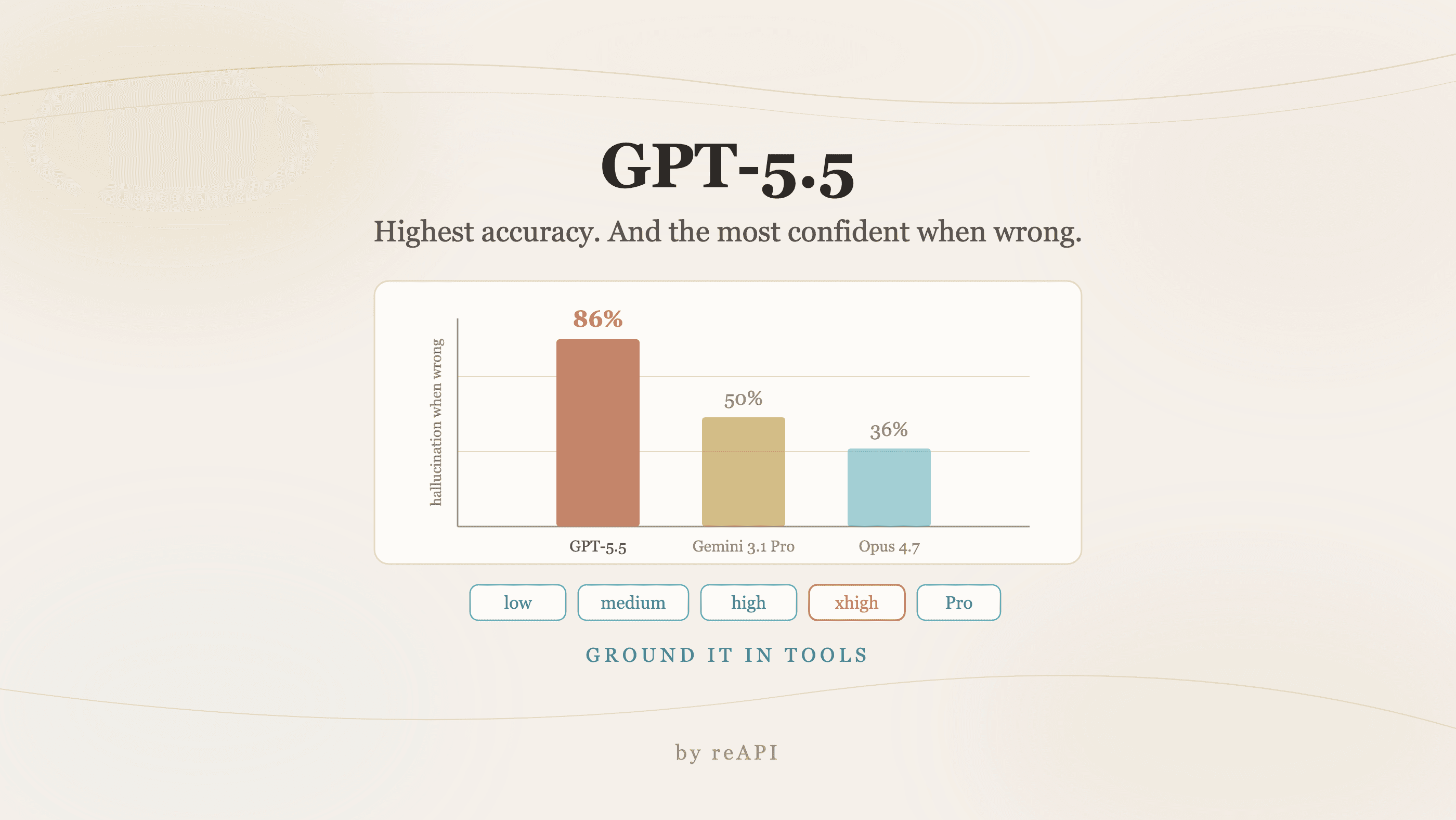
How to use GPT-5.5: the Terminal-Bench lead, why the price rise is smaller than it looks, the 86% hallucination rate nobody quotes, and the loop it needs.

What is the best API platform for building an AI design or marketing creative tool?
There is no single best API platform for AI creative tools. Four platforms compared on request contract, real prices, and what each is actually built for.

Best Open-Source AI Video Models for Local GPUs (2026)
Compare Wan 2.2, HunyuanVideo-1.5, CogVideoX1.5, and Mochi 1 by local GPU memory, output, license, speed, and deployment limits.