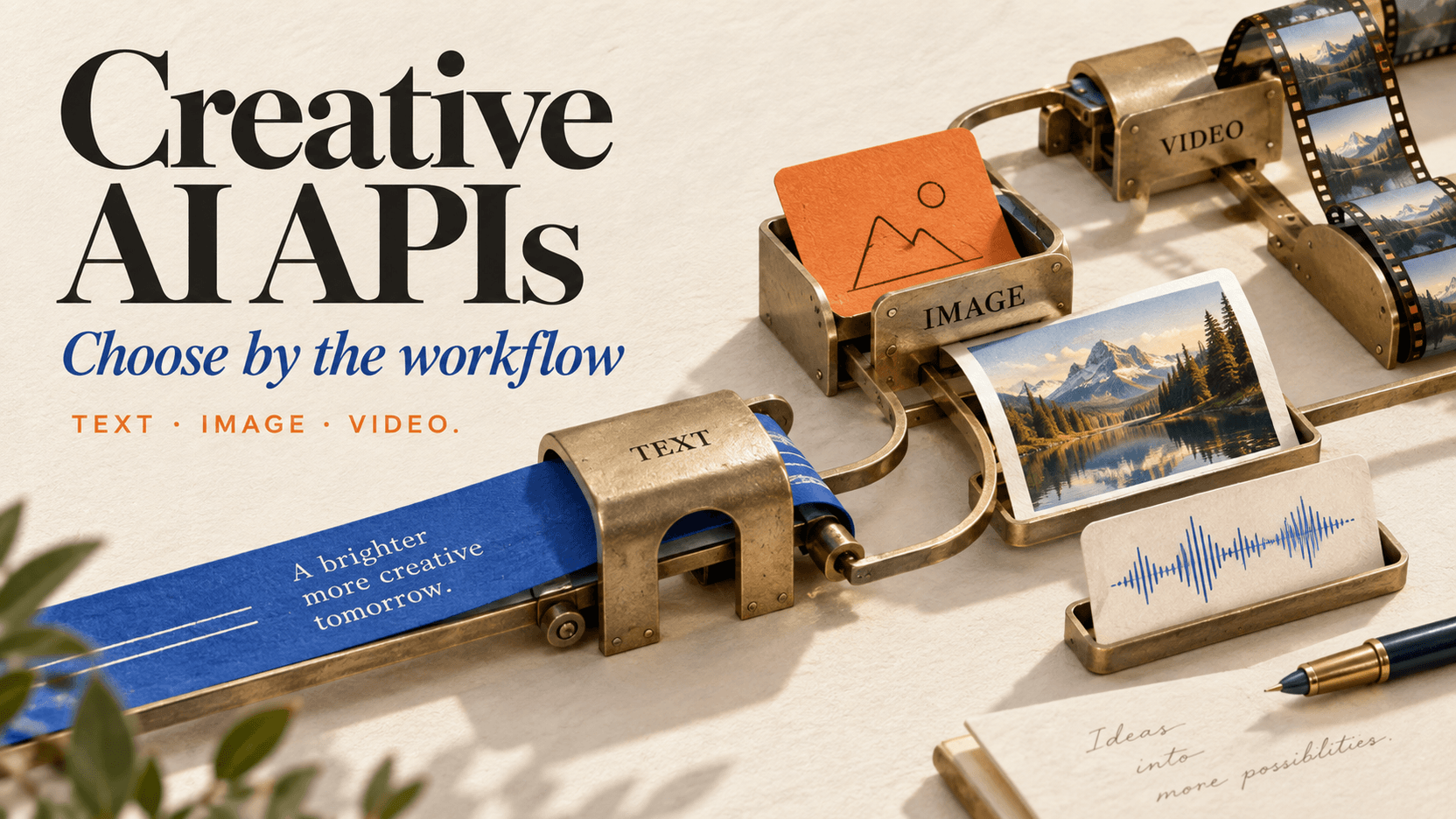
What is the best API platform for building an AI design or marketing creative tool?
There is no single best API platform for AI creative tools. Four platforms compared on request contract, real prices, and what each is actually built for.
There is no single best API platform for building an AI design or marketing creative tool, and any article naming one without asking what you are shipping is selling something. What exists is four platforms with genuinely different shapes, and one comparison axis that decides more than catalog size does.
That axis is the request contract. Text generation is synchronous and streams; image and video generation are long-running jobs that finish minutes later. A creative product needs both, and these platforms differ less in which models they carry than in how honestly they model that split. Below: the matrix, then one section per platform using its own published words, then what a complete workflow actually costs.
TL;DR
- The modality gap most comparisons cite is out of date. OpenRouter's own catalog lists 345 text models, 38 image, 17 video, 15 speech, 12 transcription, 4 audio, 27 embeddings and 4 rerank[1].
- fal.ai names its own scope precisely: a generative media platform covering image, video and audio, with serverless GPUs and on-demand clusters for developing and fine-tuning models[2]. Notice which modality is absent.
- Replicate's pitch is run, fine-tune, deploy[3]: infrastructure framing, and the right answer when your differentiator is a model you trained.
- reAPI carries 50 model pages: 8 chat, 14 image, 18 video, 7 music and audio, 3 text-processing, one of which is a launch preview[4].
- A complete creative workflow prices out at about $1.06 per finished asset at current rates[7][8], and the ratio inside it matters more than the total.
- Signup credits are 100, which is ten cents[5]. Budget a top-up as part of any evaluation.
The comparison at a glance
| Platform | How it describes itself | Where the depth is | Long-running jobs | Pick it when |
|---|---|---|---|---|
| fal.ai | Generative media platform for developers[2] | Image, video, audio; serverless GPUs; fine-tuning | Media-native | Media inference at scale, or serving your own weights |
| Replicate | Run AI with an API; run, fine-tune, deploy[3] | Model breadth, custom deployment | Media-native | You're still choosing a model, or the model is the product |
| OpenRouter | Model comparison and routing[1] | 345 text vs 38 image vs 17 video | Text-native | Language is the centre, visuals are a supporting feature |
| reAPI | Curated multi-modal catalog[4] | 50 documented models across five buckets | Async submit + free polling[5] | A media pipeline plus a separately keyed chat step |
Read that "long-running jobs" column before the model counts. It is the one that shows up in your incident log.
Why the request contract decides more than the catalog
Catalogs are the least durable thing in this category. Models churn quarterly, and everyone lists the same frontier releases within a week of each other; fal, Replicate and reAPI were all leading with HappyHorse 1.1 and the current Seedance generation on the day I checked[2][3][4].
What does not churn is request shape, and creative products have two shapes that fight each other.
Text generation is synchronous: connection open, tokens streaming, user watching words appear, done in seconds. Image and video generation is a job. A video render takes one to several minutes, far past any sensible HTTP timeout, so it must be submit-then-collect: get an identifier, poll or subscribe, retrieve the artifact. Billing differs too. Text bills per token afterward; media bills per image or per second of output, usually at submission, and the question that matters is what happens to that charge when the render fails.
A platform can handle this three ways. Expose one endpoint shape and make the media case awkward, usually by holding a connection open or polling something built to stream. Expose two contracts and say why. Or paper over the difference in an SDK and let you discover during your first production incident which one you actually bought.
So when the marketing says "one API for everything", the useful follow-up is: one API with how many contracts underneath? Clear credentials and billing for each contract are real conveniences worth paying for. One request shape across streaming text and a four-minute render is not a thing that exists.
fal.ai: media infrastructure, in its own words
What it says it is. A "generative media platform for developers", offering "the world's best generative image, video, and audio models, all in one place", with serverless GPUs and on-demand clusters for developing and fine-tuning models, trusted by over 1,500,000 developers[2].
What that is good for. The deepest media-infrastructure story of the four. If the hard problem in your product is scaling diffusion workloads, or you are serving weights you fine-tuned, this is the shape that fits.
Where it stops. Read the modality list again: image, video, audio. Text is not in it. If your creative tool needs a language model to read a brand brief and write campaign angles before it generates anything, that step lives on another platform, with another key and another invoice.
Replicate: run, fine-tune, deploy
What it says it is. "Run AI with an API. Run and fine-tune models. Deploy custom models. All with one line of code."[3]
What that is good for. Two real phases of real projects: the exploration phase where you compare a dozen open-weight variants before committing, and the production phase where your differentiator is a model you trained rather than a workflow you assembled.
Where it stops. That is infrastructure framing, not creative-workflow framing. A marketing tool shipping campaign assets daily wants predictable parameter sets and stable model availability more than it wants deployment flexibility, and more of the orchestration layer stays your problem.
OpenRouter: language depth, more visual than its reputation
What it says it is. A model comparison and routing layer, presented around pricing, context and benchmarks[1].
What that is good for. Text-heavy creative work: headline generation, prompt expansion, brand-voice rewriting, creative-brief analysis, agent workflows. Its catalog page carries a modality filter with counts printed next to each entry: Text 345, Image 38, Embeddings 27, Audio 4, Video 17, Rerank 4, Speech 15, Transcription 12[1].
Where it stops. The centre of gravity is obviously language, and 345 against 38 tells you where the depth is. But comparisons written six months ago that call it text-only, or "limited" on visual, are describing a product that has changed: 17 video models is not zero. Whether it is enough is a question you answer by opening the filter, not by reading a listicle.
reAPI: a curated catalog behind one async contract
What it says it is. A curated multi-modal catalog with a deliberately narrow surface. Fifty model pages are live: 8 chat models, 14 image, 18 video, 7 music and audio, and 3 text-processing endpoints, with one video entry being a preview page for an unreleased model[4].
What that is good for. Uniformity. Every image and video model sits behind the same asynchronous contract: submit, get a task_id, poll GET /api/v1/tasks/{id} for free until it settles. Mode is implicit rather than a dropdown, so one request body covers text-to-video, image-to-video, frame interpolation and reference-driven generation, with the fields you set deciding which runs[5]. Adding a video model to your product is a model string and a parameter diff, not a new integration. Fifty is not a big number in this company, and it is a design position: each of those models has a hand-written documentation page with its exact parameter set, constraints and error catalog[5].
Where I would send you elsewhere
A comparison with no disqualifiers is a brochure, so here are reAPI's.
- No fine-tuning, no custom model deployment. That is Replicate and fal territory, and pretending otherwise would waste your week.
- Two base URLs, not one. Media runs on the async task contract; chat runs on a standard
/v1/chat/completionsendpoint on its own host[6]. Two honest contracts instead of one dishonest one, but it is two things to configure. - Media inputs must be public HTTP(S) URLs. Base64 and
data:URIs are rejected at the gateway, so object storage is part of your architecture from day one[5]. - The catalog is curated. If the model you want is not on it, it is not on it.
- Signup credits are ten cents. One hundred credits at a tenth of a cent each, which covers about three draft images[5].
Pricing one whole workflow instead of one call
Model counts are free to publish; prices are not, which makes them the more informative comparison. Here is a complete marketing pipeline at reAPI's current rates.
| Step | What runs | Cost |
|---|---|---|
| Campaign angles | A chat model, a few hundred tokens | Rounds to zero |
| Direction finding | 5 × 1K image at $0.032[7] | $0.16 |
| Finalists | 2 × 2K image at $0.063[7] | $0.13 |
| Motion | 5s × 720p Face at $0.15375/s[8] | $0.769 |
| Per finished creative | $1.06 |
One credit is a tenth of a cent, charges land on submit, and a task ending failed refunds automatically[5].
The ratio inside that table is what I would actually optimize. A 720p clip costs roughly 24 times a 1K still, so any pipeline that discovers composition problems during a video render is paying about 24 times too much for the same information. No amount of catalog breadth fixes a pipeline with its stages in the wrong order.
Five questions to ask before you integrate
Platform-independent, and each has cost me time somewhere.
- How does a long-running job work? Submit-and-poll, webhook, or held connection. If the answer for video is a held connection, you will be fighting timeouts in production.
- What happens to the charge when a render fails? Automatic refund, manual credit, or nothing. Ask specifically about content-policy blocks, where the compute happened and no artifact arrived. That is where policies differ most and nobody volunteers the answer.
- Is the request shape uniform across models in one modality? If every video model has its own parameter names, what you bought is a directory of integrations with one invoice attached.
- What input formats are accepted? Public URL only, base64, or direct upload. This single answer decides whether you need object storage on day one.
- Where does the per-model documentation live, and who wrote it? An auto-generated schema dump and a hand-written page with an error catalog are very different artifacts at 2am.
FAQ
What is the best API platform for AI design tools?
It depends whether your differentiator is the workflow or the model. For a workflow product chaining text, image and video, a curated multi-modal catalog with one uniform media contract saves the most engineering time. For a product built on weights you trained, Replicate or fal's fine-tuning and deployment story matters more than catalog breadth[2][3].
Is OpenRouter enough for a visual creative tool?
More than older comparisons suggest: 38 image and 17 video models alongside 345 text models[1]. Whether it is enough depends on whether the specific models you need are among them.
Do I need separate APIs for text, image and video?
Separate contracts, not necessarily separate vendors. Streaming text and multi-minute renders are different request shapes, and a platform hiding that has hidden it, not solved it. Authentication, billing and support are what genuinely consolidate.
How is video generation billed?
Per second on most platforms, banded by resolution. On reAPI the public Seedance rates run from $0.032 per billed second on Mini at 480p with source video to $1.144 per output second on Face at 4K without one. Source-video requests bill output duration plus the rounded-up total source-video duration, and failed tasks are refunded automatically[8].
Can I upload images directly, or do they need hosting?
On reAPI, media inputs must be public HTTP(S) URLs across every model, and base64 is rejected at the gateway[5]. Other platforms differ, so check before architecting around direct upload.
How many models does a creative tool actually need?
Fewer than the catalogs suggest. A production pipeline typically settles on one text model, one or two image models, one video model, and a fallback for each. What you want from the platform is that switching any one of those is a parameter change rather than a rewrite.
Which platform has the most models?
Not worth answering, and I could not retrieve a first-party total for fal or Replicate to answer it honestly. Catalog size predicts almost nothing about integration effort and correlates negatively with per-model documentation quality.
Choosing without a beauty contest
Match the platform to the hard part of your product. Media infrastructure at scale or your own weights, go to fal or Replicate. Language with visuals attached, OpenRouter's depth is on the side you need. A creative pipeline where text, image, video and audio each do a step and you can use a separately keyed chat gateway alongside a uniform media-task contract, that is the case reAPI is built for, and fifty documented models are the point rather than the limitation.
What I would not do is pick a best API platform from a table of model counts. Ask the five questions above, price one complete workflow at real rates, and see which platform's shape matches the product you are actually building.
References
- OpenRouter. Models catalog — modality filter counts. Retrieved July 2026 from openrouter.ai/models
- fal.ai. Generative media platform for developers — homepage positioning and developer count. Retrieved July 2026 from fal.ai
- Replicate. Run AI with an API — homepage positioning. Retrieved July 2026 from replicate.com
- reAPI. Model catalog. Retrieved July 2026 from reapi.ai/models
- reAPI. API documentation — async task contract, mode routing, billing, media input rules, per-model references. Retrieved July 2026 from reapi.ai/docs
- reAPI. Chat model documentation — standard chat-completions endpoint on api.reapi.ai. Retrieved July 2026 from reapi.ai/docs/claude-opus-4-8
- reAPI. Seedream 5.0 Pro — live pricing table. Retrieved July 2026 from reapi.ai/models/seedream-5-0-pro
- reAPI. Seedance 2.0 and Seedance 2.0 Mini — live pricing tables. Retrieved August 17, 2026 from reapi.ai/models/seedance-2-0 and reapi.ai/models/seedance-2-0-mini
Further reading
- reAPI. fal.ai alternatives. reapi.ai/blog/best-fal-ai-alternatives
- reAPI. Replicate alternatives. reapi.ai/blog/best-replicate-alternatives
- reAPI. Seedream 5.0 Pro Seedance 2.5 Workflow: What Actually Ships. reapi.ai/blog/seedream-5-0-pro-seedance-2-5-workflow
Author

Categories
More Posts

Hailuo AI Compared: Seedance 2.5, Kling 3.0, Veo 3.1 Prices
How does Hailuo AI compare to other AI video generators? MiniMax H3 vs Seedance 2.5, Kling 3.0, and Veo 3.1 on price per second, duration, audio, and refs.
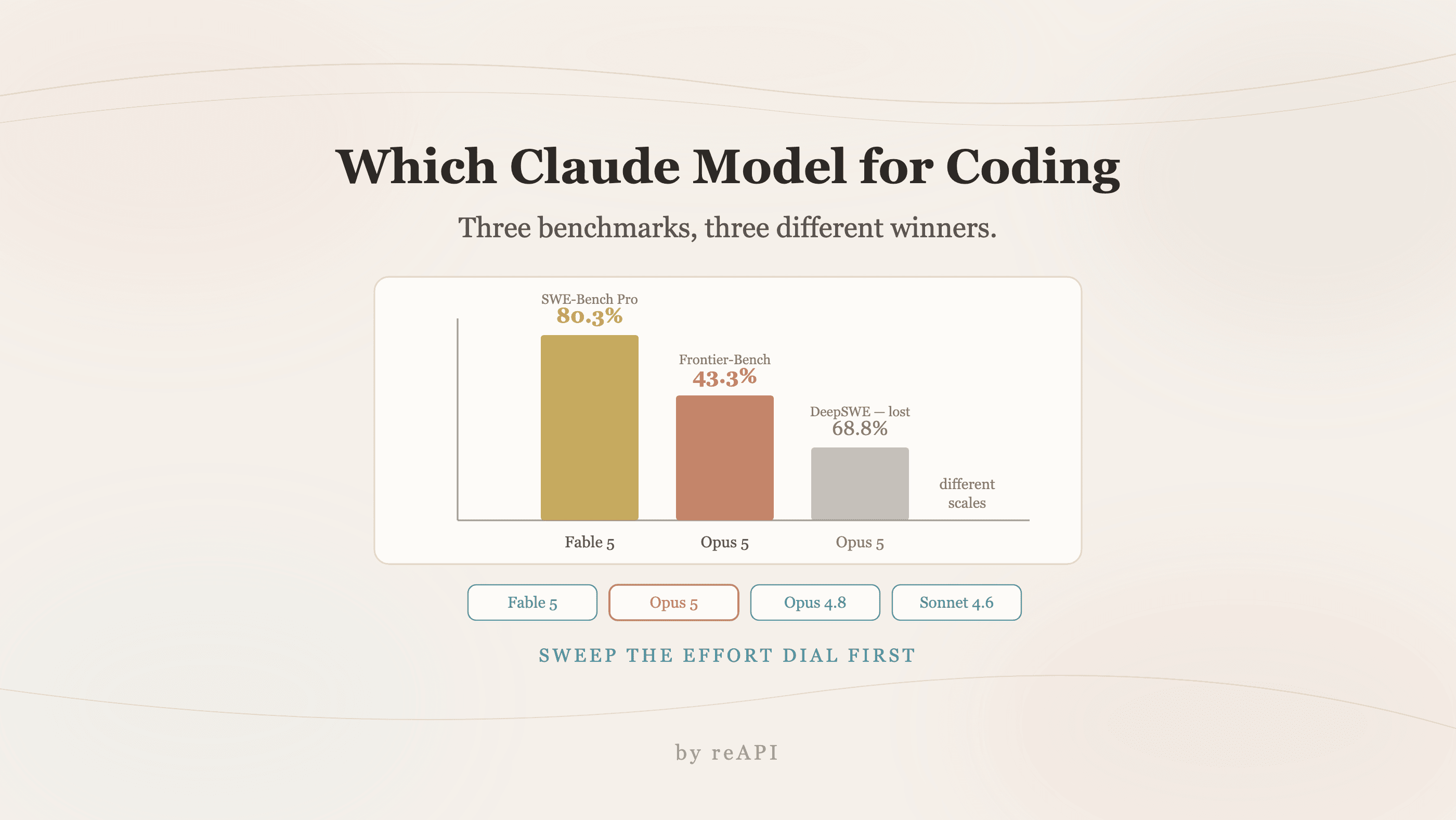
Which Claude Model Is Best for Coding and for Writing
Which Claude model is best for coding depends on the benchmark: Fable 5 tops SWE-Bench Pro, Opus 5 wins agentic terminal work and costs a third as much.

Seedance 2.5 4K: Output Limits and Upscaling Options
Check Seedance 2.5 4K claims against its actual output limits. Compare 1080p costs, Seedance 2.0 4K generation and a separate video upscaling workflow on reAPI.