AI Image Generation for Games: Cut Cost With Caching
Build a cache-first game image pipeline with semantic keys, single-flight requests, async polling, budget caps, durable storage, and acceptance-cost math.
Caching can bring the average AI image API cost per player action down to $0.002, but it cannot make a genuinely new image cheaper. At Z-Image's current reAPI rate of $0.005 per completed image, the controlling rule is paid miss rate × completed attempts per accepted asset ≤ 0.4. A 40% miss rate reaches the ceiling only when every new asset passes on its first completed attempt; staying below $0.002 requires a result below that boundary.[1]
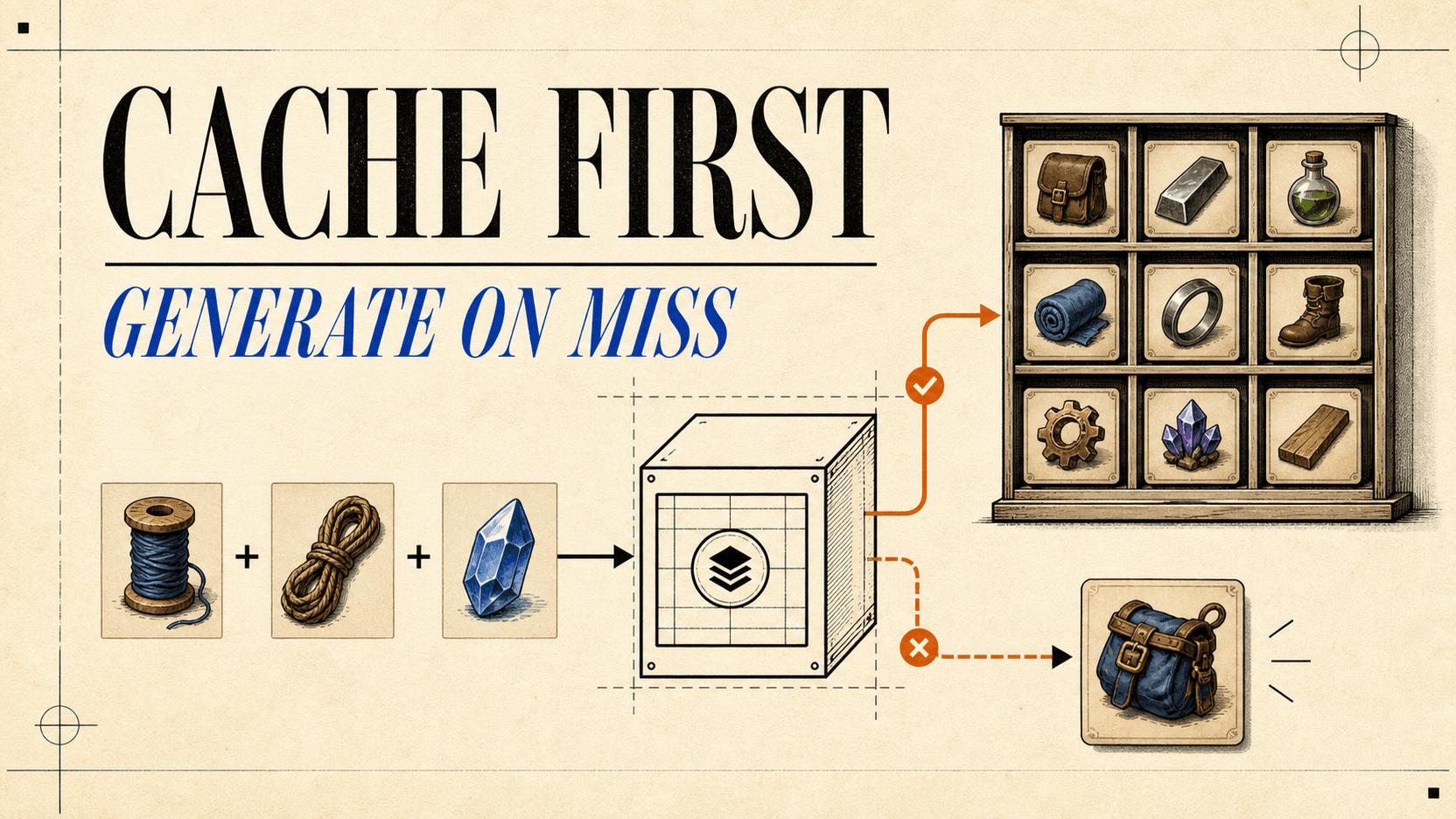
Cache the meaning of an item, not just its prompt. Merge concurrent misses, pre-generate only likely items, and measure cost per accepted game asset rather than per API response.
TL;DR
- At $0.005 per completed Z-Image generation, a game targeting an effective
cost at or below $0.002 per craft needs
paid miss rate × completed attempts per accepted asset ≤ 0.4. With exactly one attempt, 40% meets the ceiling; strictly below it means less than 40%.[1] - Keep a recipe key for what the player combined and a semantic asset key for the resulting object and art version.
- Enforce one active asset job with a shared database uniqueness constraint. An in-memory Promise map can merge same-process callers, but it is not the lock that protects multiple workers.
- Image generation is asynchronous. Submit once, retain the task ID, poll the task endpoint, and copy completed output to storage you control. [2][3]
- A three-task smoke test completed three original candidates on the first submission at 15 credits or $0.015 total. They were not visually reviewed, so they are candidates, not accepted assets.[4]
- If 3,000 daily images are already genuinely new semantic assets after caching, a conventional cache will not rescue the economics. The game must reuse more art, narrow the generative surface, or support a higher cost.
The real problem is cost per craft, not cost per image
Suppose an infinite-crafting game combines items such as iron and fire, then generates both a new result and its picture. How can it keep media cost below $0.002 per craft if players trigger 3,000 craft events a day, including many combinations the game has not seen before? That question exposes the key constraint: a game may create novel requests faster than its revenue can pay for them.
Start with this equation:
daily generation cost =
  craft events
  x paid miss rate
  x completed attempts per accepted asset
  x price per completed generation
At $0.005 per completed Z-Image task, the ceiling is:
$0.005 x paid miss rate x completed attempts per accepted asset <= $0.002
paid miss rate x completed attempts per accepted asset <= 0.4
For 3,000 craft events a day over 30 days, the one-attempt scenarios look like this:
| Paid miss rate | New generations/day | 30-day API cost |
|---|---|---|
| 100% | 3,000 | $450 |
| 40% | 1,200 | $180 |
| 20% | 600 | $90 |
| 10% | 300 | $45 |
These are scenarios, not predicted hit rates, and every row assumes one completed attempt per accepted asset. At 1.5 attempts, for example, the miss rate must be no more than 26.7% to keep the same $0.002 ceiling. If all 3,000 events remain unique after semantic deduplication, the first row applies.
Recipe keys and semantic asset keys solve different problems
A recipe key represents the player's input. If order does not matter in your rules, sort the exact canonical item IDs before hashing them. The unhashed identity is easy to inspect:
recipe identity: v3 | fire | ironThat makes iron + fire and fire + iron resolve through the same server-owned
recipe row. Include a rules version because a later balance patch may change
the result. Do not slugify IDs for the key: lossy normalization can merge two
different items.
A semantic asset key represents what the game ultimately displays. Its unhashed identity can remain equally clear:
asset identity: ember-shield | inventory-icon-v1 | z-image | 1:1 | filteredSeveral recipes may resolve to ember-shield; translations may also name it
differently. Those paths can still reuse one approved visual.
Raw prompts make poor keys: wording changes fragment the cache, and identical prompts go stale after an art-direction change. Map each recipe to a stable result ID, then key the art by result ID, model, aspect ratio, safety mode, and style version. Bump the version when you want new art.
A cache-first request flow
Treat generation as background asset production, even when the player starts it. A practical flow is:
- Resolve the incoming recipe to a semantic result ID.
- Look up the semantic asset key in durable storage.
- On a hit, return the stored URL immediately.
- On a miss, atomically insert one shared job row keyed by the semantic asset.
- In the same database transaction, reserve one slot in a shared daily submission budget. Other workers return the existing job.
- Commit the row as
submittingbefore making one POST, then persist the task ID immediately after the response. - If submission is ambiguous, mark
submit_uncertainand stop. Poll a known task ID with GET until it becomescompletedorfailed. - Record terminal status and settled credits. Copy a completed image to your
own storage and move it to
pending_review. - Only an acceptance check may move
pending_reviewtoready.
After step six, return a placeholder and pending state. Let a worker poll
while the client checks your game endpoint. Never expose the reAPI key to the
client.
Polling is free, and the in-flight task endpoint is cached for five seconds, so
poll about every five seconds.[3] Respect
Retry-After on a 429. Do not blindly retry the POST: reAPI does not
deduplicate generation requests by Idempotency-Key, so a lost response may
hide an accepted task and a second charge.[5]
A runnable Node 20 module with a shared lock
The smallest example that protects multiple workers needs shared state. The
module below is plain .mjs, uses PostgreSQL through the postgres package,
and returns after submission instead of holding the player's request open.
npm install postgresCreate the tables once. Populate game_recipes from the game's own rule data;
the browser sends two item IDs, never a result ID or display name.
CREATE TABLE game_recipes (
  recipe_key text PRIMARY KEY,
  result_item_id text NOT NULL,
  result_display_name text NOT NULL
);

CREATE TABLE game_asset_jobs (
  asset_key text PRIMARY KEY,
  origin_recipe_key text NOT NULL REFERENCES game_recipes(recipe_key),
  result_item_id text NOT NULL,
  state text NOT NULL CHECK (state IN (
    'submitting', 'submit_uncertain', 'processing', 'completed',
    'pending_review', 'ready', 'failed', 'rejected'
  )),
  submit_owner uuid NOT NULL,
  prompt text NOT NULL,
  task_id text UNIQUE,
  source_url text,
  durable_url text,
  usage_credits integer,
  error_message text,
  created_at timestamptz NOT NULL DEFAULT now(),
  updated_at timestamptz NOT NULL DEFAULT now()
);

CREATE TABLE game_generation_budgets (
  budget_day date PRIMARY KEY,
  submissions integer NOT NULL CHECK (submissions >= 0),
  submission_limit integer NOT NULL CHECK (submission_limit > 0)
);
Save this as cache-first.mjs. The full SHA-256 keys hash exact canonical IDs;
there is no slugification step that can collapse two different IDs.
import { createHash, randomUUID } from 'node:crypto';
import postgres from 'postgres';

const API_BASE = 'https://reapi.ai/api/v1';
const apiKey = process.env.REAPI_API_KEY;
const databaseUrl = process.env.DATABASE_URL;
const dailyLimit = Number(process.env.DAILY_NEW_ASSET_LIMIT ?? '100');

if (!apiKey) throw new Error('Set REAPI_API_KEY on the server');
if (!databaseUrl) throw new Error('Set DATABASE_URL on the server');
if (!Number.isInteger(dailyLimit) || dailyLimit < 1) {
  throw new Error('DAILY_NEW_ASSET_LIMIT must be a positive integer');
}

const sql = postgres(databaseUrl);
const localFlights = new Map(); // L1 only; PostgreSQL owns correctness.

function hashIdentity(value) {
  return createHash('sha256')
    .update(JSON.stringify(value), 'utf8')
    .digest('hex');
}

function canonicalId(value) {
  if (typeof value !== 'string' || value.length === 0 || value.length > 200) {
    throw new Error('Item IDs must be non-empty canonical server IDs');
  }
  return value; // Preserve the exact string; do not trim, slugify, or case-fold.
}

export function recipeKey(leftItemId, rightItemId) {
  const pair = [canonicalId(leftItemId), canonicalId(rightItemId)].sort(
    (a, b) => (a < b ? -1 : a > b ? 1 : 0),
  );
  return `recipe:v3:${hashIdentity({ rulesVersion: 'v3', itemIds: pair })}`;
}

function assetKey(resultItemId) {
  return `asset:${hashIdentity({
    resultItemId,
    styleVersion: 'inventory-icon-v1',
    model: 'z-image',
    aspectRatio: '1:1',
    contentFilter: true,
  })}`;
}

async function resolveRecipe(leftItemId, rightItemId) {
  const key = recipeKey(leftItemId, rightItemId);
  const [recipe] = await sql`
    SELECT result_item_id, result_display_name
    FROM game_recipes
    WHERE recipe_key = ${key}
  `;
  if (!recipe) throw new Error('Unknown recipe');
  if (recipe.result_display_name.length > 200) {
    throw new Error('Canonical display name is too long');
  }
  return { ...recipe, recipeKey: key };
}

function publicJob(job) {
  return {
    assetKey: job.asset_key,
    state: job.state,
    taskId: job.task_id ?? null,
    url: job.state === 'ready' ? job.durable_url : null,
    usageCredits: job.usage_credits ?? null,
  };
}

async function claimSharedJob(recipe, key, prompt) {
  const owner = randomUUID();

  return sql.begin(async (tx) => {
    const created = await tx`
      INSERT INTO game_asset_jobs (
        asset_key, origin_recipe_key, result_item_id,
        state, submit_owner, prompt
      ) VALUES (
        ${key}, ${recipe.recipeKey}, ${recipe.result_item_id},
        'submitting', ${owner}, ${prompt}
      )
      ON CONFLICT (asset_key) DO NOTHING
      RETURNING *
    `;

    if (created.length === 0) {
      const [existing] = await tx`
        SELECT * FROM game_asset_jobs WHERE asset_key = ${key}
      `;
      if (!existing) throw new Error('Concurrent job was not readable');
      return { ownsSubmit: false, job: existing };
    }

    const budget = await tx`
      INSERT INTO game_generation_budgets (
        budget_day, submissions, submission_limit
      ) VALUES (
        (now() AT TIME ZONE 'UTC')::date, 1, ${dailyLimit}
      )
      ON CONFLICT (budget_day) DO UPDATE SET
        submissions = game_generation_budgets.submissions + 1,
        submission_limit = EXCLUDED.submission_limit
      WHERE game_generation_budgets.submissions < EXCLUDED.submission_limit
      RETURNING submissions
    `;
    if (budget.length === 0) throw new Error('Shared daily budget reached');

    return { ownsSubmit: true, owner, job: created[0] };
  });
}

async function markSubmitUncertain(key, owner, message) {
  const [job] = await sql`
    UPDATE game_asset_jobs
    SET state = 'submit_uncertain', error_message = ${message},
        updated_at = now()
    WHERE asset_key = ${key} AND submit_owner = ${owner}
      AND state = 'submitting'
    RETURNING *
  `;
  return job;
}

async function submitClaimedJob(claim, key, prompt) {
  let response;
  let body = '';

  try {
    response = await fetch(`${API_BASE}/images/generations`, {
      method: 'POST',
      headers: {
        Authorization: `Bearer ${apiKey}`,
        'Content-Type': 'application/json',
      },
      body: JSON.stringify({
        model: 'z-image',
        prompt,
        aspect_ratio: '1:1',
        content_filter: true,
      }),
    });
    body = await response.text();
  } catch (error) {
    const job = await markSubmitUncertain(
      key,
      claim.owner,
      error instanceof Error ? error.message : String(error),
    );
    return publicJob(job ?? claim.job);
  }

  let task;
  try {
    task = JSON.parse(body);
  } catch {
    task = null;
  }

  if (!response.ok || !task?.id) {
    const message = `Unconfirmed submit response: HTTP ${response.status}`;
    const job = await markSubmitUncertain(key, claim.owner, message);
    return publicJob(job ?? claim.job);
  }

  const [saved] = await sql`
    UPDATE game_asset_jobs
    SET state = 'processing', task_id = ${task.id}, updated_at = now()
    WHERE asset_key = ${key} AND submit_owner = ${claim.owner}
      AND state = 'submitting'
    RETURNING *
  `;
  if (!saved) {
    throw new Error(`Task ${task.id} was accepted but its ID was not persisted; do not resubmit`);
  }
  return publicJob(saved);
}

async function startOrRead(recipe, key) {
  const prompt = [
    `A clean 3D inventory icon of ${recipe.result_display_name}.`,
    'One centered object, readable silhouette, plain warm background,',
    'soft studio light, no text, no logo, no existing game character.',
  ].join(' ');

  const claim = await claimSharedJob(recipe, key, prompt);
  if (!claim.ownsSubmit) return publicJob(claim.job);
  return submitClaimedJob(claim, key, prompt);
}

export async function getOrCreateCraftAsset({ leftItemId, rightItemId }) {
  const recipe = await resolveRecipe(leftItemId, rightItemId);
  const key = assetKey(recipe.result_item_id);
  const existing = localFlights.get(key);
  if (existing) return existing;

  const work = startOrRead(recipe, key).finally(() => {
    if (localFlights.get(key) === work) localFlights.delete(key);
  });
  localFlights.set(key, work);
  return work;
}

export async function pollAsset(key) {
  const [job] = await sql`
    SELECT * FROM game_asset_jobs WHERE asset_key = ${key}
  `;
  if (!job) throw new Error('Unknown asset job');
  if (job.state !== 'processing' || !job.task_id) return publicJob(job);

  const response = await fetch(`${API_BASE}/tasks/${job.task_id}`, {
    headers: { Authorization: `Bearer ${apiKey}` },
  });
  if (response.status === 429) {
    const parsed = Number.parseInt(response.headers.get('retry-after') ?? '', 10);
    return {
      ...publicJob(job),
      retryAfterSeconds: Number.isFinite(parsed) ? Math.max(parsed, 1) : 5,
    };
  }
  if (!response.ok) {
    throw new Error(`GET task failed with HTTP ${response.status}; retry this GET, not the POST`);
  }

  const task = await response.json();
  if (task.status === 'processing') return publicJob(job);
  const credits = Number.isInteger(task.usage?.credits)
    ? task.usage.credits
    : null;

  if (task.status === 'failed') {
    const [failed] = await sql`
      UPDATE game_asset_jobs
      SET state = 'failed', usage_credits = ${credits},
          error_message = ${task.error?.message ?? 'Generation failed'},
          updated_at = now()
      WHERE asset_key = ${key} AND task_id = ${job.task_id}
      RETURNING *
    `;
    return publicJob(failed);
  }

  if (task.status !== 'completed') {
    throw new Error(`Unexpected task status: ${task.status}`);
  }

  const sourceUrl = task.output?.image_urls?.[0] ?? null;
  const [completed] = await sql`
    UPDATE game_asset_jobs
    SET state = 'completed', source_url = ${sourceUrl},
        usage_credits = ${credits},
        error_message = ${sourceUrl ? null : 'Completed task returned no image URL'},
        updated_at = now()
    WHERE asset_key = ${key} AND task_id = ${job.task_id}
    RETURNING *
  `;
  return publicJob(completed);
}

export async function stageForReview(key, durableUrl) {
  const [job] = await sql`
    UPDATE game_asset_jobs
    SET state = 'pending_review', durable_url = ${durableUrl},
        updated_at = now()
    WHERE asset_key = ${key} AND state = 'completed'
      AND source_url IS NOT NULL
    RETURNING *
  `;
  if (!job) throw new Error('Only an archived completed asset can enter review');
  return publicJob(job);
}

export async function reviewAsset(key, accepted, reason = null) {
  const nextState = accepted ? 'ready' : 'rejected';
  const [job] = await sql`
    UPDATE game_asset_jobs
    SET state = ${nextState}, error_message = ${reason}, updated_at = now()
    WHERE asset_key = ${key} AND state = 'pending_review'
    RETURNING *
  `;
  if (!job) throw new Error('Asset is not pending review');
  return publicJob(job);
}
The database row, not localFlights, prevents a second worker from submitting
the same asset. A process that dies during POST leaves submitting; treat a
stale row as submit_uncertain and investigate it rather than recycling it.
After a known task ID exists, transient polling failures retry only GET.
The shared counter is a conservative submission cap. An unconfirmed or rejected
POST still consumes its slot, which is safer than silently exceeding the cap.
If a terminal task fails, its status and usage.credits stay in the row. This
example does not auto-retry failed or rejected assets; add a separate attempt
ledger and an explicit, budgeted operator action before supporting retries.
Your storage worker should download source_url, upload it to your object
store, and pass that durable URL to stageForReview. Only reviewAsset(..., true) creates a cacheable ready asset.
What the three-task smoke test proves
On September 3, 2026, we submitted three original 1:1 inventory-item prompts
with content_filter: true: a moss lantern, a glass compass, and an ember
shield. Each task completed on its first submission and reported 5 credits.
[4]
| Candidate | Task ID | Observed completion time | Credits |
|---|---|---|---|
| Moss lantern | task_01a065490250739d893a1efcd83f4d1d | 25.1 s | 5 |
| Glass compass | task_01a0654995df7265b44b132dce34a914 | 25.0 s | 5 |
| Ember shield | task_01a0654995fd73e28e7c682170664070 | 18.2 s | 5 |
| Total | 3 tasks | — | 15 / $0.015 |
The public smoke-test record contains the request settings, task IDs, elapsed times, and settled credits. It deliberately omits the temporary output URLs.[4]
This is a smoke test, not a latency benchmark; it says nothing about p95,
bursts, or long-term reliability. The protocol recorded task results and
settlement but did not include an art review. completed means three candidates
arrived, not that an art reviewer accepted them.
That is why the useful creative metric is:
cost per accepted asset =
  total settled generation credits x $0.001 / accepted assets
If three attempts yield one usable icon, its effective cost is $0.015. Record technical status and creative acceptance separately.
Pre-generate for latency, not imaginary savings
Pre-generate only predictable requests, such as the top 20 recipes reachable from a player's inventory. Use the same semantic cache and single-flight path, with a separate daily cap.
Do not generate the theoretical combination space. Unused assets cost money, and open-ended crafting outgrows a brute-force queue. Rank by observed demand and stop at the cap.
The hybrid usually feels best:
- approved semantic assets return immediately;
- high-probability next items are pre-generated;
- long-tail misses show a placeholder while one background task runs;
- unpopular or abusive requests hit a quota instead of an unlimited retry loop.
Safety, storage, and operational boundaries
Keep content_filter: true for player-facing generation. Z-Image leaves that
setting off by default, so relying on the default is not enough.
[2] Moderate or constrain player text before it
becomes a prompt, block attempts to imitate protected characters or real
people, and rate-limit by account and device. An upstream filter is one layer,
not your complete game policy.
Keep the key server-side. Log recipe and asset keys, task ID, status, credits, and acceptance without retaining unnecessary player data.
Finally, copy completed files to durable storage before publishing their URLs to game clients. Task output URLs are not a permanent asset contract. [3] Store a checksum and content type beside the asset record so a retry cannot quietly replace approved art.
Conclusion: when caching is not enough
Caching works only when the game permits reuse. If paid miss rate × completed attempts per accepted asset exceeds 0.4, the $0.002 ceiling cannot hold at a
$0.005 unit price. If the 3,000 daily requests in this scenario are
already unique semantic assets after caching, changing cache software will not
solve the problem.
Then change a product constraint: share art between similar items, use procedural recoloring or overlays, generate only popular items, cap discoveries, charge for long-tail creation, or accept a larger media budget.
Check the live Z-Image model page before setting a budget, then use the Z-Image API guide and Tasks API reference to implement submission and polling. Prices and model behavior can change; your own settled credits remain the source of truth for a production bill.
FAQ
Does caching reduce the price of a new AI image?
No. It reduces how often you buy one. The current Z-Image charge remains five credits per completed generation; a cache hit costs no new generation credits.
Should the prompt itself be the cache key?
Usually not. Resolve recipes to a stable result ID, then version its art separately.
What if item order matters?
Do not sort the recipe inputs. water + fire and fire + water should have
different recipe keys whenever your rules give them different outcomes.
Should a game pre-generate assets or generate them in real time?
Use both: pre-generate a budgeted likely set, serve hits immediately, and generate unpredictable long-tail items in the background.
How often should I poll a reAPI image task?
About every five seconds is a practical starting point. Faster polling does not make generation finish sooner and can waste rate-limit budget.
Are failed generations charged?
The Z-Image documentation says failed and rejected requests are not charged.
Still inspect status together with usage.credits: a completed but visually
unusable result is different from a failed task and counts toward creative
cost.[2][3]
Can I promise an average below $0.002 per craft?
Only after measuring your paid miss rate and completed attempts per accepted asset. At $0.005 per image, staying strictly below $0.002 requires their product to remain below 0.4. A 40% miss rate merely meets the ceiling when every asset passes on its first completed attempt.
Can the game client call the image endpoint directly?
It should not. A client-side credential can be extracted and abused. Route generation through your backend, enforce quotas there, and let clients query a game-owned pending job.
References
- reAPI. Z-Image model page and live pricing. Retrieved September 3, 2026 from reapi.ai/models/z-image
- reAPI. Z-Image API documentation: inputs, asynchronous response, pricing, filters, and output retention. Retrieved September 3, 2026 from reapi.ai/docs/z-image
- reAPI. Tasks API: status, settled usage, polling, rate-limit behavior, and output storage. Retrieved September 3, 2026 from reapi.ai/docs/api/tasks
- reAPI. Three-task Z-Image smoke-test record. Run September 3, 2026. Temporary output URLs are omitted; no visual acceptance review was performed.
- reAPI. API overview: idempotency behavior. Retrieved September 3, 2026.
Author

Categories
More Posts
Free AI API tiers in 2026: what each one actually limits
Google's free AI API tier excludes every image, video and music model. Here is what each provider's free tier actually allows, with official 2026 prices.

What Is Ox Alpha? The 1M-Context Stealth Model With Video Input
Ox Alpha was the anonymous 1M-context model on OpenRouter in August 2026. Z.ai later revealed it as GLM-5.3-Flash. Specs, pricing, benchmarks and API access.

Best Higgsfield Alternatives for AI Video Creators and APIs
Compare the best Higgsfield alternatives for AI video, including reAPI, Atlas Cloud, fal, Replicate, Krea, and Dreamina across workflow and billing.