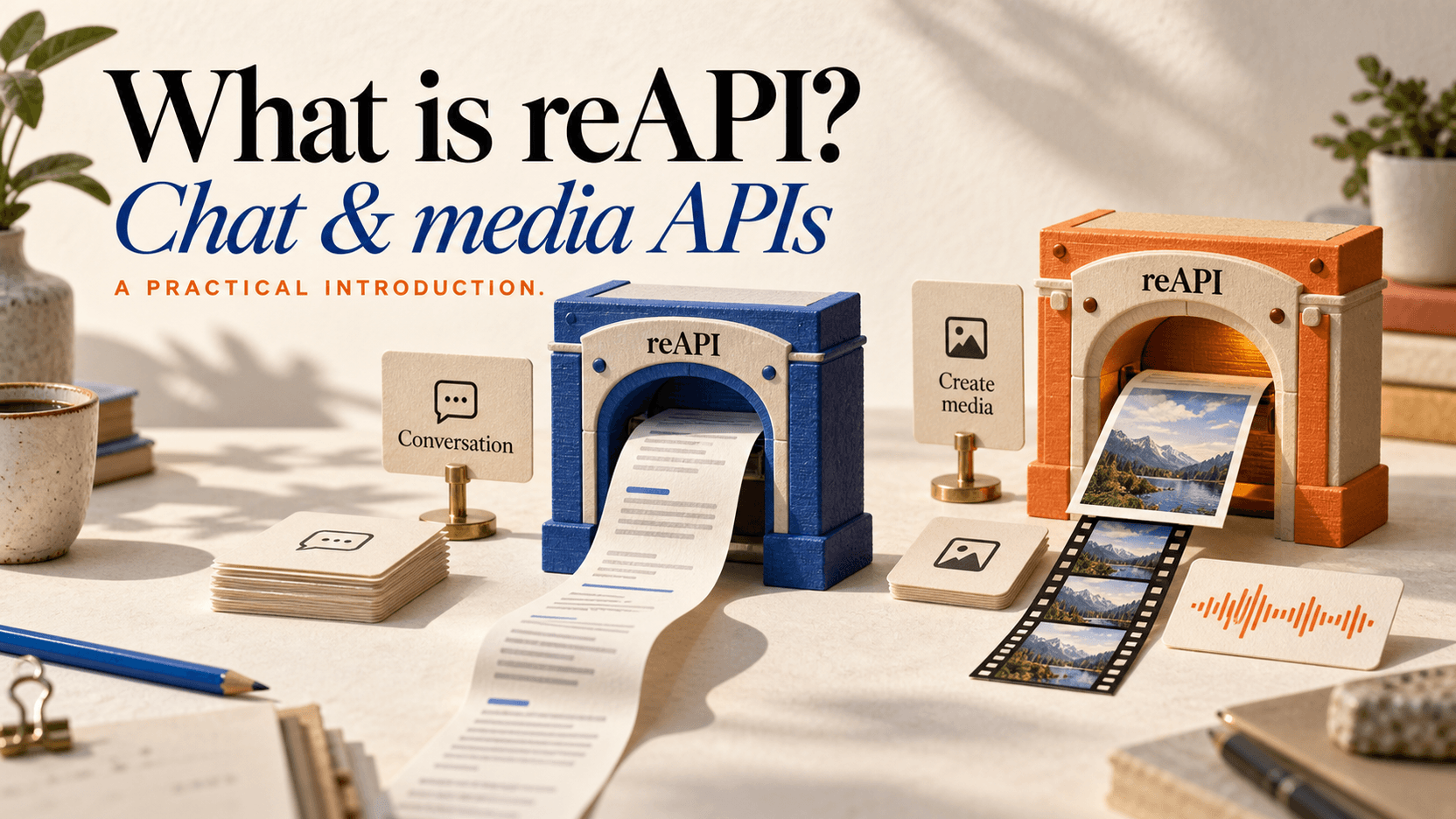
What Is reAPI? Models, Pricing, and How to Use It in 2026
reAPI provides chat and media APIs for 200+ image, video, audio, and language models. Here is what it does, what it costs, and how to make your first call.
reAPI provides generative AI access across every modality. Chat and media use separate gateways, keys, and balances: the chat gateway speaks the OpenAI format, while the media gateway handles image, video, and audio tasks. Together they cover 200+ models without a separate vendor integration for each model provider.
This guide covers what reAPI is, the models it carries, what it costs, and how to make your first call. Every endpoint and code sample below is the real API; you can paste them and run them after creating a key.
What is reAPI?
reAPI is an AI model platform with two API gateways:
- Chat models:
https://api.reapi.ai/v1, synchronous and OpenAI-compatible. - Image, video, and audio:
https://reapi.ai/api/v1, asynchronous. You submit a job, get a task id back immediately, and poll until it finishes.
Each gateway has its own workspace, API key, and balance. A key created on one gateway does not authenticate on the other.
The result is one provider relationship that covers GPT-5, Claude Opus 4.8, and Gemini for text, plus Veo 3.1, Seedance 2.0, and GPT-Image-2 for media, without four separate vendor relationships.
Core features and benefits
- Two purpose-built gateways. One serves OpenAI-compatible chat; the other serves asynchronous media tasks.
- OpenAI-compatible chat. A drop-in for existing OpenAI code; change the base URL and key.
- Published model-specific rates. Each model page lists its current billing unit and price.
- Every modality. Text, image, video, and audio across the two gateways.
- Pay-as-you-go credits. No subscription, no minimum spend; 1 credit equals $0.001, and new accounts start with free credits.
- Automatic refunds on failure. A failed generation refunds its credits the moment the job ends in failure, with no support ticket.
How reAPI works
Authentication is a Bearer token on every request:
Authorization: Bearer rk_live_xxxxxxxxxxxxCreate the appropriate key for the gateway you are calling. Chat keys come from api.reapi.ai; media keys come from the API Keys page on reapi.ai. Keys and balances do not cross between the two workspaces.
Chat requests return in one round trip, the same as calling OpenAI. Media requests are asynchronous because image and video take seconds to minutes to render:
POST /api/v1/images/generations   →   { task_id, status: "processing" }
        │
        ▼
GET  /api/v1/tasks/{task_id}       →   processing → completed / failed
                                          │
                                          ▼
                                   output.image_urls
reAPI calls the upstream model exactly once per request you send. There is no idempotency deduplication: every successful POST creates a task and charges credits, so a request is never silently skipped, and a failed task is refunded automatically.
Call a chat model in the OpenAI format
Because the chat surface is OpenAI-compatible, the official OpenAI SDK works with two changes, the base URL and the key:
from openai import OpenAI

client = OpenAI(
    base_url="https://api.reapi.ai/v1",
    api_key="YOUR_CHAT_API_KEY",
)

resp = client.chat.completions.create(
    model="gpt-5.5",
    messages=[
        {"role": "user", "content": "Tell me what reAPI does in one sentence."},
    ],
)
print(resp.choices[0].message.content)
Swap model for claude-opus-4-8 or a Gemini model and the rest of the call is identical. The same pattern works in the Node SDK and any OpenAI-compatible tooling.
Generate an image
Submit the job, then poll the task:
curl https://reapi.ai/api/v1/images/generations \
  -H "Authorization: Bearer rk_live_xxx" \
  -H "Content-Type: application/json" \
  -d '{
    "model": "gpt-image-2",
    "prompt": "a cute red panda eating bamboo, photorealistic",
    "size": "1:1"
  }'
The response comes back immediately with a task id and status: "processing". Poll until it is done:
curl https://reapi.ai/api/v1/tasks/task_018f5a3a1b6e7d9f8c2b4d6e8f0a2c4e \
  -H "Authorization: Bearer rk_live_xxx"
When status is completed, the image is at output.image_urls[0], rehosted on reAPI's CDN. Poll about once every one to two seconds; image tasks usually finish within seconds.
Generate a video
Video uses the same submit-then-poll pattern, on the videos endpoint:
curl https://reapi.ai/api/v1/videos/generations \
  -H "Authorization: Bearer rk_live_xxx" \
  -H "Content-Type: application/json" \
  -d '{
    "model": "doubao-seedance-2.0-face",
    "prompt": "a drone shot flying over a coastal city at sunset",
    "resolution": "720p"
  }'
Video runs longer than image, so pace polling accordingly; the task reaches completed with the result at output.video_urls[0]. Per-model request fields are documented on each model's page.
What reAPI costs
reAPI is pay-as-you-go with no subscription and no minimum spend. Credits are the unit: 1 credit equals $0.001, and you spend them per call. New accounts start with free credits, so the first request costs nothing.
Media uses model-specific billing units, such as per image, per generation, or per billed second:
| Model | Type | From |
|---|---|---|
| GPT-Image-2 | Image | $0.0066 / image |
| Seedance 2.0 Mini | Video | From $0.024 / billed second with source video |
| Veo 3.1 Fast | Video | $0.207 / generation |
Chat models bill per token at their published model-specific rates. A failed media task is refunded automatically and in full, so you only pay for completed output.
Reliability and billing, in plain terms
A few platform rules are worth knowing before you build on reAPI.
Media billing uses credits, where one credit equals $0.001, deducted from the media workspace balance with no monthly fee and no minimum spend. Chat usage is billed separately on the chat workspace. A failed media task is refunded automatically and atomically the moment the job ends in failure, before any poll sees the failed status, and the refund happens once and only once.
reAPI calls the upstream model exactly once for every request you send, with no idempotency deduplication. That keeps billing honest: you are charged for the calls you make, never silently double-charged and never silently skipped. If you need retry safety, send each payload once on your side, or lean on the automatic refund and resubmit.
Requests are rate-limited per user at five per second, polling included, so pace polling to about once every one to two seconds. Generated files are rehosted on reAPI's CDN; copy anything you need long-term into your own storage once a task completes.
reAPI vs calling each provider direct
Going direct means one account, key, SDK, and invoice per vendor. reAPI consolidates that access into its chat and media workspaces.
| Calling providers direct | reAPI | |
|---|---|---|
| Accounts and keys | One per vendor | Separate chat and media workspaces |
| Billing | One invoice per vendor | Separate chat and media balances |
| Pricing | Official rates | Published model-specific rates |
| Switching models | New integration per vendor | Change a string |
| Failed calls | Handled per vendor | Refunded automatically |
Models on reAPI
The catalog spans every modality. A sample of what is live:
- Chat and reasoning: GPT-5.5, GPT-5.4, Claude Opus 4.8, Claude Sonnet 4.6, Gemini.
- Image: GPT-Image-2, Gemini 3 Pro Image, Imagen 4, Seedream 5.0.
- Video: Veo 3.1, Seedance 2.0, Wan 2.7, Kling, HappyHorse 1.0, PixVerse V6, Vidu Q3.
- Audio and music: Mureka V9, plus voice tools for cleanup, separation, and conversion.
Browse the full set on the reapi.ai/models directory, each with its request schema and pricing.
Who uses reAPI
The platform fits any team that touches more than one model:
- SaaS products adding AI features without standing up a vendor integration per capability.
- Content and marketing teams generating images and video at published model-specific rates.
- Agencies billing client work through predictable pay-as-you-go balances.
- Researchers A/B testing models by changing a string instead of an account.
FAQ
Is reAPI OpenAI-compatible?
Yes, for chat. Point an OpenAI client at https://api.reapi.ai/v1 with a key created on the chat workspace. Image and video use asynchronous task endpoints at https://reapi.ai/api/v1 with a separate media key.
How much does reAPI cost?
It is pay-as-you-go with no subscription. Credits are 1 credit = $0.001, and each model page publishes its current price and billing unit. For example, GPT-Image-2 is billed per image, while Seedance 2.0 is billed by duration and configuration.
What models does reAPI support?
200+ models across chat, image, video, and audio, including GPT-5, Claude Opus 4.8, Gemini, Veo 3.1, Seedance 2.0, Wan 2.7, and GPT-Image-2. The full list is on reapi.ai/models.
Do I need separate keys for chat and media?
Yes. Chat and media are separate workspaces with separate keys and balances. A chat key cannot authenticate on the media gateway, and a media key cannot authenticate on the chat gateway.
What happens if a generation fails?
The credits are refunded automatically, in full, the moment the task ends in failure. The refund is one-shot and happens before any poll observes the failure, so you never pay for a failed render.
Does reAPI deduplicate repeated requests?
No. Every successful POST to a generation endpoint creates a new task and charges credits, by design, so no upstream call is ever silently skipped. Handle retry safety on your side.
How do I get started?
For media, create an account at reapi.ai and make a key under API Keys. For chat, sign in at api.reapi.ai and create a chat key there. Then send the matching request above.
Further reading
- reapi.ai/docs/api — full API conventions and the task reference.
- What can reAPI do for you? — use cases across image, video, and LLMs.
- Best fal.ai alternatives — how reAPI compares to a media-only API.
Getting started with reAPI
reAPI exists to remove the busywork between you and a model. Use https://api.reapi.ai/v1 with a chat-workspace key for OpenAI-compatible chat, or https://reapi.ai/api/v1 with a media-workspace key for image, video, and audio tasks. The workspaces have separate balances, so create and fund the one that matches the API you need.
Author

Categories
More Posts

GPT-6 Luna API Pricing: Token Rates and Cost Calculator
GPT-6 Luna API pricing from OpenAI's price page: input, output, cache reads and writes, the 272K long-context tier, Batch and Fast, plus worked cost examples.

LLM Max Output Tokens: API Limits and Context Budgets
Compare LLM output limits, reasoning budgets, and API parameters. Separate context windows, request caps, defaults, and Claude's batch-only output extension.

NSFW Video API Guide: Seedream 5.0 Pro to Seedance, Wan, H3
Build a reliable NSFW video API workflow: first create adult-only keyframes in Seedream 5.0 Pro, animate with Seedance, Wan, or H3, and add consent checks.