OpenAI Astra's 10 Math Breakthroughs: What They Mean
OpenAI says Astra produced ten advances in math and theoretical computer science. See what was proved, what Lean verifies, and what still needs review.
OpenAI's next major model, Astra, has moved beyond solving hard exercises and into producing new mathematical results. On August 1, 2026, OpenAI published ten advances generated by an internal version of the model, together with a 249-page manuscript, reasoning walkthroughs, and Lean formalizations. If the results survive independent scrutiny, this will matter more than another benchmark record. It still does not mean that the mathematics community has already accepted “ten conjectures solved by AI”[1].
The important signal is not one lucky proof. It is the possibility that a general-purpose model can produce research-grade work repeatedly, across several fields, at a low marginal inference cost.
TL;DR
- OpenAI released ten different kinds of results: proofs, counterexamples, and improved bounds. Calling all ten “solved conjectures” is convenient but imprecise.
- Astra is an internal, unreleased model. OpenAI has not announced public access, API pricing, or a release date.
- The paper and Lean files make the claims unusually testable, but formal verification does not replace expert review of the statement, assumptions, novelty, or significance.
- OpenAI estimates that the solution-finding tokens would cost about $2,000 at Sol API rates. That is an inference-cost estimate, not the total cost of the research program.
- If the results hold, the immediate shift is cheaper proof search and technical experimentation—not the disappearance of mathematicians.
What did OpenAI Astra actually produce?
OpenAI's announcement lists ten advances spanning high-dimensional geometry, coding theory, group theory, operator algebras, arithmetic circuit complexity, quantum complexity, lattice problems, and extremal combinatorics[1].
| Area | Reported Astra result |
|---|---|
| High-dimensional sphere packing | Determines the asymptotic strength of the Cohn–Elkies linear program and improves the general packing bound |
| Binary and spherical codes | Gives exponentially stronger bounds across the parameter range |
| Group theory | Constructs a non-sofic group, resolving a central open question |
| Operator algebras | Produces counterexamples to Connes's rigidity conjecture |
| Arithmetic circuit complexity | Improves lower bounds for circuits and formulas computing the permanent |
| Quantum complexity | Proves exponential parallel repetition for arbitrary finite two-player entangled games |
| Lattice problems | Establishes polynomial-factor hardness for approximating the Euclidean closest vector problem |
| Convex geometry | Proves the sharp Ehrhart volume bound in every dimension |
| Ramsey theory | Gives a superexponential lower bound for multicolor triangle Ramsey numbers |
| Extremal graph theory | Disproves compactness and degeneracy conjectures, resolving two Erdős problems |
The full collection runs to 249 pages[2]. Some chapters prove a conjecture, some disprove one by construction, and others improve a long-standing upper or lower bound. The results do not all have the same shape or scholarly weight.
The accurate description is therefore that OpenAI has submitted ten potentially major advances in mathematics and theoretical computer science. Whether every chapter is correct, new, and as important as the announcement suggests must be judged by specialists in the relevant fields.
Why this matters more than an AI math-olympiad medal
An olympiad problem can be extremely difficult, but it is still a closed problem. A human has selected the question, the conclusion is known, and a solution of manageable length is expected to exist.
Research mathematics removes those supports. A researcher may not know whether a statement should be proved or disproved. The expensive work includes choosing a direction, connecting distant bodies of theory, searching for counterexamples, recognizing a useful construction, and abandoning an attractive approach before it consumes months.
OpenAI had already shown one example of this behavior in May 2026. An internal general-purpose model used ideas from algebraic number theory to disprove the long-standing Erdős unit-distance conjecture. External mathematicians checked the proof, and Tim Gowers described it as a milestone in AI mathematics[3].
One result can still be treated as an exceptional hit. Ten results across unrelated domains are harder to dismiss that way. If outside review confirms them, the story is no longer simply that a model can occasionally help with a proof. It is that a model may have acquired a repeatable research capability.
That distinction is the real source of the excitement.
What the reported $2,000 token cost does—and does not—mean
OpenAI says the tokens used to find the ten solutions would cost roughly $2,000 at Sol API rates[1].
That figure does not mean the research cost $2,000. It excludes training Astra, running the underlying infrastructure, selecting problems, paying researchers, organizing the manuscripts, formalizing the arguments, and investigating failed directions. The announcement also does not provide the denominator: how many open problems were tested to obtain these ten results.
What the number does reveal is a possible collapse in the marginal cost of exploration.
A human researcher may spend weeks establishing that a promising route cannot work. A model can try many routes in parallel: test special cases, search for counterexamples, combine lemmas from separate literatures, run computations, and retain only the branches that survive initial checking.
If that process becomes reliable, research budgets start to buy a search space rather than a single line of attack. AI may not replace the person who asks the important question, but it can make mathematical trial and error far cheaper.
Astra itself is not publicly available. OpenAI has not announced an API, a price, or a release date. To compare models that are actually available now, use the reAPI model catalog; an Astra listing should not be inferred from these research results.
From Astra output to accepted mathematics
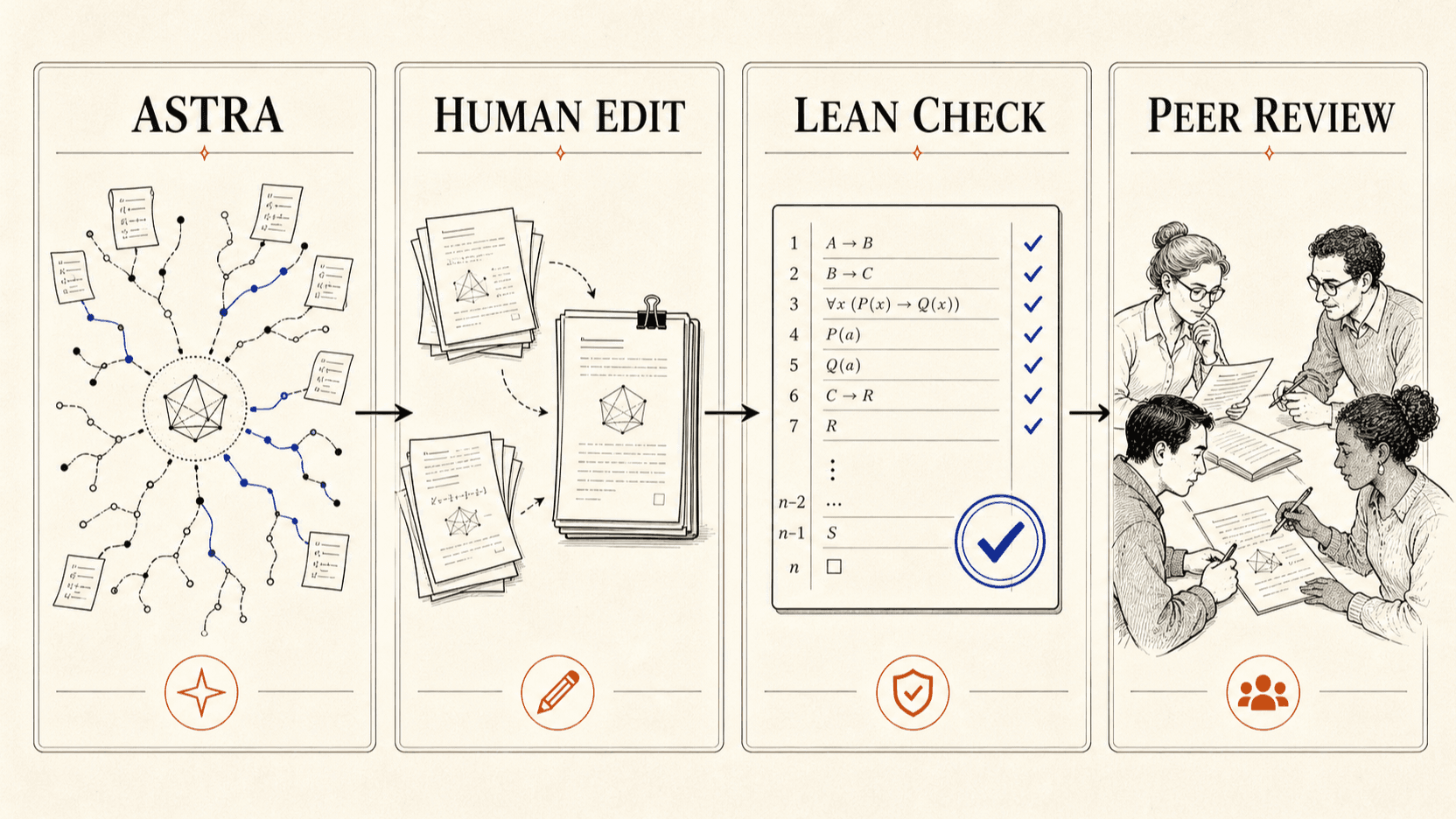
The public workflow can be separated into four stages:
- Model discovery. Astra searches for a construction, counterexample, or proof and produces a candidate argument.
- Human preparation. Researchers use the model to turn that argument into a readable manuscript.
- Formal checking. The argument is encoded in Lean so its logical steps can be checked by a small trusted kernel.
- Community review. Independent mathematicians verify that the formal statement matches the original problem and assess novelty, context, and significance.
OpenAI has published Lean 4 files for all ten results, along with build instructions and a path for independent proof checking[4]. That is a much stronger form of evidence than a polished model transcript. Reviewers can inspect definitions, rebuild the project, and challenge specific assumptions.
The four stages should not be compressed into the sentence “the machine proved it.” They answer different questions, and none of the later stages is decorative.
What does Lean verification guarantee?
Lean checks whether a formalized theorem follows from the definitions, axioms, and earlier results supplied to the system. It does not accept “obviously” as a proof step, and it is not persuaded by fluent prose. This makes it well suited to checking long AI-generated arguments.
But a successful Lean build is not an all-purpose certificate of mathematical importance or even a complete guarantee that the original informal claim was captured correctly.
Experts still need to ask:
- Does the formal theorem faithfully represent the open problem?
- Are the definitions standard for that field?
- Did the formalization introduce an assumption stronger than intended?
- Was a difficult claim moved into an imported lemma or premise?
- Is the result genuinely new?
- Does it have the significance claimed in the announcement?
Lean can establish that a derivation is valid inside a formal environment. It cannot independently decide that the environment represents the intended mathematics, nor can it search the entire scholarly record for priority.
Formal verification and peer review are complements, not substitutes.
Why independent review still matters
OpenAI is the model developer, the publisher of the paper, and the party taking responsibility for the formalizations. Releasing the manuscript and code is a strong transparency measure, but a claim of this size still needs review by experts without a stake in the model launch.
OpenAI's own First Proof experiment shows why. In February 2026, the company released ten research-level proof attempts from an internal model. One attempt that initially appeared likely to be correct was later judged incorrect after feedback from the problem authors and the mathematical community[5].
Frontier proofs can fail at a single subtle step buried inside dozens of pages. As models become better at producing confident, professional mathematical prose, surface quality becomes an even less reliable guide to correctness.
The Astra release offers considerably stronger evidence than a raw proof attempt because it includes full manuscripts and formal files. As of August 2, 2026, the responsible conclusion is still narrower than the viral headline: OpenAI has released a highly consequential, unusually well-documented set of candidate advances that now require broad independent scrutiny.
Will Astra replace mathematicians?
Not immediately. It is more likely to rearrange what mathematicians spend their time doing.
Research includes problem selection, conjecture formation, literature mapping, proof search, technical derivation, verification, explanation, and generalization. Astra appears most likely to compress the cost of proof search and technical experimentation—the parts that can consume large amounts of time without producing a publishable result.
If candidate proofs become abundant, other skills become more scarce:
- deciding which questions are worth solving;
- identifying the actual idea inside a long machine-generated argument;
- turning a technically correct proof into a concept humans can understand;
- recognizing where a new method transfers;
- designing reliable human–AI research workflows;
- auditing a growing volume of machine-produced mathematics.
The mathematician of the near future may act more like a research director, problem designer, and proof auditor. Technical work will not vanish, but manually producing every intermediate step may no longer sit at the center of the profession.
That change also creates institutional questions. How should an AI-generated proof be credited? What level of model assistance must a paper disclose? Can researchers without access to private frontier models compete? If public papers and formal libraries help train commercial systems, what obligations do developers have to the mathematical community?
OpenAI says it would be misleading to claim human authorship for an argument generated entirely by its system[1]. The Leiden Declaration on Artificial Intelligence and Mathematics goes further, calling for standards around attribution, training data, research equity, corporate power, and the preservation of human mathematical understanding[6].
These are not side issues. The more capable Astra is, the faster the research community will need workable answers.
Does Astra prove that AGI has arrived?
No.
Mathematics has explicit rules, a large digitized literature, and outcomes that can often be checked automatically. That makes it unusually suitable for a training and verification loop. Progress in formal reasoning does not automatically transfer at the same rate to fields that depend on physical experiments, noisy observations, tacit laboratory knowledge, or ambiguous goals.
The public record also does not show Astra independently completing the entire research cycle. Humans still selected or curated the problems, prepared the manuscripts, released the work, and assumed responsibility for it. Without data on failed attempts, outsiders cannot calculate the model's success rate on an arbitrary open problem.
The evidence supports a more specific claim: a general-purpose AI system may now be able to produce original, end-to-end arguments on some research-level mathematical problems, at a quality high enough to merit formal and expert review.
That is already a major result. It does not need an AGI label to be consequential.
The real turning point in AI mathematics
Computers have long helped mathematicians run calculations, search literature, and verify finite cases. Astra is attempting something different: choosing proof directions, connecting concepts, constructing counterexamples, and sustaining a novel argument across many pages.
If the ten results survive review, mathematical discovery will have a visible new production model. Candidate proofs can be searched in parallel, checked with formal systems, and scaled with additional inference resources.
Mathematics, however, is not only the act of moving a statement from “unknown” to “proved.” A proof is also valuable because it explains why a result is true and exposes structures that can be used elsewhere.
The future bottleneck may therefore be less about whether machines can generate more theorems and more about whether humans can understand, organize, and retain agency over them. Astra has not ended the role of the mathematician. It may have opened the era of automated mathematical research.
FAQ
Is OpenAI Astra publicly available?
No. OpenAI describes Astra as its next major model and says these results came from an internal version. As of August 2, 2026, the announcement includes no public release date, API access, or pricing[1].
Did Astra solve ten mathematical conjectures?
Not in one uniform sense. The collection includes proofs, counterexamples, and improved bounds. The manuscripts and Lean files are public, but specialists still need to review each result independently.
Does a Lean proof guarantee that the result is correct?
Lean can guarantee that a formal theorem follows from its stated assumptions inside the formal system. It cannot by itself guarantee that the theorem exactly matches the original informal problem, that the assumptions are appropriate, or that the result is new and significant.
Did the ten results cost only $2,000?
No. The $2,000 figure is OpenAI's estimate for the solution-finding tokens at Sol API rates. It excludes model training, infrastructure, staff, failed experiments, problem selection, manuscript preparation, and formalization.
Will Astra make mathematicians obsolete?
The nearer-term effect is task reallocation. Proof search and technical trial and error may become heavily automated, while problem selection, interpretation, verification, conceptual compression, and research governance become more important.
Further reading
- Browse currently available AI models — capabilities and access for released models, not unreleased Astra research systems.
- What is reAPI? — how one API provides access to models from multiple providers.
References
- OpenAI. Ten advances in mathematics and theoretical computer science. August 1, 2026. openai.com/index/ten-advances-in-mathematics
- OpenAI. Ten Advances in Mathematics and Theoretical Computer Science. August 2026. cdn.openai.com/pdf/ten-proofs-oai.pdf
- OpenAI. An OpenAI model has disproved a central conjecture in discrete geometry. May 20, 2026. openai.com/index/model-disproves-discrete-geometry-conjecture
- OpenAI. Ten Advances in Mathematics and Theoretical Computer Science — Lean 4 formalizations. Retrieved August 2, 2026. github.com/openai/ten-proofs
- OpenAI. Our First Proof submissions. February 20, 2026. openai.com/index/first-proof-submissions
- Leiden Declaration Working Group. Leiden Declaration on Artificial Intelligence and Mathematics. May 2026. leidendeclaration.ai
Author

Categories
More Posts

Sora 2 API Shutdown: Export, Migrate, and What It Costs
The Sora 2 API shutdown hits September 24, 2026 with no official replacement. Export your library, remap the endpoints, and see what each tier really costs.

What is the best API platform for building an AI design or marketing creative tool?
There is no single best API platform for AI creative tools. Four platforms compared on request contract, real prices, and what each is actually built for.
How to Use Claude Fable 5: Refusals, Fallback, and Cost
How to use Claude Fable 5: the full benchmark table, the refusal and fallback contract that changes your code, mandatory retention, and what Opus 5 changed.