· reAPI Team
Muse Image API Pricing: Is Meta Muse Image Free?
Muse Image API pricing from Meta's own docs, what is free in Meta AI and what is not, how to access the model from code, and worked costs per 1,000 images.
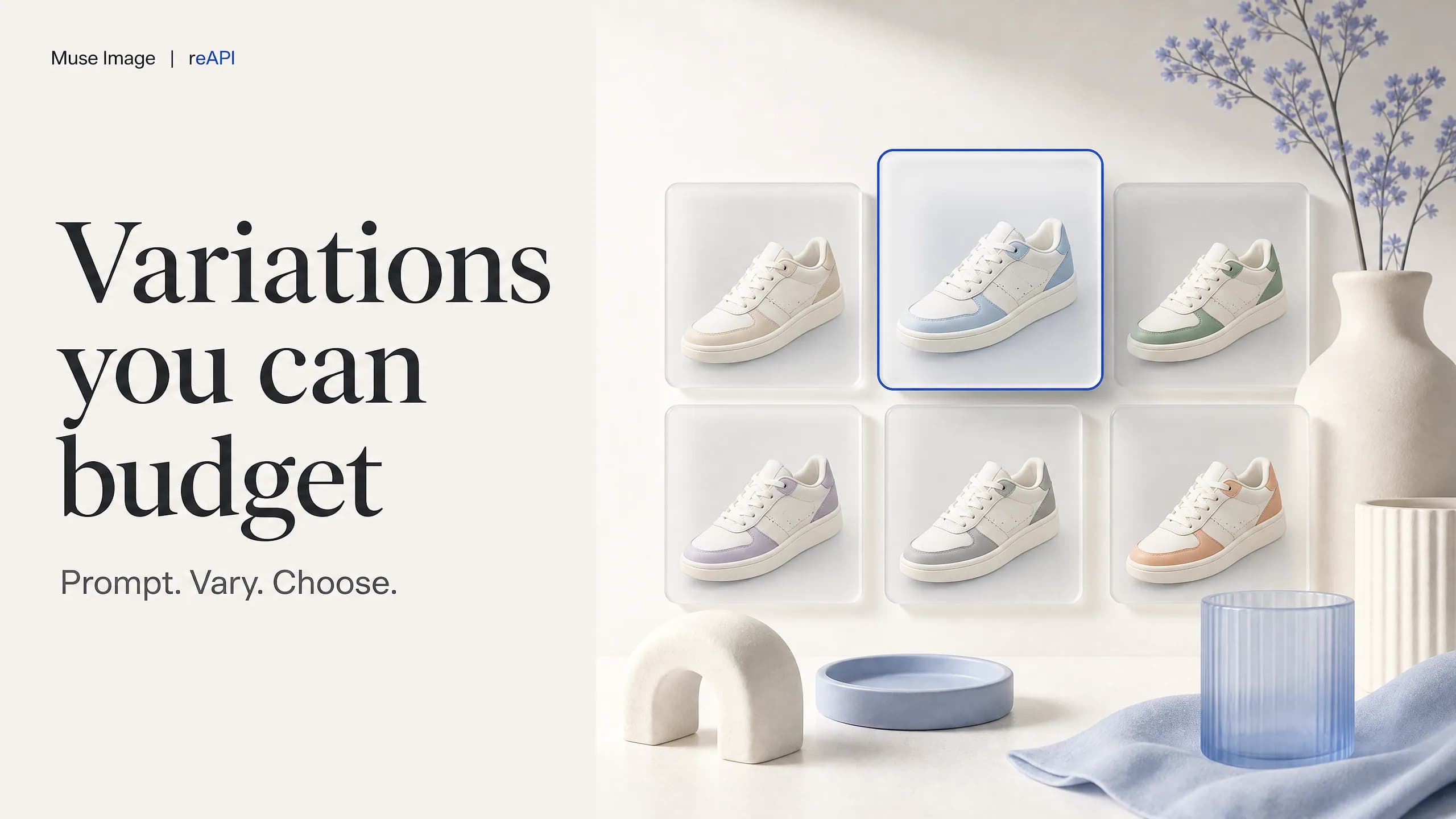
The Muse Image API costs $0.01 per generated image on Meta's own Model API, with the same price for every prompt length, every reasoning setting and every built-in web search the model runs[1]. Making pictures inside the Meta AI app is a different product: Meta says that using Meta AI with Muse Image "is free for everyday creation", with more available through its subscription plans[2].
So the short answer to "is Meta Muse Image free?" is yes in Meta's apps and no from code. This guide lays out the Muse Image API price, the limits that come with it, the ways to reach the model, and what 100, 1,000 and 10,000 images cost on Meta's API and on reAPI, with the arithmetic written out.
TL;DR
- Meta Model API: $0.01 per generated image for
muse-image-1.0; failed or safety-filtered images are not billed[1]. - Rate limit on Meta's API: 150 requests per minute for
muse-image-1.0[1]. - Free use exists only inside Meta's apps, such as the Meta AI app and meta.ai, with subscriptions for heavier use[2][3].
- On reAPI (checked October 29, 2026): $0.005 per image, billed as 5 credits, one flat price for text-only and reference requests[4].
- Open source? No. Meta serves Muse Image as a hosted model; its open-weight releases are other models[5].
- The two API surfaces differ: Meta's endpoint returns up to 10 images per call and has an edit endpoint, while reAPI returns one image per request from a prompt and up to 9 references.
What the Muse Image API costs on Meta's Model API
Meta bills Muse Image as a flat rate per generated image. Its pricing page lists one line for the model: "Generated image, $0.01 per image"[1]. The same page says the price "is the same regardless of prompt length, reasoning_strength, or the tools the model uses during generation, including its built-in web and image search, which isn't charged separately"[1].
Three billing rules follow from Meta's wording:
| Rule on Meta's Model API | What it means for a bill |
|---|---|
"A request that returns n images is billed for n images" | Asking for 4 images costs $0.04 |
| Images that fail, or are "removed by safety filtering before they're returned, aren't counted" | Refused or failed images cost nothing |
Image responses include a usage object "for reference" | Token counts are shown but are not what you pay |
Source: Meta Model API pricing and rate limits[1].
The image-generation guide repeats the point about search: the model can look up references and current facts before it renders, and "this built-in search is part of the per-image price, so it carries no extra search-grounding charge"[6]. That matters when you compare the Muse Image API with image models that bill grounding separately.
Meta lists a rate limit of 150 requests per minute for muse-image-1.0 on the same page[1]. At one image per request that is 150 × 60 = 9,000 images an hour from one account; at n: 10 the same limit allows ten times as many.
Is Meta Muse Image free?
It depends on where you use it. Meta launched Muse Image on July 7, 2026 inside Meta AI, and the announcement says: "Using Meta AI with Muse Image is free for everyday creation. For people who want to create even more, it's available as part of Meta's subscription plans"[2]. Meta's research post lists where that consumer version runs: the Meta AI app, meta.ai, Instagram Stories in the US and WhatsApp in limited countries, with Facebook to follow[3].
None of that covers code. A program calling the Muse Image API pays per image, on Meta's Model API or through a provider such as reAPI. reAPI gives new accounts 100 credits, worth $0.10, which covers 20 Muse Image requests at 5 credits each[4]. That is a test allowance, not a free tier.
How to access Muse Image from code
There are two routes to the Muse Image API today, and they expose different request shapes.
Meta Model API. The model id is muse-image-1.0. Meta offers a conversational Responses API for multi-turn editing and single-shot /v1/images/generations and /v1/images/edits endpoints that are "compatible with the OpenAI Images API"[6]. On the images endpoint, n runs from 1 to 10, size is a "WxH" string that sets the aspect ratio rather than the exact pixels, and output_format is WebP by default, with PNG and JPEG available[6]. You can also set reasoning_strength and switch the built-in tools off[6].
reAPI. The model id is muse-image on POST /api/v1/images/generations, with the same key you use for every other reAPI model[7]. A request takes a prompt, 0 to 9 reference image URLs and one of seven aspect ratios (1:1, 16:9, 9:16, 4:3, 3:4, 3:2, 2:3), or no ratio for auto. Each request returns one WebP image, and you poll the task for the URL[7].
| Feature | Meta Model API | reAPI |
|---|---|---|
| Model id | muse-image-1.0 | muse-image |
| Images per request | 1–10 | 1 |
| Reference images | Yes | Up to 9 URLs |
| Edit endpoint | /v1/images/edits | No; describe the change with references |
| Aspect ratio | size as "WxH" | 7 named ratios or auto |
| Output format | WebP, PNG or JPEG | WebP |
| Reasoning and tool switches | Yes | Not exposed |
| Delivery | Response body (base64) | Task, then an image URL |
Sources: Meta image generation guide[6]; reAPI Muse Image docs[7].
Pick Meta's API when you need several images per call, PNG output or multi-turn editing with conversation state. Pick reAPI when you want Muse Image next to other image and video models on one key and one balance, and one picture per request is what your pipeline sends anyway.
Working out a Muse Image API bill
Both Muse Image API prices are flat per image, so the arithmetic is one multiplication. The table uses Meta's $0.01 list price[1] and reAPI's $0.005 launch price[4], with every image successful.
| Images | Meta Model API ($0.01 each) | reAPI ($0.005 each) |
|---|---|---|
| 100 | $1.00 | $0.50 |
| 1,000 | $10.00 | $5.00 |
| 10,000 | $100.00 | $50.00 |
Three things do not change these numbers. Reference images are free on both: Meta bills per generated image, and reAPI charges the same 5 credits with or without references[1][7]. Aspect ratio does not move the price on either side. And failed images cost nothing: Meta does not count them, and reAPI refunds a failed task in full[7].
What does change the bill is the number of variations you ask for. On Meta's API, n: 4 is four images and four cents. On reAPI, four variations are four requests at 5 credits each. A pipeline that keeps one image out of four pays for all four on either route.
Planning a Muse Image API workflow
A few habits keep a Muse Image API bill predictable.
- Write the brief once, then vary one thing. Muse Image follows a specific prompt closely, so changing only the setting or the light between variations makes the extra images worth paying for.
- Send references instead of describing a product. On reAPI, up to 9 reference URLs ride in the same request at no extra cost[7]. Say in the prompt what must stay the same.
- Set the shape in the request. Leave the ratio unset to follow the references, or set
9:16or16:9for each channel; every ratio costs the same. - Budget for retries you choose, not failures. Failed or filtered images are not billed on Meta's API[1], and failed reAPI tasks are refunded, so the real cost driver is how many keepers you need.
Muse Image API FAQ
Is Meta Muse Image free?
Inside Meta AI, yes for everyday creation, with subscriptions for more[2]. From code, no: the Muse Image API is billed per generated image, $0.01 on Meta's Model API[1] and $0.005 on reAPI at launch[4].
How do I access a Muse Image?
For one-off pictures, use the Meta AI app or meta.ai, where Muse Image runs today[3]. For code, call Meta's Model API with muse-image-1.0, or reAPI's /api/v1/images/generations with muse-image and an API key from the reAPI dashboard[7].
How much does the Muse Image API cost per image?
$0.01 per generated image on Meta's Model API, regardless of prompt length, reasoning setting or built-in search[1]. On reAPI it is 5 credits, which is $0.005, per image[4].
Is Muse Image open source?
No. Meta serves Muse Image as a hosted model. The open-weight models Meta lists are Muse Glimmer and Muse Spark Open, which are different models[5].
Does the Muse Image API charge for failed images?
Not on Meta's Model API: images that fail or are removed by safety filtering are not counted[1]. On reAPI, a failed task is refunded in full[7].
What is the Muse Image API rate limit?
Meta lists 150 requests per minute for muse-image-1.0 on its Model API[1].
Can the Muse Image API edit images?
Meta's API has an edit endpoint and multi-turn editing through its Responses API[6]. On reAPI, you send the image as a reference and describe the change; the result is a new picture, and there is no mask field[7].
Choosing where to run Muse Image
If you only need pictures for yourself, Meta AI is free for everyday use and nothing in this guide applies. If you are building something, the Muse Image API is a per-image bill on either route, and the choice comes down to the request you need. Meta's endpoint returns up to 10 images per call, has an edit endpoint that changes only what you ask for, and lets you pick PNG. reAPI returns one image per request from a prompt and up to 9 references, at half of Meta's list price at launch, on the same key as the rest of its catalog. Try a few prompts in the Muse Image playground before you wire the Muse Image API into a pipeline.
References
- Meta. Pricing and rate limits. Retrieved October 2026 from dev.meta.ai/docs/pricing-rate-limits
- Meta Newsroom. Introducing Muse Image: Image Generation Built for Your World. July 7, 2026. Retrieved October 2026 from about.fb.com/news/2026/07/introducing-muse-image-meta-ai
- AI at Meta. Introducing Muse Image and Muse Video. July 7, 2026. Retrieved October 2026 from ai.meta.com/blog/introducing-muse-image-muse-video-msl
- reAPI. Muse Image model page and pricing. Checked October 29, 2026 at reapi.ai/models/muse-image
- Meta. Models. Retrieved October 2026 from dev.meta.ai/docs/models
- Meta. Image generation with Muse Image. Retrieved October 2026 from dev.meta.ai/docs/image-generation
- reAPI. Muse Image API reference. reapi.ai/docs/muse-image