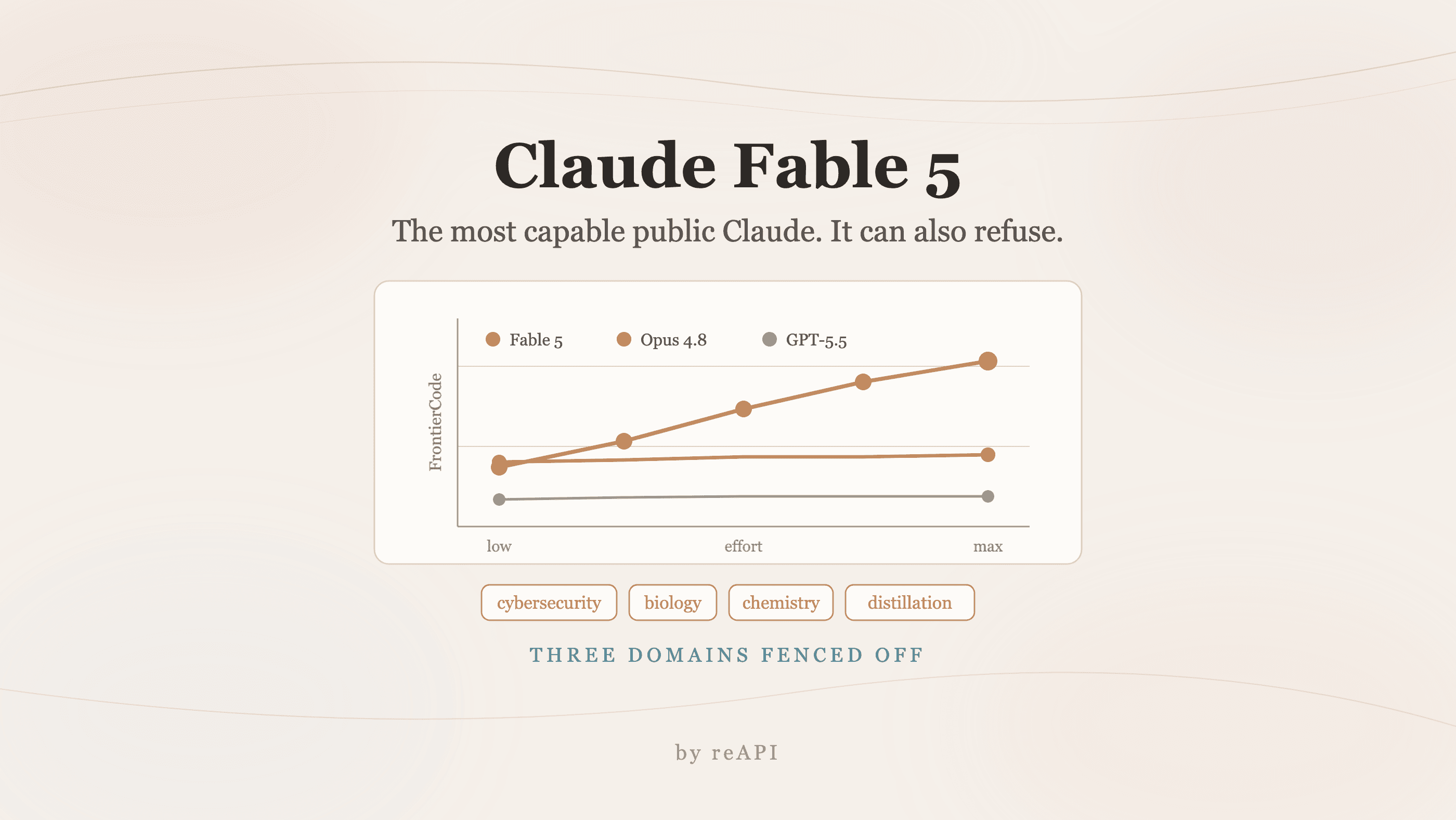
Comment utiliser Claude Fable 5 : refus, secours et coût
Comment utiliser Claude Fable 5 : benchmarks complets, le contrat de refus et de secours, rétention obligatoire et impact d'Opus 5 sur le coût.
Anthropic a publié Claude Fable 5 le 9 juin 2026, le premier modèle disponible au public de sa famille Mythos, au prix de 10 dollars par million de jetons d'entrée et 50 dollars par million de jetons de sortie[1]. C'est le modèle le plus capable qu'Anthropic ait mis à la disposition du grand public, et le tarif unitaire le plus élevé de la gamme Claude.
Apprendre à utiliser Claude Fable 5 signifie apprendre une chose que les autres modèles Claude ne vous forcent pas à gérer : il peut refuser une demande. Fable 5 est livré avec des classificateurs de sécurité que Mythos 5 n'a pas, et une demande refusée revient sous la forme d'une réponse HTTP 200 réussie avec stop_reason: "refusal" plutôt qu'une erreur[1]. Votre intégration a besoin de trois nouveaux comportements pour cela : gestion des refus, un chemin de secours vers un autre modèle, et une compréhension de la facturation des refus.
Ce guide couvre ce que Fable 5 fait réellement, comment il diffère de son homologue restreint Mythos 5, le contrat de refus et de secours en détail, la suspension de contrôle d'exportation qui l'a mis hors ligne pendant dix-huit jours, et pourquoi l'arrivée de Claude Opus 5 a changé la réponse à « dois-je payer pour cela ? »
TL;DR
- Le tarif unitaire est de 10 $ / 50 $ par million de jetons, le double de Claude Opus 4.8[3]. Sur reAPI, il s'exécute à 7,00 $ / 35,00 $ (22 octobre 2026 vérifié), ce qui représente 70 % du taux publié par Anthropic.
- Il peut refuser. Fable 5 embarque des classificateurs de sécurité couvrant la cybersécurité, la biologie et la chimie, ainsi que les tentatives de distillation. Un refus est une réponse HTTP 200 avec
stop_reason: "refusal", et la réponse indique quel classificateur a refusé[1]. - Les refus ne sont pas facturés quand aucune sortie n'est générée, et le secours rembourse le coût du cache d'invite lors d'une nouvelle tentative sur un autre modèle[1].
- La réflexion ne peut pas être désactivée. La réflexion adaptative est toujours active ;
thinking: {"type": "disabled"}n'est pas supporté. Utilisezeffortpour contrôler la profondeur[1]. - La rétention obligatoire des données pendant 30 jours. Fable 5 et Mythos 5 sont des modèles couverts et ne sont pas disponibles sous rétention zéro[1].
- Claude Opus 5 a changé les calculs. Anthropic décrit Opus 5 comme offrant une intelligence de pointe à la moitié du coût de Fable 5[4].
Qu'est-ce que Claude Fable 5

Claude Fable 5 est le modèle disponible le plus capable d'Anthropic, construit pour les travaux de raisonnement les plus exigeants et le travail d'agent à horizon lointain[1]. L'identifiant API est claude-fable-5.
Le lancement concerne deux modèles, et les confondre est la plus grande erreur à faire.
| Claude Fable 5 | Claude Mythos 5 | |
|---|---|---|
| Identifiant API | claude-fable-5 | claude-mythos-5 |
| Disponibilité | Généralement disponible | Sortie limitée par Project Glasswing uniquement |
| Classificateurs de sécurité | Oui | Non |
| Contexte / sortie max | 1M jetons / 128k | Identique |
| Tarif unitaire | 10 $ / 50 $ par MTok | Identique |
Ils partagent les mêmes capacités sous-jacentes et les mêmes spécifications[1]. La différence est la couche de classificateur. Donc quand un chiffre de benchmark est attribué à « Mythos 5 / Fable 5 » sur une ligne cybersécurité ou biologie, lisez-le attentivement : ce plafond appartient au modèle sans les freins. Le Fable 5 public que vous pouvez réellement appeler refusera précisément ces questions par conception.
Benchmarks
Anthropic a publié une comparaison directe par rapport à Mythos Preview, Opus 4.8, GPT-5.5 et Gemini 3.1 Pro. Le point fort est le codage d'agent, où l'avance est importante plutôt que marginale[1].
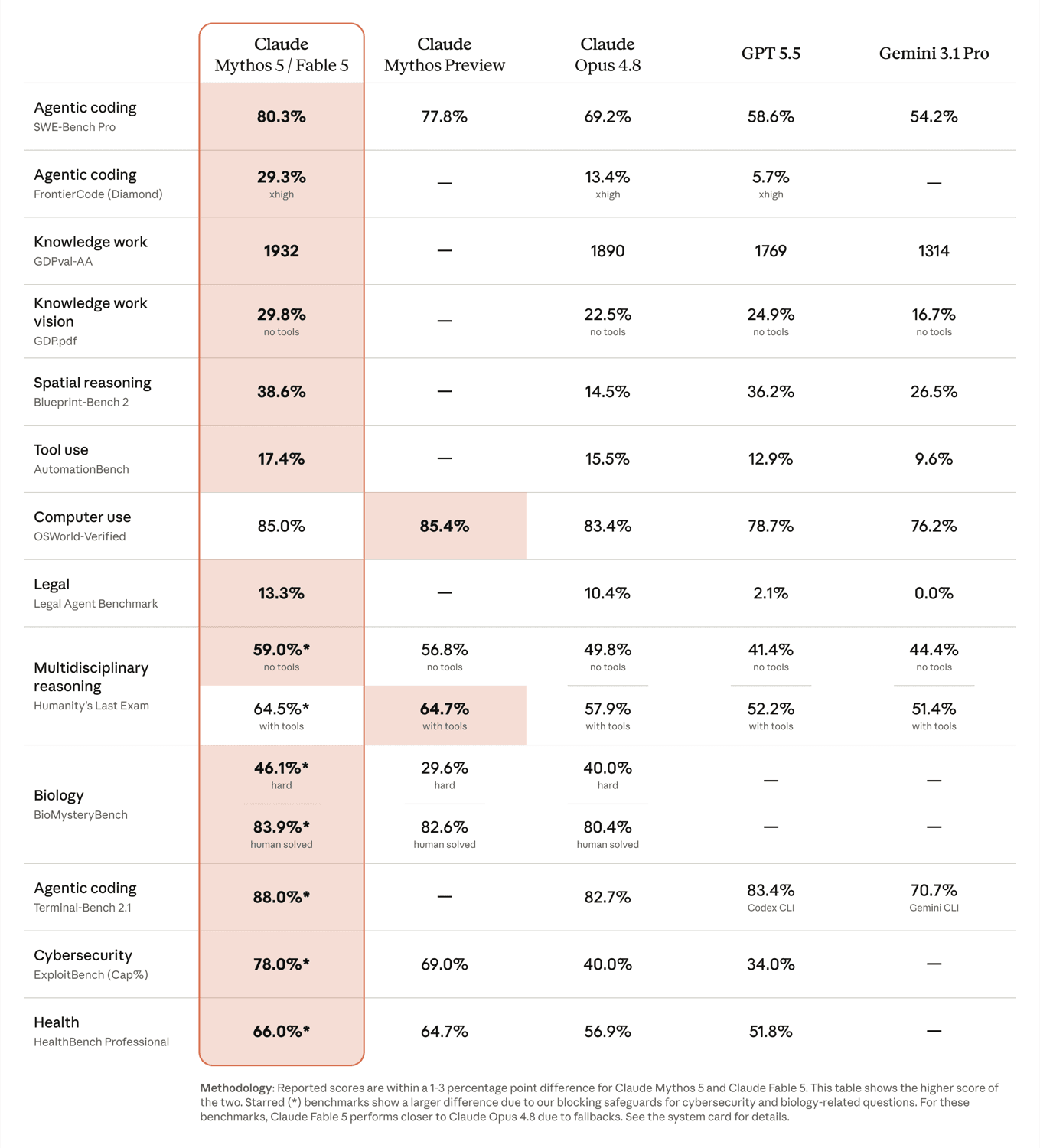
| Benchmark | Mythos 5 / Fable 5 | Mythos Preview | Opus 4.8 | GPT-5.5 | Gemini 3.1 Pro |
|---|---|---|---|---|---|
| Codage d'agent (SWE-Bench Pro) | 80,3 % | 77,8 % | 69,2 % | 58,6 % | 54,2 % |
| Codage d'agent (FrontierCode Diamond, xhigh) | 29,3 % | n/a | 13,4 % | 5,7 % | n/a |
| Codage d'agent (Terminal-Bench 2.1) | 88,0 %* | n/a | 82,7 % | 83,4 %† | 70,7 %† |
| Travaux de connaissance (GDPval-AA) | 1932 | n/a | 1890 | 1769 | 1314 |
| Vision travaux de connaissance (GDP.pdf, sans outils) | 29,8 % | n/a | 22,5 % | 24,9 % | 16,7 % |
| Raisonnement spatial (Blueprint-Bench 2) | 38,6 % | n/a | 14,5 % | 36,2 % | 26,5 % |
| Utilisation d'outils (AutomationBench) | 17,4 % | n/a | 15,5 % | 12,9 % | 9,6 % |
| Utilisation informatique (OSWorld-Verified) | 85,0 % | 85,4 % | 83,4 % | 78,7 % | 76,2 % |
| Juridique (Legal Agent Benchmark) | 13,3 % | n/a | 10,4 % | 2,1 % | 0,0 % |
| Raisonnement (HLE, sans outils) | 59,0 %* | 56,8 % | 49,8 % | 41,4 % | 44,4 % |
| Raisonnement (HLE, avec outils) | 64,5 %* | 64,7 % | 57,9 % | 52,2 % | 51,4 % |
| Biologie (BioMysteryBench, difficile) | 46,1 %* | 29,6 % | 40,0 % | n/a | n/a |
| Biologie (BioMysteryBench, résolu par humains) | 83,9 %* | 82,6 % | 80,4 % | n/a | n/a |
| Cybersécurité (ExploitBench, Cap%) | 78,0 %* | 69,0 % | 40,0 % | 34,0 % | n/a |
| Santé (HealthBench Professional) | 66,0 %* | 64,7 % | 56,9 % | 51,8 % | n/a |
† Les chiffres de Terminal-Bench pour GPT-5.5 et Gemini 3.1 Pro ont été exécutés via la CLI Codex et la CLI Gemini respectivement.
La note méthodologique d'Anthropic elle-même dans ce tableau est la chose la plus importante : les scores rapportés se situent dans une différence d'un à trois points de pourcentage pour Mythos 5 et Fable 5, et le tableau affiche le plus élevé des deux. Les lignes marquées d'un astérisque affichent un écart plus important « en raison de nos garde-fous de blocage pour les questions liées à la cybersécurité et la biologie », et sur celles-ci « Claude Fable 5 fonctionne plus proche de Claude Opus 4.8 en raison des recours»[1].
Lisez cela attentivement avant de citer tout chiffre marqué. Le chiffre cybersécurité de 78,0 % et le chiffre santé de 66,0 % ne sont pas ce que le modèle public livre sur ces questions.
Les lignes non marquées sont les gains que le modèle public conserve. SWE-Bench Pro à 80,3 % est plus de dix points au-dessus d'Opus 4.8 et plus de vingt au-dessus de GPT-5.5 et Gemini 3.1 Pro.
FrontierCode est la ligne qui explique le prix.
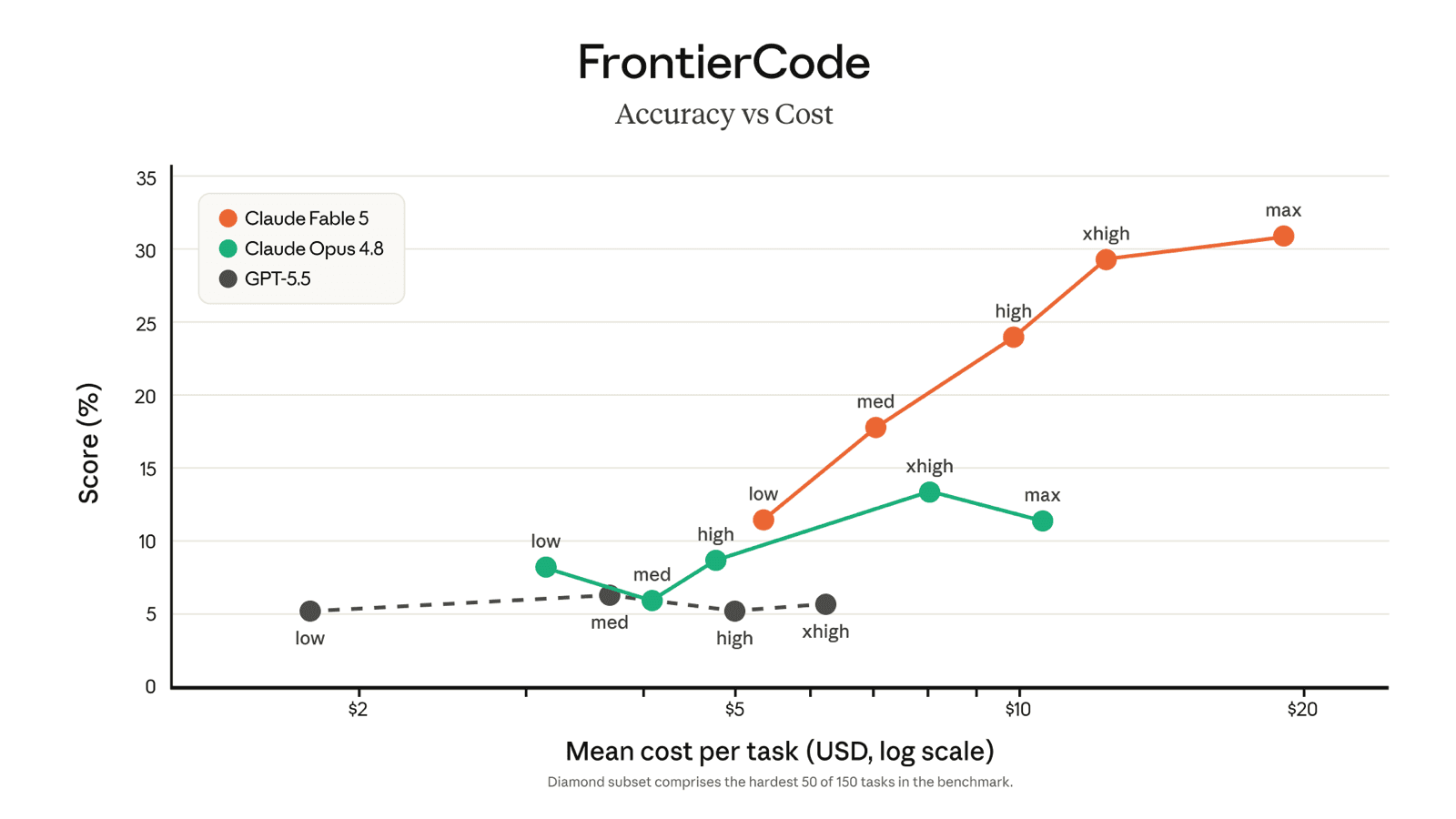
Sur ce sous-ensemble le plus difficile, Fable 5 grimpe d'environ 11 % à bas effort à environ 31 % à effort maximum, tandis qu'Opus 4.8 plafonne près de 13 % à xhigh et redescend à maximum, et GPT-5.5 reste plat autour de 5 % à 6 % sur toute son échelle. Fable 5 convertit le calcul supplémentaire en précision réelle sur les problèmes difficiles d'une manière que les autres ne font pas. Vous payez pour un modèle conçu pour continuer à travailler un problème plus longtemps.
Les résultats des partenaires du lancement sont suffisamment spécifiques pour être falsifiables : Stripe a signalé l'achèvement d'une migration de base de code Ruby de 50 millions de lignes en environ une journée contre une estimation manuelle de deux mois ; Hex a déclaré que Fable 5 était le premier modèle à franchir 90 % sur son benchmark analytique principal ; Hebbia a enregistré son score le plus élevé en matière de finance. Sur la vision, le modèle a terminé Pokémon FireRed en utilisant uniquement la vision.
Comment utiliser Claude Fable 5 quand il refuse
C'est la partie de Fable 5 qui change votre code, et il vaut la peine d'être précis car il est facile de le décrire mal.
Fable 5 ne réachemine pas silencieusement une demande risquée vers un modèle plus petit. Quand un classificateur refuse, l'API Messages retourne stop_reason: "refusal" comme une réponse HTTP 200 réussie, pas une erreur, et la réponse indique quel classificateur a refusé[1]. Le code qui indexe le premier bloc de contenu inconditionnellement se cassera sur cela. Vérifiez la raison d'arrêt avant de lire le contenu.
Réessayer sur un autre modèle Claude est votre choix, et il y a trois chemins supportés[1] :
- Côté serveur. Passez le paramètre
fallbackset laissez l'API réessayer pour vous, soit en son mode"default"utilisant les modèles recommandés par Anthropic, soit avec une liste que vous nommez. En bêta sur l'API Claude. - Côté client. Utilisez l'intergiciel SDK pour réessayer du client sur n'importe quelle plateforme.
- Manuel. Construisez le réessai vous-même, dans n'importe quel langage.
Les règles de facturation ont autant d'importance que la mécanique. Vous n'êtes pas facturé pour une demande refusée avant que toute sortie ne soit générée, et quand vous réessayez sur un autre modèle, le crédit de secours rembourse le coût du cache d'invite du commutation de sorte que vous ne le payez pas deux fois[1].
Trois domaines sont clôturés : la cybersécurité, y compris l'exploitation et les travaux offensifs ; la biologie et la chimie ; et les tentatives de distillation visant à extraire les capacités de Fable 5 pour entraîner un autre modèle.
Ce que la suspension du contrôle d'exportation a révélé
Fable 5 a déjà été mis hors ligne une fois, et la raison en vaut la peine de savoir avant de construire un produit dessus.
Vendredi, 12 juin, trois jours après le lancement, le gouvernement américain a appliqué des contrôles d'exportation à Fable 5 et Mythos 5, exigeant d'Anthropic qu'il restreigne l'accès aux ressortissants étrangers, qu'ils soient à l'intérieur ou à l'extérieur des États-Unis. Parce que l'ordre a pris effet immédiatement et Anthropic n'avait pas de moyen fiable de vérifier la nationalité en temps réel, il a suspendu l'accès aux deux modèles pour tous les utilisateurs[2].
Les contrôles ont été levés le 30 juin, et Fable 5 est revenu mondialement le 1er juillet sur Claude Platform, Claude.ai, Claude Code et Claude Cowork, avec AWS, Google Cloud et Microsoft Foundry réactivés après[2]. L'accès à Mythos 5 a été rétabli à un ensemble d'organisations américaines suite à l'approbation gouvernementale le 26 juin[2].
Dix-huit jours d'indisponibilité totale est un fait opérationnel réel, pas une note de bas de page. Si Fable 5 est le seul modèle sur un chemin de production, ce chemin n'avait aucun service pendant dix-huit jours. La leçon pratique est la même que celle que le contrat de refus enseigne déjà : ce modèle a besoin d'un secours, et le secours doit être configuré avant d'en avoir besoin.
L'exigence de rétention
Fable 5 et Mythos 5 portent une rétention obligatoire de 30 jours et ne sont pas disponibles sous rétention zéro, car les deux sont désignés comme modèles couverts[1]. Les organisations qui détenaient précédemment des accords à rétention zéro ne les conservent pas pour ce modèle.
Si vous avez des engagements de résidence des données ou de rétention envers vos propres clients, c'est la clause à lire avant d'adopter Fable 5. Elle n'est pas négociable par compte, et aucune configuration de passerelle ne la change.
Tarification, et ce qu'Opus 5 a changé
Fable 5 affiche un tarif de 10 dollars par million de jetons d'entrée et 50 dollars par million de jetons de sortie, le double des 5 $ / 25 $ d'Opus 4.8[3]. C'était le calcul en juin.
Ce n'est plus le calcul maintenant. Quand Anthropic a expédié Claude Opus 5 le 24 juillet, il a décrit le modèle comme fournissant une intelligence de pointe à la moitié du coût de Claude Fable 5[4], et Opus 5 affiche un tarif de 5 $ / 25 $, inchangé par rapport à Opus 4.8[3]. Opus 5 n'a également aucune couche de refus de classificateur du genre de Fable 5, aucune rétention obligatoire de 30 jours, et une échelle d'effort complète.
Sur reAPI, l'écart est encore plus important (tarifs vérifiés le 22 octobre 2026) :
| Modèle | Tarif reAPI par 1M jetons |
|---|---|
| Claude Fable 5 | 7,00 $ entrée / 35,00 $ sortie |
| Claude Opus 5 | 2,40 $ entrée / 12,00 $ sortie |
| Claude Opus 4.8 | 2,80 $ entrée / 14,00 $ sortie |
Fable 5 coûte presque trois fois ce qu'Opus 5 coûte sur la même passerelle. Cela ne rend pas Fable 5 inutile. Cela signifie que le fardeau de la preuve s'est déplacé : vous avez maintenant besoin d'une raison spécifique pour le saisir, mesurée sur vos propres tâches.
Fable 5, Opus 5, ou Opus 4.8 ?
Choisissez Fable 5 quand la tâche est à horizon lointain et véritablement difficile, et quand vous avez mesuré qu'il gagne : migrations à l'échelle du répertoire, refactorisations multi-fichiers contre une suite de tests fiable, boucles d'agent nocturnes, travaux analytiques denses où avoir tort est coûteux. La courbe FrontierCode est la preuve, car la précision continue de grimper avec l'effort où d'autres modèles s'aplatissent.
Commencez avec Opus 5 pour la plupart des nouveaux travaux. La formulation propre d'Anthropic la rapproche de l'intelligence de pointe de Fable 5 à la moitié du prix, et elle ne porte pas la couche de refus ni l'exigence de rétention.
Restez sur Opus 4.8 pour le grand milieu où vos évaluations caractérisent déjà son comportement, et où son mode rapide moins cher a de l'importance.
Une note opérationnelle qui est facile de manquer : une équipe de sécurité ou de sciences de la vie qui a besoin de capacité complète est pire en payant les tarifs Fable 5, car ce sont exactement les domaines où les classificateurs refusent. Appeler Opus 4.8 ou Opus 5 directement, ou demander à Project Glasswing l'accès à Mythos 5, est le chemin honnête.
Autonomie et mémoire basée sur les fichiers
La capacité qu'Anthropic souligne le plus est la durée. Fable 5 et Mythos 5 peuvent fonctionner autonomément plus longtemps que n'importe quel modèle Claude précédent, et les exemples de soutien sont délibérément à horizon lointain : avec la mémoire basée sur les fichiers, la performance de Mythos 5 sur Slay the Spire s'est améliorée trois fois plus que celle d'Opus 4.8, et dans les travaux en sciences de la vie, elle a fonctionné autonomement pendant une semaine pour assembler les données de cellules uniques pour des millions de cellules dans 138 espèces.
Les fonctionnalités supportées au lancement incluent l'effort, les budgets de tâche en bêta, l'outil mémoire, l'exécution de code, l'appel d'outils programmatique, l'effacement des résultats d'outils par édition de contexte, la compaction et la vision[1].
Deux règles de surface de demande découlent de la réflexion toujours active. thinking: {"type": "disabled"} n'est pas supporté, donc effort est le seul levier pour la profondeur de réflexion. Et la chaîne de réflexion brute n'est jamais retournée : thinking.display prend par défaut la valeur "omitted", avec "summarized" retournant un résumé lisible à la place[1].
Appel de Claude Fable 5 à côté de vos autres modèles
Lisez les quatre dernières sections ensemble et une exigence en découle : Fable 5 a besoin d'un deuxième modèle filé à côté de lui, pas comme une optimisation mais comme une exigence de correction. Il refuse sur trois domaines par conception. Il était complètement indisponible pendant dix-huit jours. Et un modèle au tiers de son prix couvre maintenant la plupart de ce pour quoi les gens l'ont acheté.
reAPI expose Claude Fable 5 via un point d'extrémité /v1/chat/completions compatible OpenAI, donc le même client qui appelle Opus 5, GPT et Gemini l'appelle aussi :
from openai import OpenAI

client = OpenAI(
    api_key="YOUR_REAPI_KEY",
    base_url="https://api.reapi.ai/v1",
)

resp = client.chat.completions.create(
    model="claude-fable-5",
    messages=[{"role": "user", "content": "Plan and execute this multi-file refactor."}],
    max_tokens=16000,
    stream=True,
)
Les tarifs sur la passerelle sont de 7,00 $ par million de jetons d'entrée et 35,00 $ par million de jetons de sortie (22 octobre 2026 vérifié), ce qui représente 70 % des 10 $ / 50 $ publiés par Anthropic. La passerelle expose également la surface native Anthropic /v1/messages, donc les SDK écrits pour ce format fonctionnent sans changement. Les détails sont sur reapi.ai/docs/claude-fable-5 et reapi.ai/models/claude-fable-5.
Changer la chaîne de modèle quand un refus revient est une modification trois lignes quand les deux modèles se trouvent derrière une clé et un client. C'est un projet quand ils ne le font pas.
FAQ
Que se passe-t-il quand Claude Fable 5 refuse une demande ?
L'API Messages retourne une réponse HTTP 200 réussie avec stop_reason: "refusal", et indique quel classificateur a refusé. Ce n'est pas une réponse d'erreur, donc vérifiez la raison d'arrêt avant de lire le contenu[1].
Suis-je facturé pour une demande refusée ?
Non, pas quand la demande est refusée avant que toute sortie ne soit générée. Si vous réessayez sur un autre modèle, le crédit de secours rembourse le coût du cache d'invite de la commutation[1].
Quelle est la différence entre Claude Fable 5 et Claude Mythos 5 ?
Mêmes capacités, mêmes spécifications, même prix. Mythos 5 est livré sans les classificateurs de sécurité et n'est disponible que via Project Glasswing pour les clients approuvés. Fable 5 est la version généralement disponible[1].
Puis-je désactiver la réflexion sur Claude Fable 5 ?
Non. La réflexion adaptative est toujours active et thinking: {"type": "disabled"} n'est pas supporté. Contrôlez la profondeur avec le paramètre effort à la place[1].
Claude Fable 5 prend-il en charge la rétention zéro des données ?
Non. Fable 5 et Mythos 5 sont désignés comme modèles couverts, portent une rétention de 30 jours, et ne sont pas disponibles sous rétention zéro[1].
Pourquoi Claude Fable 5 était-il indisponible en juin ?
Le gouvernement américain a appliqué des contrôles d'exportation le 12 juin 2026, exigeant un accès restreint pour les ressortissants étrangers. Sans moyen de vérifier la nationalité en temps réel, Anthropic a suspendu l'accès pour tous les utilisateurs. Les contrôles ont été levés le 30 juin et Fable 5 est revenu le 1er juillet[2].
Dois-je utiliser Claude Fable 5 ou Claude Opus 5 ?
Commencez par Opus 5 sauf si vous avez mesuré que Fable 5 gagne sur vos propres tâches. Anthropic décrit Opus 5 comme fournissant une intelligence de pointe à la moitié du coût de Fable 5, sans la couche de refus ni l'exigence de rétention[4].
Comment appel-je Claude Fable 5 avec le SDK OpenAI ?
Pointez le client OpenAI vers https://api.reapi.ai/v1 et configurez model à claude-fable-5. Le point d'extrémité est compatible OpenAI, et la surface native Anthropic /v1/messages est également disponible.
Acheter le sommet de la gamme intentionnellement
Fable 5 est une classe véritablement différente de modèle sur la ligne qui compte le plus pour le travail d'agent, et la courbe FrontierCode est l'argument honnête pour cela : sur les problèmes difficiles, l'effort supplémentaire continue d'acheter de la précision au lieu de s'aplatir. Si votre charge de travail est une migration à l'échelle du répertoire ou une boucle nocturne où une exécution échouée coûte plus que les jetons, cette courbe en vaut la peine.
Tout le reste à ce sujet est une contrainte que vous devez concevoir autour d'elle. Il refuse trois domaines par contrat, il porte une rétention obligatoire de 30 jours sans option de rétention zéro, il est devenu complètement sombre pendant dix-huit jours sous les contrôles d'exportation, et un modèle à un tiers du prix s'assoit maintenant proche derrière lui. Rien de cela n'est disqualifiant, et tout cela soutient la même chose : sachez comment utiliser Claude Fable 5 avec un secours déjà filé, et saisissez-le délibérément plutôt que par défaut.
Références
- Anthropic. Introducing Claude Fable 5 and Claude Mythos 5 — capabilities, refusals, fallback, billing, retention, and supported features. Retrieved July 2026 from platform.claude.com/docs/en/about-claude/models/introducing-claude-fable-5-and-claude-mythos-5
- Anthropic. Redeploying Fable 5 — export-control timeline and restoration. Retrieved July 2026 from anthropic.com/news/redeploying-fable-5
- Anthropic. Pricing — token, cache, and batch rates. Retrieved July 2026 from platform.claude.com/docs/en/about-claude/pricing
- Anthropic. What's new in Claude Opus 5. Retrieved July 2026 from platform.claude.com/docs/en/about-claude/models/whats-new-opus-5
- Anthropic. Refusals and fallback — response shapes and retry paths. Retrieved July 2026 from platform.claude.com/docs/en/build-with-claude/refusals-and-fallback
Further reading
- reAPI. How to use Claude Opus 5. reapi.ai/blog/how-to-use-claude-opus-5
- reAPI. How to use Claude Opus 4.8. reapi.ai/blog/how-to-use-claude-opus-4-8
- reAPI. Claude Fable 5 endpoint reference. reapi.ai/docs/claude-fable-5
Auteur

Catégories
Plus d'articles

API d'images de personnage 3D cohérent : $0.143
Générez un personnage 3D cohérent à partir d'une image maître et cinq scènes en groupe. Calculez le coût total et par scène après acceptation.

Guide d'intégration et de tarification de l'API Kling
Comparez les tarifs actuels de l'API Kling, choisissez Kling 3.0 ou Turbo, et implémentez la génération vidéo, l'interrogation, les tentatives et le stockage.

FLUX 3 Video : tarif brouillon, HD, FHD et continuation
Calculez les coûts vidéo FLUX 3 selon le mode : brouillon, HD, FHD, keyframe ou continuation, incluant brouillon-vers-final et totaux 5–20 secondes.