Atlas Cloud AI Alternatives: Review, Pricing and Legit Check
Looking for Atlas Cloud AI alternatives? Our review compares pricing for Nano Banana Pro, Seedance and Wan, and checks whether Atlas Cloud AI is legit.
Atlas Cloud sells itself as a "full-modal AI inference platform": one OpenAI-compatible API for chat, image, video, and audio, with a catalog it bills at 400+ models and a promise to launch new ones on day zero[1]. Its own docs name fal.ai and kie.ai as the incumbents it undercuts, and it runs a per-second, per-image, pay-as-you-go meter with no monthly minimum[2]. If you are shopping for AtlasCloud alternatives, you usually want one of three things: the same image and video models for less money, a bill you can read without a sales call, or a platform whose headline price is not a rotating promo.
This guide compares five AtlasCloud alternatives on the axis that decides most media work, which is what the same models actually cost, plus catalog breadth, API shape, and where each one fits. Four are platforms in their own right: fal.ai, Replicate, Together AI, and RunPod. The fifth is reAPI, which we build, so read that section knowing the source. Every figure below came from each vendor's own pages in July 2026, and prices move, so confirm before you commit.
TL;DR
- fal.ai is the closest media-first match: 1,000+ image, video, and audio models on the fastest diffusion engine, but each model is its own endpoint and it is not OpenAI-compatible[4].
- Replicate runs almost any model through one predictions API and lets you deploy your own, at the cost of fragmented billing and no OpenAI endpoint[6].
- Together AI is the open-source LLM cloud with real GPU clusters and drop-in OpenAI compatibility; media generation is a thin add-on to a text-first catalog[8].
- RunPod is GPU-first (H100 SXM from $3.29/hr) and now serves managed media endpoints too, but the media side is a scattered catalog rather than one unified API[11].
- reAPI carries the same flagship media models through a REST media gateway, with a separate OpenAI-compatible gateway for chat. The two workspaces use separate keys and balances. On October 5, 2026 its list prices were lower than Atlas Cloud's on Nano Banana Pro (79–86% below Atlas Cloud's standard tier), GPT Image 2, Seedance 2.0 and Wan 3.0[12].
What Atlas Cloud does well, and where it leaves gaps
Atlas Cloud's pitch is breadth on top of a serious inference engine.
Where it is strong:
- One unified, OpenAI-compatible API across every modality. Chat, image, video, and audio through a single key, sold as a drop-in replacement for the OpenAI SDK, with streaming, batching, and structured outputs[1].
- Day-0 access to new frontier media models. The catalog carries the newest video and image models (Seedance 2.0, Kling V3.0, Nano Banana 2, Veo 3.1, Grok Imagine) close to their release[1].
- A real high-throughput engine. Its "Atlas Photon" stack is built on SGLang with FP4 quantization, and Atlas Cloud is a named SGLang collaborator, which is a genuine credential rather than a slogan[1].
- Enterprise posture and a GPU business. SOC and HIPAA certifications, plus on-demand GPUs, bare metal, and serverless fine-tuning for teams that want to rent compute directly[3].
Where teams hit walls:
- The flagship price page hides behind a challenge and a promo. The public model-pricing table renders behind a bot check, and headline discounts like "20% off Seedance" are promotional, so the number you quote today may not be the number you pay next month[2].
- GPU pricing is a sales call. Compute starts "from $2.95/GPU-hr," but the per-model H100, H200, and B200 rates sit behind a contact form[3].
- It is an aggregator serving upstream models. Availability and quality ride on models it does not own, which is the same structural reality as any unified gateway, reAPI included.
How to evaluate an AtlasCloud alternative
Four questions sort the field faster than any feature list:
- Price on the models you actually run. Not the headline "from" rate, but the specific resolution and mode you use, and whether that price is stable or a promo.
- Catalog fit. Do they carry the exact image and video models you need, and how quickly do new ones land?
- API shape. OpenAI-compatible chat plus clean REST for media, and whether the two surfaces share credentials or use separate workspaces, keys, and balances.
- How you pay. Transparent per-unit pricing, free credits to start, and no prepaid minimum, or seats, quotes, and sales gates.
What the same models cost on Atlas Cloud and reAPI
Both platforms carry the same flagship image and video models, so their prices line up model by model. Atlas Cloud figures below come from its public price calculator on October 5, 2026, at each model's default settings, with any promotional discount Atlas Cloud was showing already applied. reAPI figures are the list prices on its model pages the same day[2][12].
Image models
| Model and size | Atlas Cloud | reAPI | Difference |
|---|---|---|---|
| Nano Banana Pro, 1K / 2K | $0.14 (developer tier $0.049) | $0.030 | −79% (−39% vs developer) |
| Nano Banana Pro, 4K | $0.24 (developer tier $0.084) | $0.033 | −86% (−61% vs developer) |
| GPT Image 2, 1024×1024 | $0.0577 | $0.03 (1K) | −48% |
| GPT Image 2, 2048×2048 | $0.1120 | $0.05 (2K) | −55% |
| GPT Image 2, 3840×2160 | $0.1051 | $0.08 (4K) | −24% |
Atlas Cloud lists Nano Banana Pro in a standard tier and a cheaper "developer" tier; reAPI's Default price is lower than both. Its GPT Image 2 figures are calculator estimates at the default medium quality, because Atlas Cloud meters that model by tokens. reAPI's default GPT Image 2 variant charges a flat price per resolution[2][12].
Video models
Atlas Cloud prices video by token-based estimates, so the per-second figures below are its calculator total for a 10-second clip at default settings, divided by ten.
| Model and resolution | Atlas Cloud | reAPI | Difference |
|---|---|---|---|
| Seedance 2.5, 480p | $0.140/s | $0.119/s | −15% |
| Seedance 2.5, 720p | $0.302/s | $0.267/s | −12% |
| Seedance 2.0, 480p | $0.090/s | $0.072/s | −20% |
| Seedance 2.0, 720p | $0.194/s | $0.154/s | −21% |
| Seedance 2.0, 1080p | $0.437/s | $0.383/s | −12% |
| Seedance 2.0, 4K | $0.976/s | $0.780/s | −20% |
| Wan 3.0, 480p / 720p / 1080p | $0.040 / $0.080 / $0.160 per s | $0.036 / $0.071 / $0.142 per s | −10% / −11% / −11% |
| Wan 3.0 Prime, 480p / 720p / 1080p | $0.061 / $0.126 / $0.252 per s | $0.057 / $0.116 / $0.232 per s | −7% / −8% / −8% |
For a 10-second 720p Seedance 2.0 clip, that is about $1.94 on Atlas Cloud and $1.54 on reAPI. Atlas Cloud's video totals move with clip length and settings, and its promotions change, so check both calculators before you commit a budget[2][12].
Five AtlasCloud alternatives worth comparing
1. fal.ai: the media-first inference API
fal.ai is the closest thing to Atlas Cloud's media half done as a pure-play. It bills itself as a "generative media platform for developers," with the world's image, video, and audio models in one place[4].
- What it does: serves 1,000+ generative media models on an inference engine tuned for speed, with serverless GPUs and on-demand clusters underneath[4].
- Models: FLUX, Kling, Veo, Seedance, Nano Banana, Sora, Hailuo, Wan, and more, the same frontier media roster Atlas Cloud carries[4].
- API: its own queue model (submit, poll status, fetch result) with a first-party client. It is not OpenAI-compatible, and each model is a separate
fal-ai/<model>endpoint with its own schema[4]. - GPU rental: yes, from $1.89/hr for an H100[5].
- For: teams that want the widest, fastest media catalog and do not mind wiring each model separately.
- Vs Atlas Cloud: both are media-first, and fal.ai's catalog is larger. The trade is that fal.ai gives you a per-model endpoint zoo rather than one normalized, OpenAI-compatible interface.
2. Replicate: run and fine-tune almost any model
Replicate's line is "Run AI with an API," and it leans on running open-source models plus deploying your own[6].
- What it does: runs community models and lets you package custom ones with Cog, deploy them, and autoscale, all behind one predictions API[6].
- Models: the same media flagships appear here, including Seedance 2.0, Veo 3.1, Kling v3, FLUX.2, Nano Banana 2 and Pro, and GPT Image 2[6].
- API: a predictions endpoint you submit to and poll, not OpenAI-compatible, and billing is mixed, with some models charged by hardware and time and others by input and output[6].
- GPU rental: billed as per-second hardware, with an H100 at $5.49/hr and an A100 80GB at $5.04/hr[7].
- For: teams that want to run community models and ship their own custom models on the same platform.
- Vs Atlas Cloud: comparable media breadth plus custom deploys, but the fragmented billing and lack of a normalized media schema or OpenAI endpoint make cost harder to predict.
3. Together AI: the open-source LLM cloud with GPUs
Together AI calls itself "the AI Native Cloud," a full stack of inference, fine-tuning, and GPU clusters centered on open-weight LLMs[8].
- What it does: open-source LLM inference, fine-tuning, and raw GPU clusters, with image generation attached to a text-first catalog[8].
- Models: for media it carries FLUX, GPT Image 2, Wan, and Seedance, but not Kling, Veo, or Nano Banana at the time of writing[8].
- API: genuinely OpenAI-compatible. Point the OpenAI SDK at
api.together.ai/v1and most calls work unchanged[9]. - GPU rental: yes, with an H100 at $3.99/hr, H200 at $5.99/hr, and B200 at $8.19/hr on demand[9].
- For: teams built around open-weight LLMs and fine-tuning who want some media on the side.
- Vs Atlas Cloud: Together is stronger on open LLM infrastructure and clusters, but its media catalog is thinner, so a media-first workload gets more from fal.ai, Atlas Cloud, or reAPI.
4. RunPod: raw GPUs plus managed media endpoints
RunPod is "the AI Developer Cloud," and it started as raw GPU rental before growing managed endpoints on top[10].
- What it does: GPU pods, serverless workers, and clusters across 30+ GPU SKUs, plus "Public Endpoints" that serve ready-made media models per call[10].
- Models: its Public Endpoints now include Seedance, Kling, Nano Banana Edit and Pro Edit, FLUX, and WAN, so it is no longer GPU-only[11].
- API: partial OpenAI compatibility, limited to its vLLM LLM endpoints; the media endpoints each have their own REST shape[10].
- GPU rental: its core business, with an H100 SXM at $3.29/hr and a B200 at $5.89/hr[11].
- For: teams that want low-level GPU control, fast cold starts, and no egress fees, with a few managed media endpoints available.
- Vs Atlas Cloud: RunPod gives you cheaper raw compute and more control, but its media side is a scattered set of endpoints rather than one curated, unified media API.
5. reAPI: the same media models at a lower listed price
reAPI pairs an OpenAI-compatible chat gateway with a separate REST media gateway and a deliberately focused catalog of image, video, and chat models[12]. Each workspace has its own key and balance. Up front, the catalog is narrower than Atlas Cloud's 400+ and reAPI does not rent raw GPUs, so if you need the widest possible catalog or bare-metal compute, Atlas Cloud or RunPod is the honest answer.
- What it does: async image and video generation on REST endpoints plus OpenAI-compatible chat, with sub-second failover and zero request retention across separate media and chat gateways[12].
- Models: the same flagships you would pick Atlas Cloud for, including Seedance 2.5 and 2.0, Nano Banana Pro, GPT Image 2, plus Veo, Kling, and Wan[12].
- API: OpenAI-compatible chat at
https://api.reapi.ai/v1and media REST athttps://reapi.ai/api/v1; each gateway has its own bearer key and balance[12]. - Pricing: credit-based at 1 credit = $0.001, you pay only for completed generations, provider failures and timeouts are refunded automatically, and eligible new accounts may receive promotional test credits with no card[12].
- For: builders who want Atlas Cloud's flagship media models at a lower listed price with a bill they can read.
- Vs Atlas Cloud: Atlas Cloud advertises one OpenAI-compatible interface across modalities; reAPI separates OpenAI-compatible chat from its REST media API. Atlas Cloud wins on raw breadth, GPU rental, and enterprise compliance. reAPI's edge is a lower per-unit price on several shared flagship models and transparent credit billing with no promo or quote games, as the price section above lays out.
AtlasCloud vs the alternatives at a glance
| Platform | Catalog | Media focus | OpenAI-compatible | Rents GPUs | How you pay |
|---|---|---|---|---|---|
| Atlas Cloud | 400+ models | Image, video, audio, plus LLM | Yes | Yes (from $2.95/GPU-hr, rates on request) | Pay-as-you-go, promo-driven |
| fal.ai | 1,000+ media models | Media-first | No (own queue) | Yes (H100 from $1.89/hr) | Per generation + GPU/hr |
| Replicate | Large, plus custom deploys | Media and general models | No (predictions) | By hardware-time (H100 $5.49/hr) | Per run, mixed metrics |
| Together AI | 180+ models | LLM-first, media add-on | Yes | Yes (H100 $3.99/hr) | Per token, per image, GPU/hr |
| RunPod | 30+ GPU SKUs + endpoints | GPU-first, media endpoints | Partial (vLLM only) | Yes (H100 SXM $3.29/hr) | Per-hour GPU, per-call endpoints |
| reAPI | ~48 curated models | Image, video, chat | Yes (chat); media uses a separate REST/task gateway, key, and balance | No | Credits, 1cr = $0.001, pay per completion |
Capability claims are from each vendor's official pages as of July 2026, and features change, so confirm before you commit.
The split that actually decides it
Two questions sort this list faster than any feature table.
First, do you want raw compute or a finished media API? RunPod and the GPU side of Together and Atlas Cloud rent you hardware to run whatever you like. fal.ai, Replicate, reAPI, and the media side of Atlas Cloud hand you the model as a call. If your workload is "generate this video," you want the second group, and paying for GPU hours is mostly a distraction.
Second, unified or per-model? fal.ai and Replicate give you enormous reach but a different endpoint and schema per model. Together AI and reAPI's chat gateway are OpenAI-compatible, and Atlas Cloud advertises the same. If you are wiring media into a product, clearly defined interfaces and credentials save more time than a few extra models in the catalog.
Calling reAPI from the OpenAI SDK
Because reAPI's chat gateway speaks the OpenAI format, moving a chat call over is a base-URL change. Image and video use the media REST endpoints with a separate key and balance.
from openai import OpenAI

client = OpenAI(
    base_url="https://api.reapi.ai/v1",
    api_key="YOUR_CHAT_API_KEY",
)

resp = client.chat.completions.create(
    model="claude-opus-4-8",
    messages=[{"role": "user", "content": "Draft three taglines for a launch."}],
)
FAQ
Is Atlas Cloud AI legit?
Atlas Cloud is an operating API platform with public model pages, documentation and a price calculator. It states that it holds SOC 2 and HIPAA certifications[1][2]. Those are Atlas Cloud's own statements, not an independent audit, so run a small paid test before moving production traffic.
Is Atlas Cloud AI safe?
Atlas Cloud says it encrypts data at rest and in transit and offers private cloud deployment on dedicated infrastructure for stricter data requirements[1]. Check its data retention and content policies against your own requirements before sending sensitive inputs.
What is Atlas Cloud AI?
Atlas Cloud is an AI inference and API platform that serves image, video, audio and language models through one API, alongside GPU rental[1][3]. reAPI covers a narrower catalog of image, video and chat models and does not rent GPUs[12].
How much does Atlas Cloud cost?
Atlas Cloud is pay-as-you-go: images are priced per image and video per second, with token-based estimates for some models, as shown in the tables above[2]. On October 5, 2026 its calculator gave about $1.94 for a 10-second 720p Seedance 2.0 clip, against $1.54 on reAPI[2][12].
Is Atlas Cloud free?
Atlas Cloud advertises free credits for trying its models; beyond those it is pay-as-you-go[1]. On reAPI, eligible new accounts may receive promotional test credits, with no card required[12].
Is Atlas Cloud AI down?
This article cannot show Atlas Cloud's live status. Atlas Cloud describes its platform as production-grade with high concurrency and a dedicated support team[1]. If you need a second provider ready for the models in the tables above, those models are also available on reAPI[12].
Picking an AtlasCloud alternative
Atlas Cloud does a real job: it puts 400+ models, day-0 media access, a fast inference engine, and a GPU business behind one OpenAI-compatible API. The reason to look at an AtlasCloud alternative is usually specific. Choose fal.ai for the widest, fastest media catalog, Replicate to run and deploy your own models, Together AI for open-weight LLMs with real clusters, and RunPod when you want raw GPU control. If what you want is the same flagship image and video models at a lower listed price, with credit billing you can read and refunds on failed jobs, reAPI is the AtlasCloud alternative aimed at developers who care more about cost and clarity than catalog size. Run one real workload through two of these and let price and model fit decide which AtlasCloud alternative you keep.
Further reading
- reapi.ai/models lists the full catalog of image, video, and chat models across the two gateways.
- reapi.ai/models/seedance-2-0 and reapi.ai/models/gemini-3-pro-image-preview show the live rates used above.
- reapi.ai/docs/api/quickstart covers the OpenAI-compatible chat endpoint in a few lines.
References
- Atlas Cloud. Homepage, model highlights and FAQ. Retrieved July and October 2026 from atlascloud.ai
- Atlas Cloud. Docs, model pricing, and price calculator — OpenAI-compatible API and pay-as-you-go billing. Calculator prices retrieved October 5, 2026 from atlascloud.ai.
- Atlas Cloud. GPU Cloud — on-demand compute from $2.95/GPU-hr. Retrieved July 2026 from atlascloud.ai/gpus
- fal.ai. Generative media platform for developers — models and quickstart. Retrieved July 2026 from fal.ai
- fal.ai. Pricing — serverless GPUs and per-model rates. Retrieved July 2026 from fal.ai/pricing
- Replicate. Run AI with an API — models and predictions. Retrieved July 2026 from replicate.com
- Replicate. Pricing — hardware and per-run rates. Retrieved July 2026 from replicate.com/pricing
- Together AI. The AI Native Cloud — inference, fine-tuning, and clusters. Retrieved July 2026 from together.ai
- Together AI. Pricing and OpenAI compatibility. Retrieved July 2026 from together.ai/pricing
- RunPod. The AI Developer Cloud — pods, serverless, and vLLM compatibility. Retrieved July 2026 from runpod.io
- RunPod. Pricing — GPU rates and Public Endpoints. Retrieved July 2026 from runpod.io/pricing
- reAPI. Model catalog, model pages and live rates. Retrieved October 5, 2026 from reapi.ai/models
Author

Categories
More Posts
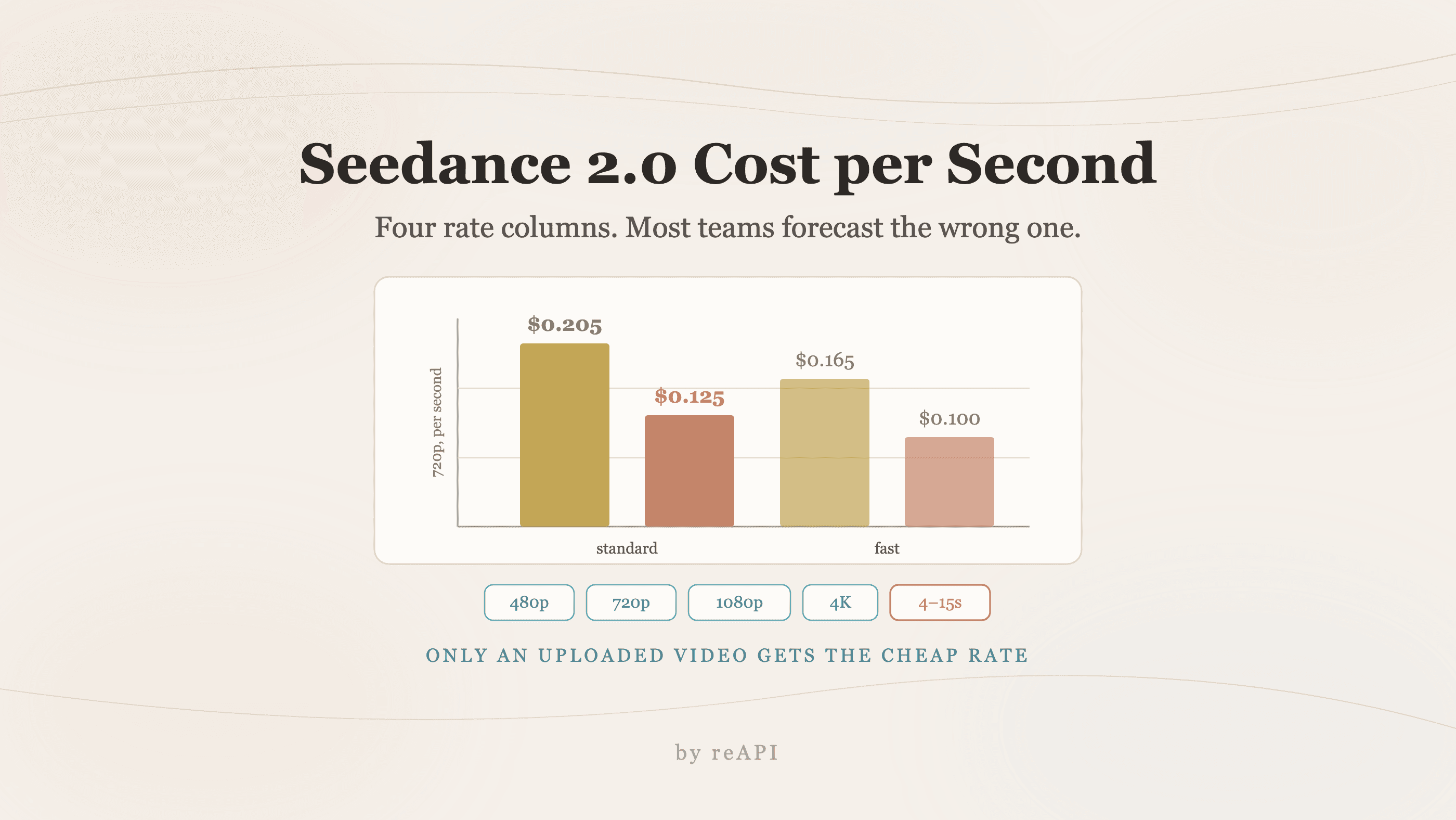
Seedance 2.0 Cost Per Second: The Real Billing Model
The Seedance 2.0 cost per second, by resolution and tier, plus the cheaper rate that only an uploaded video unlocks and the forecasting mistake it causes.
Atlas Cloud vs Higgsfield: API Platform or Creator Studio?
Atlas Cloud vs Higgsfield vs reAPI for Seedance: compare API access, creator workflows, pricing, model breadth, and which platform fits your team.

Best-Value Seedance 2.0 API in 2026: Prices Compared
A matched Seedance 2.0 API price comparison across reAPI, Atlas, Replicate, fal, and WaveSpeed, including billing rules and best-value picks.