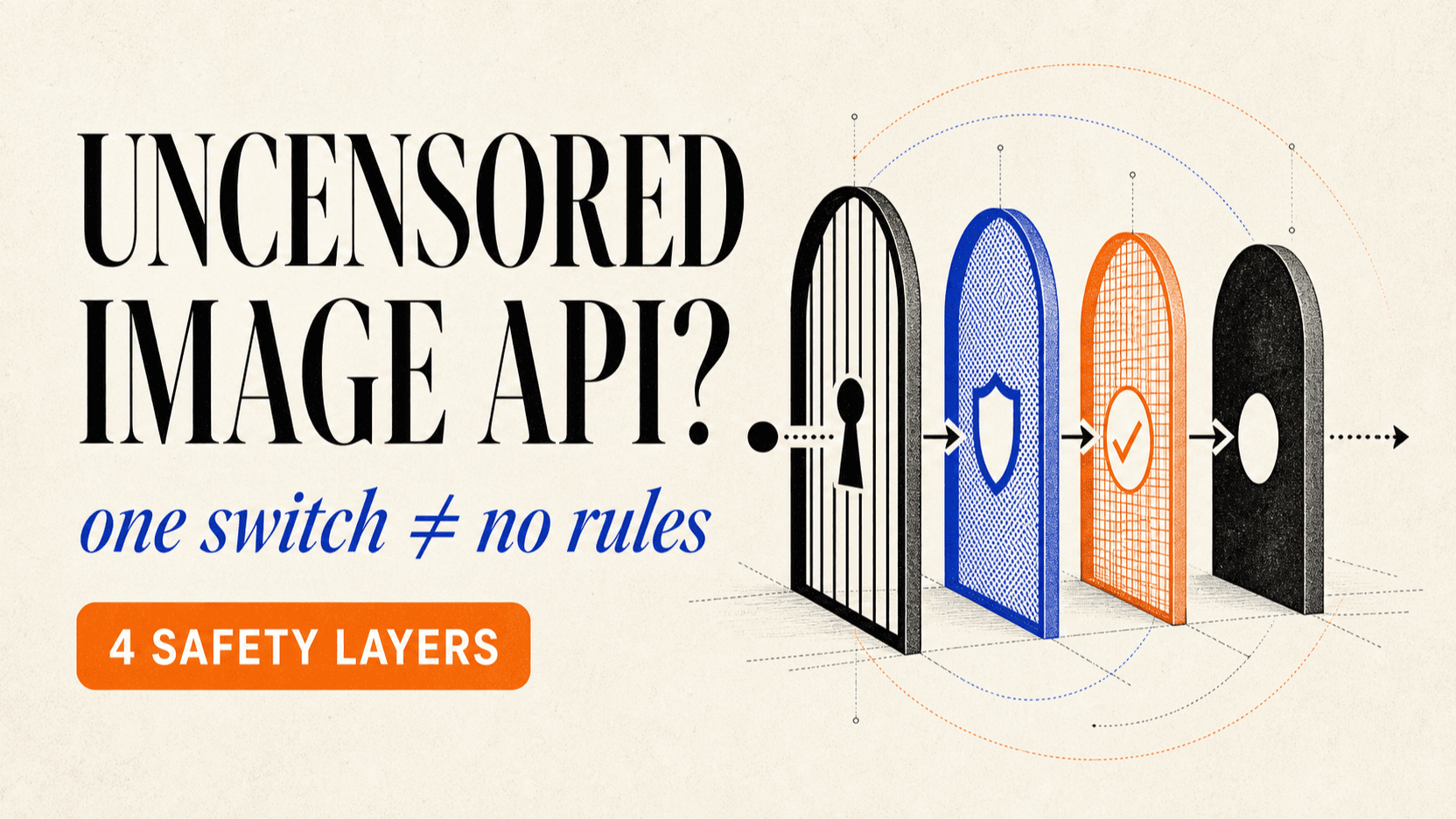
Uncensored AI Image API? How Content Filters Work (2026)
Looking for an uncensored AI image API? Learn how NSFW checkers, provider moderation, model alignment, billing, and configurable safety layers actually work.
An uncensored AI image API is usually a misleading promise. Some gateways
let developers disable an additional nsfw_checker, but that switch does not
erase provider policies, model alignment, upstream request inspection, legal
restrictions, or application-level obligations. It changes one layer in a
larger moderation system.
The more useful question is: which safety layer blocked the request, and which controls are actually configurable? That framing helps teams handle benign false positives—medical illustration, fine art, swimwear, health education— without pretending prohibited content has become acceptable.
TL;DR
- No production image API should be treated as unconditionally uncensored.
nsfw_checker: falsecan disable an additional reAPI output check on selected routes. It does not disable upstream moderation.- Qwen Image 2 and Seedream 5.0 Pro currently expose this direct-API control; their public playgrounds keep it enabled.
- GPT Image 2 and Seedream 5.0 Lite do not expose the same reAPI field.
- Diagnose rejections by stage: before task creation, during provider generation, or after an output is returned.
- “Less restrictive” still requires consent, age controls, abuse prevention, and compliance with the provider's acceptable-use rules.
Why “uncensored AI image API” is the wrong technical model
Image safety is a pipeline, not one Boolean value. A request can pass one classifier and fail at the next stage. Even when a model has comparatively light alignment, the host, gateway, storage provider, or application may apply separate controls.
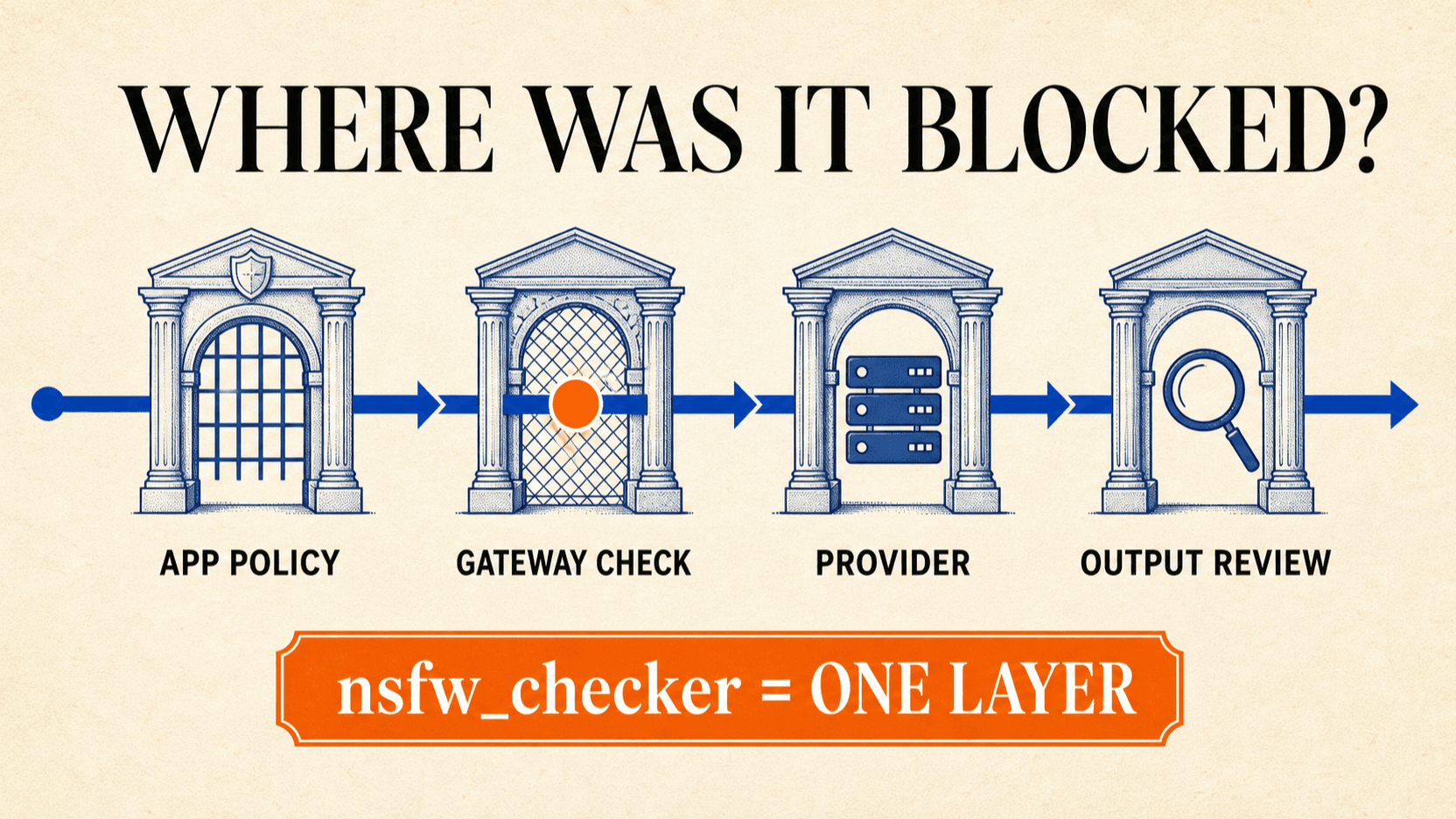
A typical production request moves through four layers:
- Application policy. Your own product validates users, prompts, source images, permissions, and intended use.
- Gateway moderation. An API gateway may run an independent prompt or output classifier.
- Provider and model controls. The upstream service can reject inputs, refuse generation, or filter results under its own policies.
- Output review and distribution. The application decides whether a generated asset can be stored, shown, shared, or published.
OpenAI, for example, documents separate moderation models for classifying text and image inputs, while its platform data controls still require customers to follow usage policies even when approved for modified abuse monitoring or zero data retention.[1][2] Retention settings, moderation behavior, and generation policy are related but not interchangeable controls.
What nsfw_checker actually controls on reAPI
On supported reAPI routes, nsfw_checker controls an additional independent
output-classification layer. With the value set to true, the finished image is
checked before it is returned. With false, that additional reAPI check is
skipped.
It does not:
- remove the upstream provider's prompt rules;
- retrain or “unalign” the model;
- guarantee that a job will be accepted;
- allow illegal, exploitative, non-consensual, or rights-violating content;
- make the API anonymous or exempt it from logging and abuse controls.
This field can matter for permitted content that generic classifiers sometimes misread. A medical anatomy diagram, a breastfeeding education graphic, or a museum-style figure study may be legal and non-exploitative yet still trigger a broad nudity classifier. In that situation, a configurable final checker can reduce false positives, but the application should replace it with a more specific review policy rather than removing review entirely.
Current image API filter controls compared
| reAPI route | nsfw_checker field | Playground behavior | What remains upstream |
|---|---|---|---|
| Qwen Image 2 | Direct callers may set false | Locked on | Alibaba/Qwen policy and model controls |
| Seedream 5.0 Pro | Direct callers may set false | Locked on | ByteDance/provider policy and model controls |
| Seedream 5.0 Lite | Not exposed | No separate toggle | Provider and model controls |
| GPT Image 2 | Not exposed | No separate toggle | OpenAI policy and safety systems |
This table describes reAPI's current public request fields as of August 1, 2026. It is not a ranking of which model accepts the most sensitive material. Acceptance changes by category, provider revision, source image, jurisdiction, and account status.
For Qwen Image 2, the direct API control is documented in the Qwen Image 2 API guide. Seedream's route and billing behavior are covered in Is Seedream 5 Pro Uncensored?.
A safe request with the additional checker disabled
Direct callers can set the field on a supported route. The prompt below uses a permitted educational context and explicitly excludes sexualization.
curl https://reapi.ai/api/v1/images/generations \
  -H "Authorization: Bearer $REAPI_API_KEY" \
  -H "Content-Type: application/json" \
  -d '{
    "model": "qwen-image-2",
    "prompt": "Non-sexual adult anatomy illustration for a physical therapy textbook. Neutral standing pose, simplified muscle groups, clinical labels, no erotic framing, no minors, no graphic injury.",
    "image_size": "3:4",
    "output_format": "png",
    "nsfw_checker": false
  }'
Disabling the extra output check should be an application policy decision, not a user-controlled passthrough. Restrict the option to reviewed use cases, record why the workflow needs it, and apply a domain-appropriate classifier or human review before distribution.
How to diagnose image API safety rejections
Rejected before a task ID exists
The request likely failed in application validation, gateway prompt moderation, authentication, or upstream input inspection. Capture the HTTP status, provider error code, model ID, and which configurable checks were enabled.
Do not automatically mutate and resubmit the prompt. First determine whether the request is malformed, benign but ambiguous, or outside policy.
Task created but generation failed
The provider or model may have rejected the prompt or source image after deeper inspection. Some systems also fail when a reference image cannot be downloaded, is the wrong format, or violates a size limit. Keep safety errors separate from technical media errors in your telemetry.
Generation completed but the output is hidden
This pattern points to an output-classification layer. On routes with a separate
nsfw_checker, the output can be generated and billed even when the final image
is withheld. A retry can therefore repeat the charge without changing the
underlying problem.
Output returned but your application blocks it
That is your product policy working as designed. Model output is untrusted user content until it passes your publication and rights checks. A provider accepting an image does not mean your marketplace, ad network, school, or app store must accept it.
Billing when an image is filtered
Filtering does not always cancel inference cost. If a provider generates an image and a later classifier hides it, the expensive model work has already occurred. The route may therefore charge the request even though no usable image is returned.
Production cost reports should separate:
- rejected before inference;
- failed during inference;
- generated but filtered;
- returned but rejected by application policy;
- accepted and published.
That funnel shows whether the problem is prompt design, a generic checker, upstream policy, or your own acceptance criteria. A single “failed” counter cannot support a useful moderation or budget decision.
How to choose a less restrictive image API responsibly
Look for control and documentation, not the word uncensored.
Prefer explicit request fields
A documented field such as nsfw_checker is easier to govern than a provider
that vaguely promises “no filters.” You can test it, restrict it by account,
record configuration, and detect schema changes.
Require a clear acceptable-use policy
The provider should define prohibited categories, appeals, data handling, and enforcement. Missing rules are operational risk, not creative freedom.
Test a benign boundary set
Build a small evaluation set covering permitted medical, art, fashion, and health scenarios that are relevant to your product. Record acceptance, false-positive stage, latency, and billing. Do not include illegal or exploitative material in this test set.
Keep identity and consent checks separate
A general nudity classifier does not solve non-consensual intimate imagery, face misuse, impersonation, copyright, or model-release consent. These need their own rules and sometimes human review.
Preserve provider traceability
Store the model ID, provider route, policy version, prompt hash, source-asset provenance, safety configuration, and decision result. Minimize retained personal data, but keep enough structured evidence to investigate abuse and appeals.
Claims that should make buyers cautious
Treat the following marketing phrases as warning signs:
- “100% uncensored” without an acceptable-use policy;
- “no logs” without retention documentation or contractual terms;
- “all content allowed” without jurisdiction or age restrictions;
- “filter off” without explaining whether it affects the gateway, provider, or model;
- “private by default” without describing storage and abuse monitoring.
The same caution applies to unauthorized account automation. A third-party wrapper can appear permissive because it hides whose account or endpoint it is using. That is not a stable API contract. The article on Midjourney API availability explains why authorization matters even when a JSON endpoint appears to work.
Building an application-level moderation policy
A practical image application needs more than one universal threshold:
- Define prohibited content that is never accepted.
- Define restricted content allowed only in specific contexts or age groups.
- Detect source-image identity, consent, and rights risks separately.
- Review prompts and outputs, because either side can carry policy risk.
- Give users a reason code and an appeal path for permitted edge cases.
- Rate-limit repeated rejected requests and investigate adversarial patterns.
- Re-test whenever the model, provider, or classifier version changes.
OpenAI's moderation endpoint can classify both text and image inputs, but its categories and thresholds are only one possible policy component.[1] Your final rules must match the product's audience, geography, distribution channel, and risk tolerance.
For video, the same layered principle applies. Read Seedance 2.0 safety filters and API control instead of assuming an image-model toggle transfers to video routes.
FAQ
Is there a truly uncensored AI image API?
Not in the unconditional sense implied by the phrase. Hosted APIs operate under provider policies, law, infrastructure controls, and application rules even when one optional checker can be disabled.
What happens when nsfw_checker is false?
On supported reAPI routes, it skips an additional output checker. It does not remove upstream provider moderation or model alignment.
Which reAPI image models expose nsfw_checker?
Qwen Image 2 and Seedream 5.0 Pro currently expose it to direct API callers. Their public playgrounds keep the checker enabled.
Can a filtered image still be billed?
Yes. If generation finishes before a final output checker blocks the result, the inference cost has already been incurred.
How should medical or fine-art applications handle false positives?
Use reviewed prompts, adult-only and non-sexual context where relevant, a domain-specific moderation policy, reason codes, and human appeals. Do not rely on disabling every safety layer.
Conclusion
The best answer to “uncensored AI image API” is not a provider leaderboard. It is a map of the moderation pipeline. Choose routes with explicit controls, document which layer each control affects, keep upstream policy assumptions visible, and replace broad false-positive filters with a more precise safety system—not with no safety system at all.
References
- OpenAI. Moderations API reference for text and image inputs. platform.openai.com/docs/api-reference/moderations
- OpenAI. Data controls, abuse monitoring, and customer responsibilities. platform.openai.com/docs/models/default-usage-policies-by-endpoint
- Alibaba Cloud Model Studio. Image generation and editing model documentation. alibabacloud.com/help/en/model-studio/image-model
Author

Categories
nsfw_checker actually controls on reAPICurrent image API filter controls comparedA safe request with the additional checker disabledHow to diagnose image API safety rejectionsRejected before a task ID existsTask created but generation failedGeneration completed but the output is hiddenOutput returned but your application blocks itBilling when an image is filteredHow to choose a less restrictive image API responsiblyPrefer explicit request fieldsRequire a clear acceptable-use policyTest a benign boundary setKeep identity and consent checks separatePreserve provider traceabilityClaims that should make buyers cautiousBuilding an application-level moderation policyFAQIs there a truly uncensored AI image API?What happens when nsfw_checker is false?Which reAPI image models expose nsfw_checker?Can a filtered image still be billed?How should medical or fine-art applications handle false positives?ConclusionReferencesMore Posts

Best CometAPI Alternatives in 2026: 5 Options Compared
Looking for CometAPI alternatives in 2026? Compare OpenRouter, WaveSpeed, Together AI, Replicate, and reAPI on models, pricing, speed, and API design.

Grok Imagine Video 1.5 API: Pricing, 1080p, and Limits (2026)
Use the Grok Imagine Video 1.5 API for image-to-video with native audio. Compare 480p, 720p, and 1080p pricing, limits, reAPI routes, and code.
Use ChatGPT Without Sounding Like AI: A Human-First Workflow
Use ChatGPT without generic AI prose. Turn a real thesis, evidence, constrained drafting, and careful human editing into publishable writing.