Seedream 5.0 Pro Price: The Pixel Line That Decides It
The Seedream 5.0 Pro price splits at 2.36 million pixels, not at a tier label. What each tier costs, and how to size a 16:9 export to stay in the cheap one.
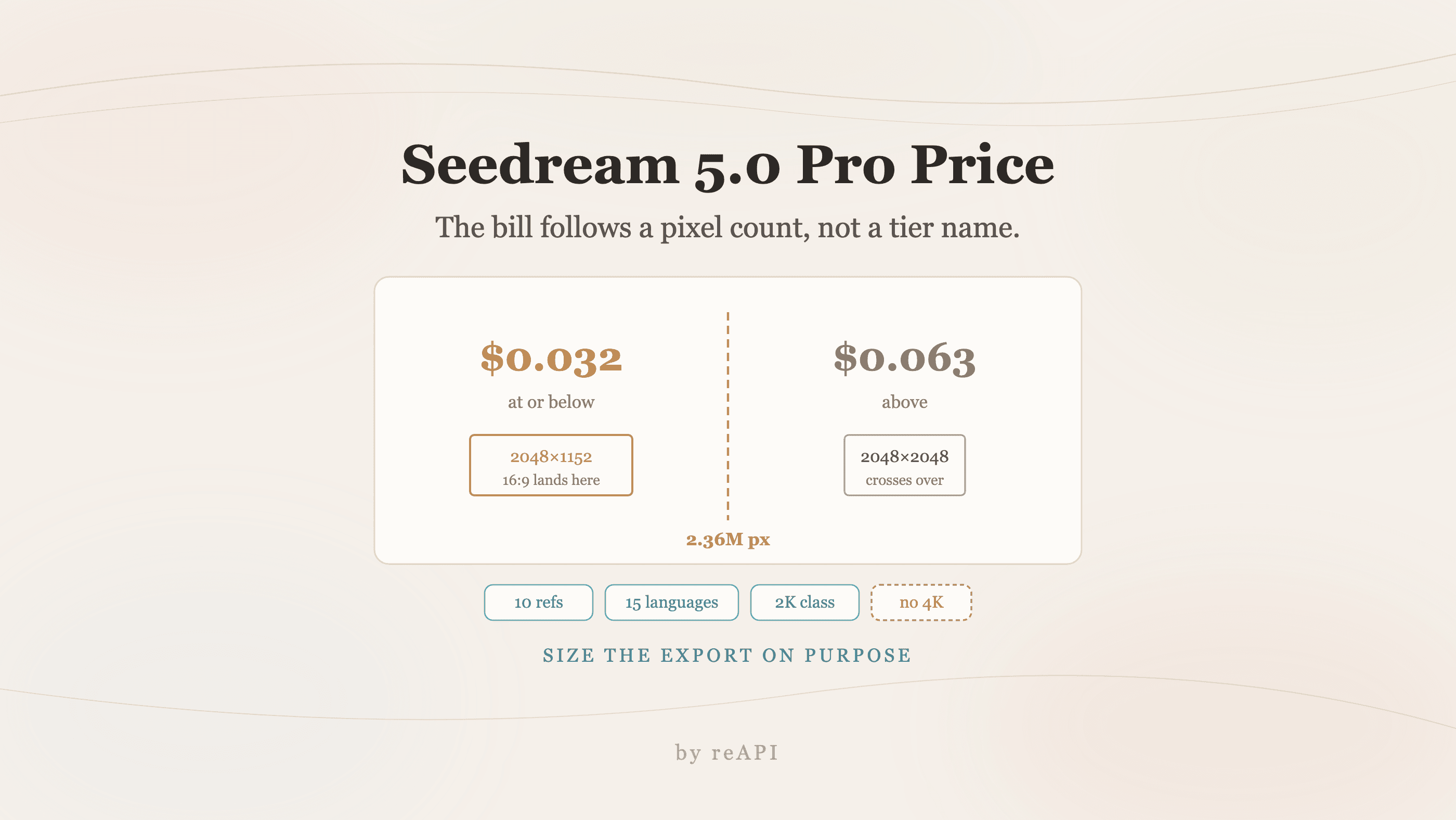
The Seedream 5.0 Pro price has two tiers, and the thing that decides which one you land in is not the tier name. It is a pixel count: 2.36 million[1].
That detail is worth more than the headline rate, because it means a large 16:9 frame at 2048×1152 stays in the cheaper tier while a smaller-sounding 2048×2048 square does not. Sizing exports against that boundary on purpose is the difference between paying the low rate and the high one for output that looks the same on a page.
On reAPI the two tiers are $0.032 and $0.063 per image, against ByteDance's published $0.045 and $0.09.
TL;DR
- Billing is per image, split at 2.36M pixels, not by a resolution label[1].
- reAPI rates: $0.032 at 1K, $0.063 at 2K. Roughly 29% below the published rate.
- A 16:9 frame at 2048×1152 bills at the cheap tier, because it is under the pixel line.
- Up to 10 reference images, with in-image text across 15 languages[1].
- No 4K at launch. If 4K is a hard requirement, this is the wrong tier[1].
- reAPI carries an output-check-disabled variant at $0.034 and $0.067, API only.
The pixel boundary, not the label
![]()
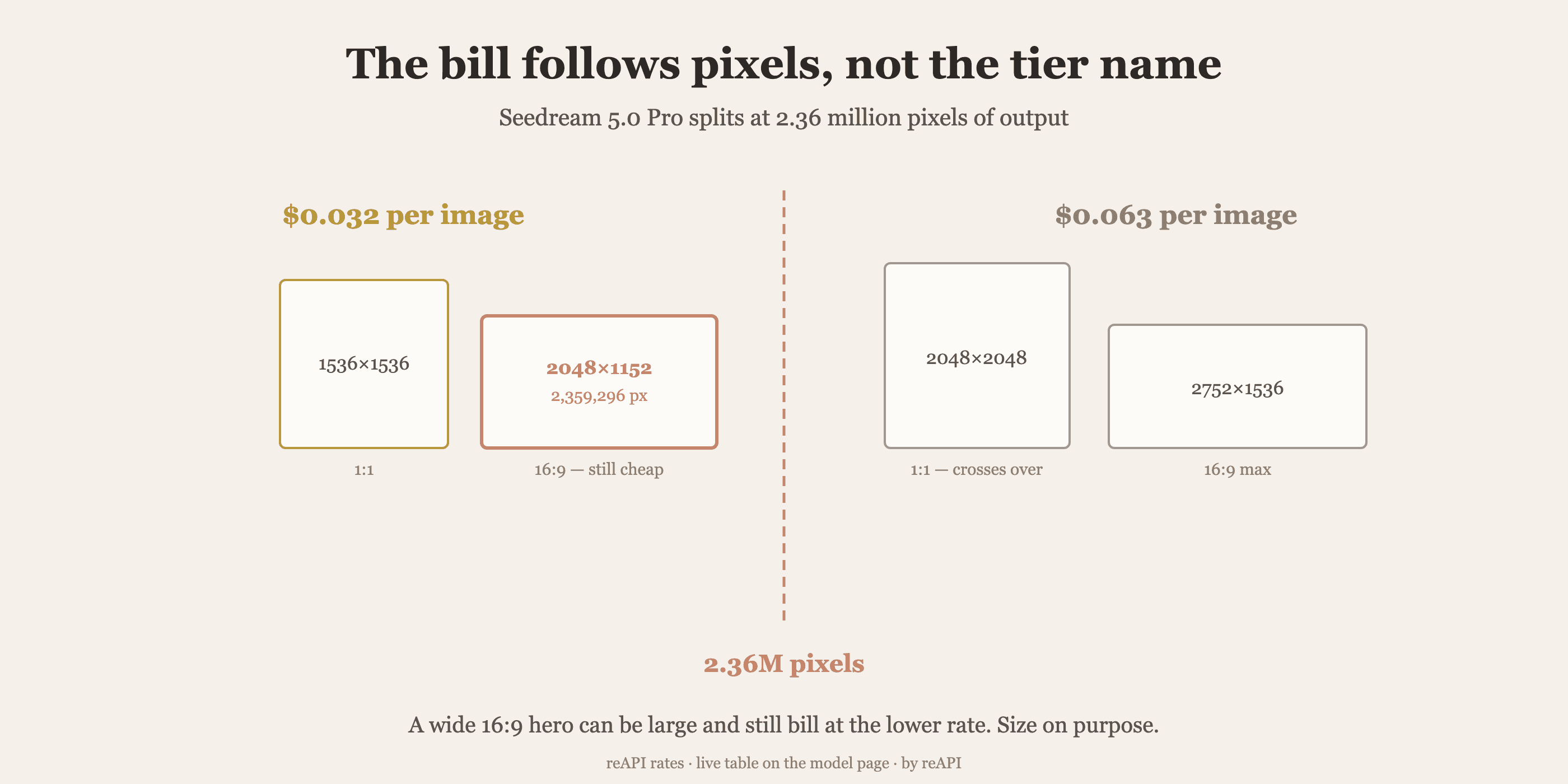
The tiers are labeled 1K and 2K, and those labels are shorthand for a pixel budget rather than a literal dimension. The largest square in each is 1536×1536 and 2048×2048, and the bill follows the 2.36M-pixel line[1].
| Tier | 1:1 | 4:3 | 16:9 |
|---|---|---|---|
| Cheap tier, ≤ 2.36M px | 1536×1536 | 1776×1328 | 2048×1152 |
| High tier, > 2.36M px | 2048×2048 | 2360×1770 | up to 2752×1536 |
Read the 16:9 row twice. At 2048×1152 you get a wide, genuinely large frame for the cheaper rate, because 2,359,296 pixels sits just under the line. Push the same aspect ratio to its maximum and the long edge reaches about 2752, which is roughly 2.7K, at the higher rate.
The practical consequence: for web heroes, thumbnails, social crops, and slide covers, specifying 2048×1152 rather than "2K" keeps a large asset in the cheap tier. That is a sizing decision, not a quality compromise.
What it costs on reAPI
| Variant | Per image |
|---|---|
| 1K image (≤ 2.36M px) | $0.032 |
| 2K image (> 2.36M px) | $0.063 |
| 1K, output check disabled, API only | $0.034 |
| 2K, output check disabled, API only | $0.067 |
The published rate for the same model is $0.045 and $0.09[1], so the gateway rate lands roughly 29% lower on both tiers.
The second pair is a variant with the output check disabled, available through the API only, at about a 6% premium. It exists for pipelines where an automated content check on the returned image is not wanted in the loop. If that is not your situation, the standard rows are the ones to use.
Where it sits against the other image models on reAPI
Comparing against the models on the same gateway is more useful than a cross-vendor table, because these are the choices you can actually route between with one key.
| Model | Per image at 1K |
|---|---|
| Nano Banana 2 Lite | $0.022 |
| Seedream 5.0 Pro | $0.032 |
| Nano Banana Pro | $0.053 |
Seedream 5.0 Pro sits in the middle: about 45% more than Lite, and about 40% less than Nano Banana Pro. That position is the interesting part. It is priced near the draft tier while being a full-quality model rather than a speed-optimized one.
The routing implication is that Seedream 5.0 Pro can be a default rather than an escalation. Where the Lite-to-Pro pattern is draft-cheap-then-render-expensive, a Seedream-centered pipeline can generate at near-draft cost and skip the second render for anything that does not need 4K or Nano Banana Pro's reasoning rating.
What the price does not buy
Two limits worth knowing before you standardize on it[1].
No 4K at launch. The model is positioned as 2K-class by long edge. If print-adjacent or large-crop output is a requirement today, this tier does not cover it.
Reference images are capped at 10. Generous for most work, but below what a heavy multi-character consistency pipeline might want.
What it does cover: in-image text rendering across 15 native languages, which matters for localized creative, and up to 10 references for character and product consistency.
Calling it
curl https://reapi.ai/api/v1/images/generations \
-H "Authorization: Bearer YOUR_API_KEY" \
-H "Content-Type: application/json" \
-d '{
"model": "seedream-5-0-pro",
"prompt": "editorial hero for a coffee brand, warm morning light, hand-lettered headline",
"size": "2048x1152"
}'Specifying 2048x1152 rather than a 2K preset is the sizing decision described above: a wide hero frame that bills at the cheaper tier.
Two platform rules. Media inputs are public http(s) URLs only, no base64 on any model. And rates move, so the live table on reapi.ai/models/seedream-5-0-pro is canonical rather than any number quoted here. Request shapes are in the reapi.ai/docs/seedream-5-0-pro reference.
FAQ
How much does Seedream 5.0 Pro cost per image?
On reAPI, $0.032 for output at or below 2.36M pixels and $0.063 above it. The published rate for the same model is $0.045 and $0.09[1].
What decides which tier I am billed at?
Output pixel count, not the tier name. The line is 2.36 million pixels[1].
Can I get a large 16:9 image at the cheap rate?
Yes. 2048×1152 is 2,359,296 pixels, just under the boundary, so it bills at the lower tier.
Does Seedream 5.0 Pro support 4K?
Not at launch. It is positioned as 2K-class by long edge[1].
How many reference images can it take?
Up to 10, with in-image text supported across 15 native languages[1].
What is the output-check-disabled variant?
A variant available through the API only, at $0.034 and $0.067, for pipelines that do not want an automated check on the returned image in the loop. It carries about a 6% premium.
How does the price compare to the other image models on reAPI?
It sits between Nano Banana 2 Lite at $0.022 and Nano Banana Pro at $0.053, at $0.032 for 1K.
Where is the authoritative price?
The Seedream 5.0 Pro model page. Rates change, so treat article figures as planning numbers.
Sizing against the boundary
The useful thing about the Seedream 5.0 Pro price is not that it is low, though at $0.032 on reAPI it is. It is that the billing rule is a pixel count you can design around rather than a tier you are assigned to.
Decide the output dimensions deliberately. If the asset is a web hero, a social crop, or a slide cover, 2048×1152 gives you a large wide frame in the cheap tier. Reserve the higher tier for the frames that genuinely need the pixels, and check the live rate rather than the one you remember, because the Seedream 5.0 Pro price is a moving number in a table, not a constant.
References
- BytePlus. ModelArk — Seedream 5.0 Pro pricing, resolution tiers, and reference-image limits. Retrieved July 2026 from byteplus.com/en/modelark
- reAPI. Seedream 5.0 Pro model page — live per-image rates. Retrieved July 2026 from reapi.ai/models/seedream-5-0-pro
Further reading
- reAPI. Nano Banana Pro vs Nano Banana 2. reapi.ai/blog/nano-banana-pro-vs-nano-banana-2
- reAPI. How to use Nano Banana 2 Lite. reapi.ai/blog/how-to-use-nano-banana-2-lite
- reAPI. Model catalog. reapi.ai/models
作者

分类
更多文章

Best Replicate Alternatives in 2026: 5 Options Compared
Looking for Replicate alternatives in 2026? Compare fal.ai, Together AI, RunPod, Hugging Face, and reAPI on model range, pricing, speed, and API design.


Gemini Omni vs Seedance 2.0: The 2026 Video Model Split
Gemini Omni vs Seedance 2.0 in May 2026: Google's I/O launch meets ByteDance's Arena leaderboard #1. Capabilities, multi-shot, audio, prices side by side.


Best fal.ai Alternatives in 2026: 5 Options Compared
Looking for fal.ai alternatives in 2026? We compare Replicate, Together AI, RunPod, Hugging Face, and reAPI on model range, pricing, speed, and API design.