
État de Seedance 2.5 : accès API, tarifs et limites
Seedance 2.5 est disponible : identifiant du modèle, tarifs 480p/720p, vidéos de 30 secondes, références étendues et aucune route 4K.
Seedance 2.5 existe bel et bien, il est officiel et désormais appelable. ByteDance a présenté le modèle de production le 31 juillet 2026, et reAPI l'expose sous l'identifiant doubao-seedance-2.5-face en 480p, 720p et 1080p[12][13][14]. L'ancienne présentation de Volcano Engine annonçait déjà correctement les vidéos de 30 secondes, les références multimodales étendues et le contrôle des prompts par segment[1].
En juin, j'avais suivi la rumeur Seedance 2.1 et son démenti publié le jour même. Ce démenti était exact : Seedance 2.1 n'existe pas. Le véritable successeur a simplement sauté un numéro de version. Cet article distingue désormais le contrat API Seedance 2.5 en production des anciens articles et des arnaques. Le fameux « 4K natif » ne résiste toujours pas au contrôle : la route de production accepte le 480p, le 720p et, depuis août 2026, le 1080p[14].
TL;DR
- Officiel et appelable. ByteDance a publié le lancement le 31 juillet, et reAPI sert maintenant
doubao-seedance-2.5-face[12][13]. - Ce que confirment les documents de lancement et le contrat de production : une vidéo cohérente de 30 secondes en une génération, jusqu'à 30 images, 10 vidéos et 10 extraits audio comme références, le contrôle des prompts par segment et les flux d'édition ou d'extension[12][14].
- Ce qui n'est pas confirmé pour la route de production : la 4K native en 10-bit et une amélioration de 20 % du respect des prompts[4][5]. Seedance 2.0 propose déjà officiellement la 4K[6], tandis que Seedance 2.5 plafonne désormais au 1080p (ajouté en août 2026).
- L'instantané du 3 juillet ne contenait pas encore d'entrée 2.5. Cette absence datée ne décrit pas l'état actuel des classements[7][8].
- reAPI publie ses tarifs. Sans vidéo source, ils sont de $0.118589/s en 480p et $0.266824/s en 720p ; avec vidéo source, de $0.071153/s et $0.160094/s[13].
- Seedance 2.0 Mini est également disponible, à partir de $0.038/s sans vidéo source ou $0.024/s avec une vidéo source en 480p[9].
Ce que ByteDance a effectivement mis par écrit
La promotion initiale de Volcano Engine présentait « Doubao Seedance 2.5 » autour de quatre axes : génération narrative de 30 secondes en un passage, références étendues à toutes les modalités, contrôle par prompts segmentés et édition plus poussée avec rendu de texte multilingue[1]. Le contrat de production apporte depuis ce qui manquait : identifiant du modèle, sortie 480p/720p/1080p, limites de références et règles de facturation[13][14].
La date de sortie n'est plus une prévision. L'équipe Seed de ByteDance a publié la présentation le 31 juillet 2026[12]. Les anciennes cartes « sortie en juillet » servent de contexte historique, pas de signal de disponibilité actuel.
Au 3 juillet, Seedance 2.5 ne figurait pas encore dans le blog Seed, les listes de modèles ou les documents tarifaires. Cet instantané est désormais dépassé par la publication de ByteDance du 31 juillet et les pages de modèle et de documentation en production de reAPI[12][13][14].
Le problème de l'affirmation 4K
Les articles consacrés à l'annonce de FORCE ont ajouté des chiffres absents de la page de présentation : sortie 4K native avec profondeur de couleur 10-bit, jusqu'à 50 références en entrée et amélioration d'environ 20 % du respect des prompts[4][5]. Le contrat reAPI en production confirme depuis la limite de 50 références — 30 images, 10 vidéos et 10 extraits audio —, mais pas la 4K[14].
Le problème est simple : Seedance 2.0 génère déjà officiellement en 4K. La documentation de production de Volcano Engine pour le modèle actuel indique des sorties allant de 480p à 4K, cette dernière étant fournie en 10-bit H.265[6]. De même, « l'audio généré conjointement avec la vidéo » décrit déjà Seedance 2.0 chez ByteDance ; ce n'est pas une nouveauté de la version 2.5. Soit la presse a résumé trop vite une présentation, soit les intervenants de ByteDance ont inclus des fonctions du modèle actuel dans la partie consacrée au nouveau. Ces deux scénarios sont courants.
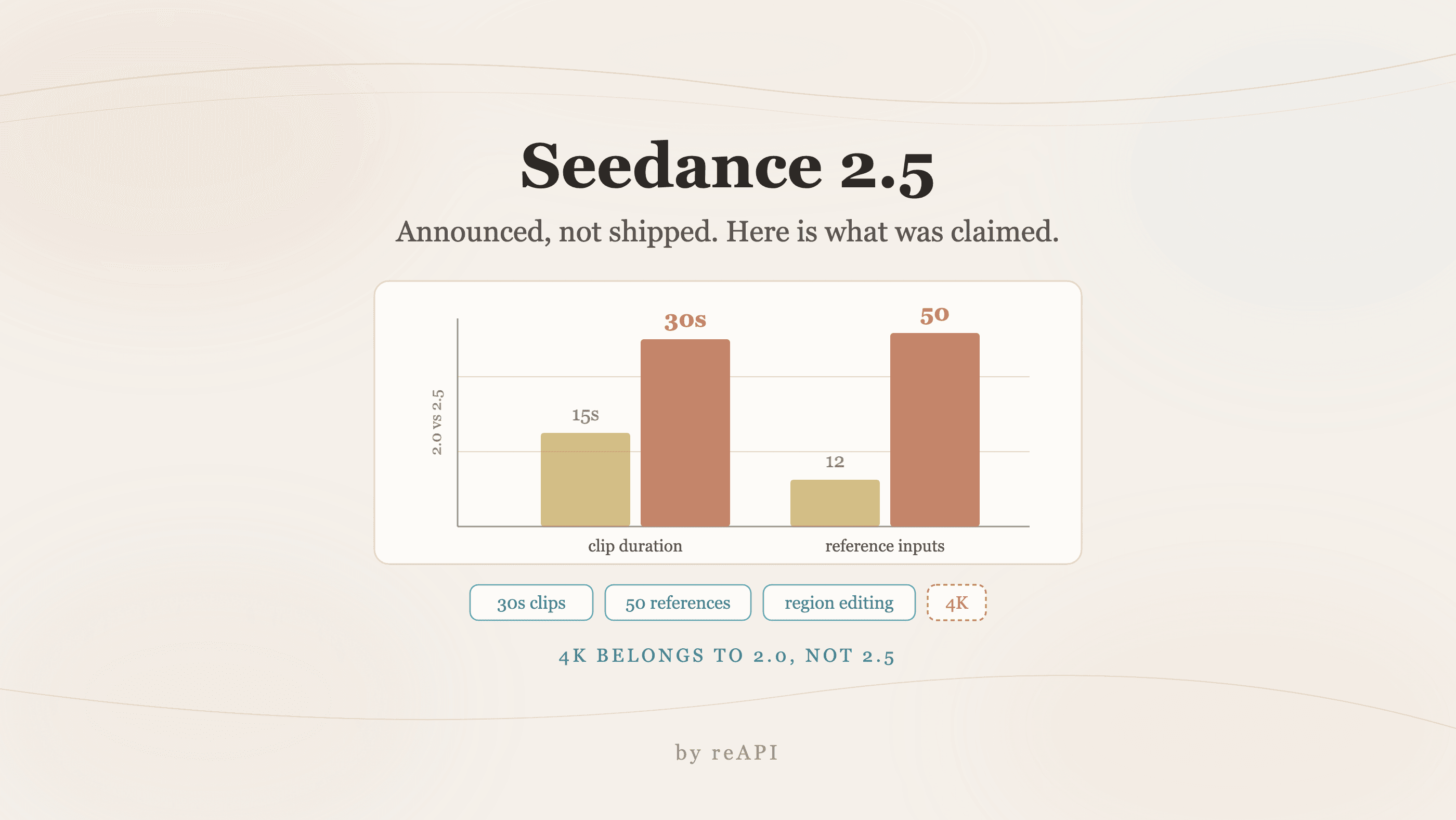
Le matériel de lancement et la route de production confirment désormais la génération de 30 secondes en un passage, la limite de 50 références, le contrôle des prompts par segment et les flux d'édition ou d'extension[12][14]. Seedance 2.0 est limité à 15 secondes et à 9 images, 3 vidéos et 3 extraits audio[6]. L'affirmation 4K/10-bit ne s'applique pas à la route 2.5, qui accepte le 480p, le 720p et, depuis août 2026, le 1080p.
Cinquante références documentées vont au-delà d'une simple orientation de style : une requête peut réunir fiches de personnages, vues de produit, clips de mouvement et indications audio. La limite pratique peut être inférieure pour un prompt donné ; commencez donc par le plus petit jeu de références qui définit la scène.
Ce que montrait l'instantané d'avant-lancement
Lors de la vérification initiale du 3 juillet, aucun des classements cités ne comportait d'entrée Seedance 2.5[7][8]. Ce résultat daté n'établit pas le statut actuel ; l'API en production permet désormais à des tiers d'effectuer des tests reproductibles.
Les classements montrent en revanche le niveau que son successeur devra dépasser, car Seedance 2.0 les domine toujours :
- Artificial Analysis, texte vers vidéo : Dreamina Seedance 2.0 (720p) occupe la première place avec un Elo de 1,222. Son avance de 71 points sur le deuxième est la plus importante du classement[7].
- Artificial Analysis, image vers vidéo : première place avec un Elo de 1,195. Sora 2 ne figure même pas dans ce classement[7].
- LMArena, image vers vidéo : première place avec 1,474 points sur près de 82,000 votes ; Veo 3.1 (audio, 1080p) obtient 1,391 points[8].
- LMArena, texte vers vidéo : deuxième place avec 1,466 points, derrière une version préliminaire de Gemini Omni Flash évaluée sur une fraction de ce nombre de votes[8].
Le successeur du modèle vidéo considéré comme numéro un mérite l'attention. Mais cela signifie aussi que Seedance 2.5 arrive avec les attentes créées par sa propre famille, et les participants aux tests à l'aveugle ne le jugeront pas sur la qualité de sa page promotionnelle.
Rumeurs crédibles et arnaques
Éléments plausibles mais non vérifiés, clairement identifiés comme tels :
- Des vidéos de 180 secondes dans la bêta entreprise. Cette information vient de la publication d'un bêta-testeur. Plausible, mais non confirmée.
- Un accès API autour du 10 juillet. Cette date sans source était fausse. ByteDance a publié la présentation le 31 juillet et l'accès reAPI est désormais disponible[12][13].
- Des estimations de prix à la seconde. L'ancienne fourchette de $0.022 à $0.50 est obsolète. Sur reAPI, le tarif sans vidéo source est de $0.118589/s en 480p ou $0.266824/s en 720p[13].
- Un déploiement d'abord en Chine. Cette information vient des comptes rendus de l'annonce[4] et concorde avec la sortie en juillet indiquée sur le portail documentaire[2]. Le calendrier mondial au-delà de cette étape relève de la spéculation. Le propre déploiement mondial de Seedance 2.0 avait été suspendu pendant un mois en raison de litiges liés aux droits d'auteur, avant de reprendre partout sauf aux États-Unis[10].
Viennent ensuite les arnaques. Quelques jours après l'annonce, des sites imitateurs proposant un « accès à Seedance 2.5 » sont apparus, et des publications communautaires ont repris des affirmations de test étrangement similaires. Puisqu'une API active existe désormais, la vérification utile ne consiste plus à demander si un point de terminaison existe : contrôlez l'identifiant exact du modèle, les paramètres documentés, les tarifs et les conditions de remboursement avant de payer un revendeur.
Ce que la rumeur de juin avait vu juste
Avant l'article initial, les questions portaient sur une « amélioration de 20 % de la qualité » de Seedance 2.1 et sur une déclinaison Mini plus légère. Seedance 2.0 Mini est disponible sur reAPI à $0.038/s en 480p et $0.082/s en 720p sans vidéo source, ou $0.024/s et $0.050/s avec une vidéo source[9]. La partie 2.1 s'est résolue autrement : le démenti était exact, et le véritable successeur est arrivé sous le nom Seedance 2.5.
Deux enseignements demeurent. Les informations issues de la plateforme sur la famille Seedance ont un taux de fiabilité correct. Et les démentis de ByteDance doivent être lus au sens strict : ils démentent une information, pas la feuille de route. Ces deux principes s'appliquent désormais aux rumeurs de juillet sur le calendrier de l'API Seedance 2.5.
Utiliser Seedance 2.5 aujourd'hui
La question pratique n'est pas de savoir si Seedance 2.5 est prometteur, mais sur quel modèle construire ce mois-ci. Ma réponse est volontairement pragmatique : utilisez la gamme déjà disponible et conservez une architecture facile à adapter.
La gamme Seedance 2.0 complète fonctionne sur reAPI, avec des tarifs allant de $0.024/s pour Mini en 480p avec vidéo source à $0.780/s pour Face en 4K sans vidéo source[9][11]. Elle reste l'option de plus haute résolution et la moins chère.
Seedance 2.5 sur reAPI est désormais appelable sous l'identifiant doubao-seedance-2.5-face. Utilisez-le pour les prises de 16 à 30 secondes, les ensembles de références plus grands et les flux d'édition ou d'extension ; conservez Seedance 2.0 pour le 1080p/4K et les niveaux moins chers[13][14].
FAQ
Seedance 2.5 est-il déjà disponible ?
Oui. ByteDance a publié le lancement le 31 juillet, et reAPI expose l'identifiant appelable doubao-seedance-2.5-face[12][13].
Quelles nouveautés de Seedance 2.5 par rapport à Seedance 2.0 sont officielles ?
Seedance 2.5 ajoute la génération de 30 secondes en un passage, jusqu'à 30 images, 10 vidéos et 10 extraits audio, le contrôle des prompts par segment et des flux d'édition ou d'extension[12][14]. La caractéristique 4K/10-bit appartient à Seedance 2.0 ; la route 2.5 en production s'arrête au 720p[6].
Quand l'API Seedance 2.5 sera-t-elle disponible ?
Elle est disponible maintenant sur reAPI. Utilisez doubao-seedance-2.5-face avec l'endpoint de génération vidéo et validez les requêtes selon le schéma actuel 480p/720p/1080p[13][14].
Combien coûtera Seedance 2.5 ?
Sur reAPI, Seedance 2.5 coûte $0.118589/s en 480p et $0.266824/s en 720p sans vidéo source. Avec vidéo source, les tarifs sont de $0.071153/s et $0.160094/s, avec des secondes facturables égales à max(sortie + ceil(durée totale des vidéos sources), ceil(5 / 3 × sortie))[13][14].
Seedance 2.5 peut-il vraiment générer des vidéos de 30 secondes ?
Oui. La route reAPI en production accepte jusqu'à 30 secondes[14]. La qualité sur toute la prise doit encore être testée avec des prompts et références représentatifs ; « 30 secondes en 4K » reste faux, car la route de production ne prend en charge que le 480p et le 720p.
À quoi servent les références supplémentaires ?
À maintenir la cohérence à l'échelle d'une production : personnages, lieux, accessoires, mouvements et références audio dans une génération. Seedance 2.0 accepte jusqu'à 9 images, 3 vidéos et 3 extraits audio[6]. Seedance 2.5 porte ces limites à 30, 10 et 10 sur reAPI[14].
seedance2.ai et les sites proposant un « accès anticipé à Seedance 2.5 » sont-ils officiels ?
Non. Ces domaines imitateurs n'appartiennent pas à ByteDance. Une API tierce peut être légitime, mais vérifiez son véritable identifiant de modèle et sa documentation ; l'identifiant de production de reAPI est doubao-seedance-2.5-face[14].
Seedance 2.5 sera-t-il disponible aux États-Unis ?
On l'ignore. Le déploiement mondial de Seedance 2.0 avait été suspendu en mars 2026 en raison de litiges liés aux droits d'auteur, puis avait repris partout sauf aux États-Unis[10]. Aucune annonce ne précise encore si Seedance 2.5 changera cette situation.
Évaluer la route disponible
Les inconnues d'avant-lancement sont désormais plus étroites. Seedance 2.5 possède un identifiant appelable, des tarifs précis en 480p/720p/1080p, des limites de références documentées et une formule de facturation ; la 4K native ne fait toujours pas partie de la route de production. Conservez des prompts transférables, testez Seedance 2.5 sur vos propres images et laissez le taux de sorties acceptables, plutôt qu'un ancien gros titre, décider s'il remplace Seedance 2.0 pour une charge donnée.
Références
- Volcano Engine (ByteDance). Doubao Seedance 2.5 — page promotionnelle officielle. Consulté en juillet 2026 sur ark.volcengine.com/promotion?modelName=seedance-2-5
- Volcano Engine (ByteDance). Portail de documentation — « Modèle de génération vidéo Doubao 2.5, sortie en juillet ». Consulté en juillet 2026 sur volcengine.com/docs/search?q=Seedance 2.5
- The Information. ByteDance dévoile le modèle vidéo Seedance 2.5. Consulté en juillet 2026 sur bytedance-unveils-seedance-2-5-video-model
- CNET. ByteDance présente le nouveau modèle vidéo Seedance 2.5. Consulté en juillet 2026 sur cnet.com/tech/services-and-software/bytedance-introduces-new-seedance-2-5-video-model
- The Next Web. Seedance 2.5 de ByteDance pousse la vidéo IA jusqu'à la 4K et 30 secondes. Consulté en juillet 2026 sur thenextweb.com/news/bytedance-seedance-2-5-ai-video-4k-30-seconds
- Volcano Engine (ByteDance). Doubao Seedance 2.0 — caractéristiques du modèle (résolutions, durées, limites de références). Consulté en juillet 2026 sur volcengine.com/docs/82379/1330310
- Artificial Analysis. Classements texte vers vidéo et image vers vidéo. Consulté en juillet 2026 sur artificialanalysis.ai/video/leaderboard/text-to-video
- LMArena. Classements texte vers vidéo et image vers vidéo. Consulté en juillet 2026 sur arena.ai/leaderboard/text-to-video
- reAPI. Seedance 2.0 Mini — page du modèle et tarifs en vigueur. Consulté le 17 août 2026 sur reapi.ai/models/seedance-2-0-mini
- Reuters. ByteDance suspend le lancement de son modèle d'IA vidéo après des litiges liés aux droits d'auteur. Consulté en juillet 2026 sur reuters.com/technology/bytedance-suspends-launch-video-ai-model
- reAPI. Seedance 2.0 — page du modèle et tarifs en vigueur. Consulté le 17 août 2026 sur reapi.ai/models/seedance-2-0
- ByteDance Seed. One-take Creation, Flexible Referencing: Introducing Seedance 2.5. Publié le 31 juillet 2026. seed.bytedance.com/en/blog/one-take-creation-flexible-referencing-introducing-seedance-2-5
- reAPI. Seedance 2.5 — tarifs de production en vigueur. Consulté le 17 août 2026 sur reapi.ai/models/seedance-2-5
- reAPI. doubao-seedance-2.5-face — identifiant du modèle, schéma de requête, résolutions, limites de références et facturation. Consulté le 17 août 2026 sur reapi.ai/docs/seedance-2-5
Pour aller plus loin
- The Verge. Netflix donne trois jours à ByteDance pour mettre fin au vol par l'IA Seedance. theverge.com/ai-artificial-intelligence/880542
- CNBC. Des sénateurs demandent à ByteDance de fermer Seedance. cnbc.com/2026/03/17/bytedance-seedance-shut-down
- reAPI. Seedance 2.1 et Seedance 2.0 Mini : ce qui arrive réellement. reapi.ai/blog/seedance-2-1-and-seedance-2-0-mini-preview
Auteur

Catégories
Plus d'articles
DeepSeek V4 1M : max_tokens, facturation et concurrence
DeepSeek V4 partage 1M tokens entre entrée et sortie (384K max). Découvrez max_tokens, la facturation du cache et les limites de concurrence.
Seedance 2.5 : 30 secondes et 50 références multimodales
Seedance 2.5 : clips de 30 secondes, 50 références multimodales, édition par région, et la distinction cruciale avec la 4K native de Seedance 2.0.

Générateur vidéo IA avec vraies personnes: Ce qui marche
Utiliser de vraies personnes en vidéo IA : références consenties, dialogue natif, limites d'entrée, contrôle du contenu et coût de génération.