Nano Banana 2 Lite 使用指南:速度、价格与限制
Nano Banana 2 Lite 的使用方法:四秒生成 1K 图像、官方基准测试、成本计算、分辨率上限及提示词编写技巧。
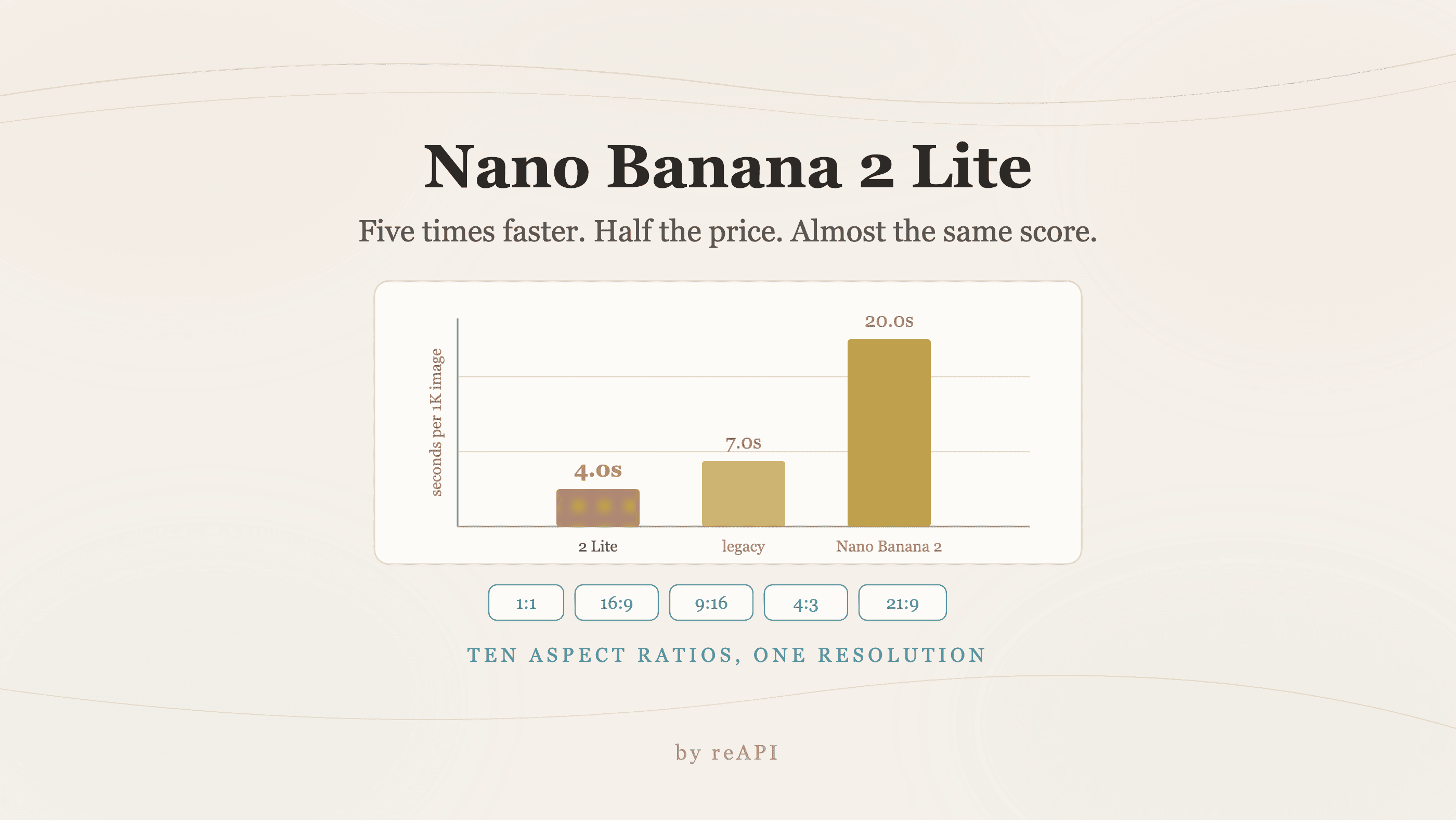
Google 在 2026 年 6 月 30 日推出了 Nano Banana 2 Lite,这是其 Nano Banana 图像生成系列中速度最快、成本最低的一档[1]。官方 API 名称为 Gemini 3.1 Flash-Lite Image,核心优势是速度:约四秒生成一张 1K 图像,成本约为完整版 Nano Banana 2 的一半。
掌握 Nano Banana 2 Lite 的用法,关键在于一个容易被忽视的数字。在图像生成上,它相比基础版 Nano Banana 2 下降约 19 个 Elo 分,即约 1.5% 的质量差距,但运行速度快五倍,成本仅为一半[1]。这个权衡对大多数应用都很有利,但对某些特定应用则不适合,本指南就是帮你区分这两种情况。
先说一个命名陷阱:文本专用的 gemini-3.1-flash-lite 是另一个不同的模型,不能生成图像。图像生成模型是单独的 -image 变体[1]。
快速总结
- 每张 1K 图像约需四秒,相比之下基础版 Nano Banana 2 需要 20 秒[1]。
- 按 Google 官方价格约 3.4 美分/张 1K 图像,批量模式下约 1.7 美分。在 reAPI 上是 $0.022/张,比 Google 官方价格低约 56%(2026 年 10 月 22 日检查)。
- 1K 是上限。 不支持 2K 或 4K,需要使用基础版 Nano Banana 2 或 Nano Banana Pro[1]。
- 生成质量接近主力版本(1251 vs 1270 Elo),但编辑功能不如(1308 vs 1387)[1]。
- 支持十种宽高比,包括 16:9、9:16 和 21:9[1]。
- Google 评定为"低推理能力",因此复杂的多约束场景应当选择更高档的模型[1]。
Nano Banana 的三个档位
Nano Banana 2 Lite 取代了第一代 Nano Banana(Google 现已标记为已停用),使得整个产品线形成了一个清晰的三层堆栈[1]。
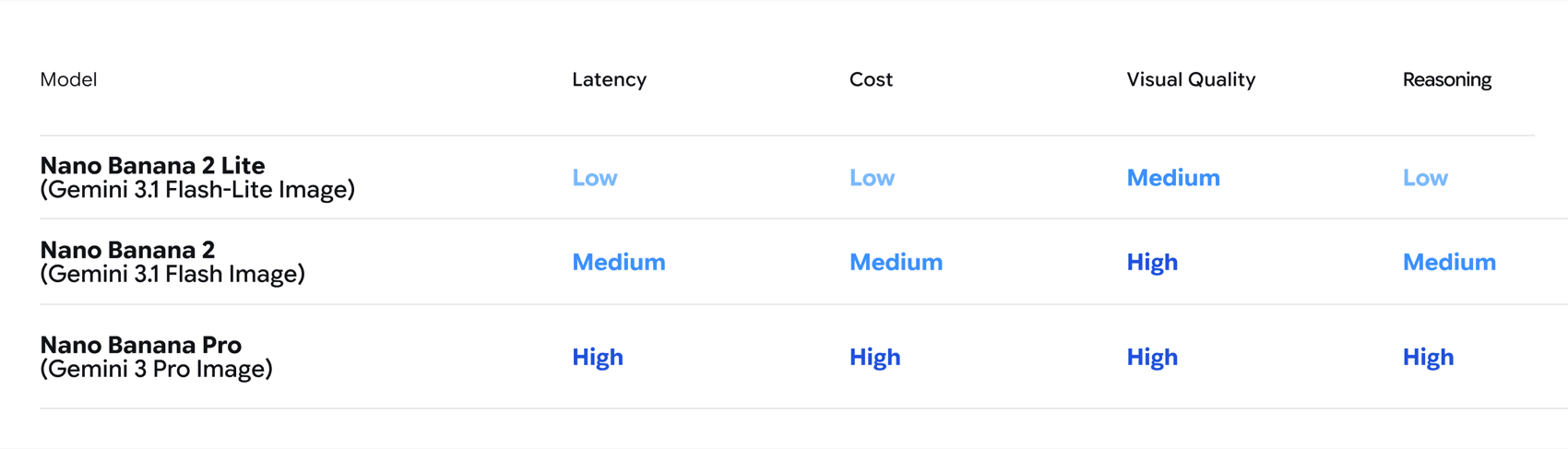
| 档位 | 底层模型 | 延迟 | 成本 | 视觉质量 | 推理能力 |
|---|---|---|---|---|---|
| Nano Banana 2 Lite | Gemini 3.1 Flash-Lite Image | 低 | 低 | 中 | 低 |
| Nano Banana 2 | Gemini 3.1 Flash Image | 中 | 中 | 高 | 中 |
| Nano Banana Pro | Gemini 3 Pro Image | 高 | 高 | 高 | 高 |
注意版本细节。Lite 和基础版 Nano Banana 2 都运行在 Gemini 3.1 Flash 上,而 Pro 运行在 Gemini 3 Pro Image 系列,这是一个面向推理密集型生成的不同且更强大的模型[1]。Lite 是中等质量、低推理能力的定位。你用较低的保真度和复杂指令处理能力换取了该系列最低的延迟和成本。
基准测试
Google 发布了一个四面板的对比图表,将 Lite 与基础版 Nano Banana 2、已停用的旧版本以及三个竞品进行比较。Elo 分数来自 LMArena,延迟数据来自 Artificial Analysis[1]。
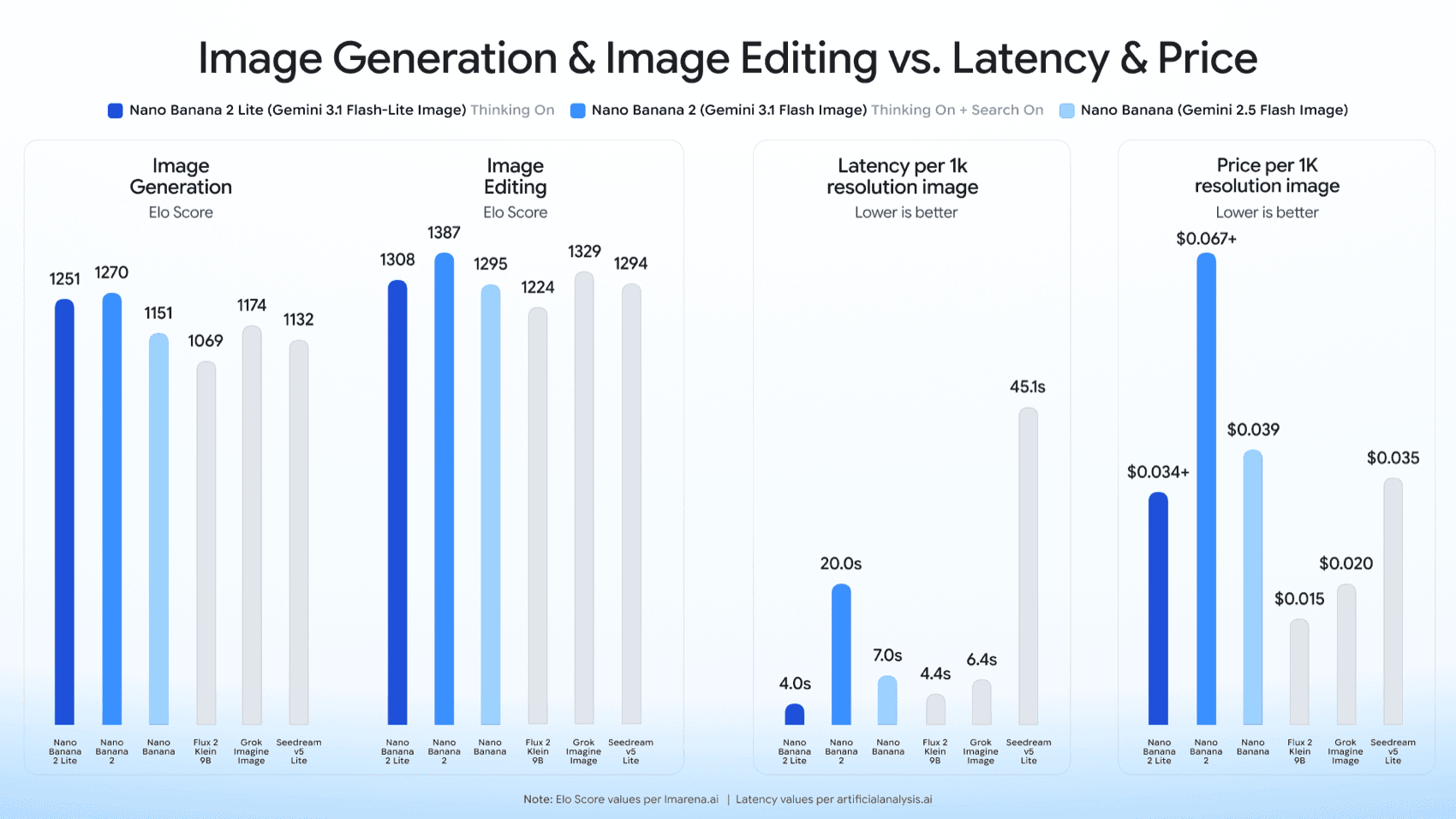
| 模型 | 生成 Elo | 编辑 Elo | 延迟 (1K) | 官方价格 (1K) |
|---|---|---|---|---|
| Nano Banana 2 Lite | 1251 | 1308 | 4.0s | $0.034+ |
| Nano Banana 2 | 1270 | 1387 | 20.0s | $0.067+ |
| Nano Banana (旧版) | 1151 | 1295 | 7.0s | $0.039 |
| Flux 2 Klein 9B | 1069 | 1224 | 4.4s | $0.015 |
| Grok Imagine Image | 1174 | 1329 | 6.4s | $0.020 |
| Seedream v5 Lite | 1132 | 1294 | 45.1s | $0.035 |
权衡很有利。在生成上,Lite 相比基础版 Nano Banana 2 仅下降约 19 Elo,但速度快五倍且成本仅为一半。在编辑上差距更大,1308 对 1387,所以编辑密集的工作负载仍然倾向于使用完整模型。与业界对手相比,Lite 在质量和速度上都击败了 Flux 2 Klein 9B 和 Seedream v5 Lite,在编辑上稍弱于 Grok Imagine Image,但生成质量领先[1]。
该表格附带两个注意事项。Google 自己选择了对比集合,没有包含 GPT Image,所以不存在官方的 Lite 对 GPT Image 对比数据。而且 Google 公布 Elo 值时没有公开排行榜排名,所以任何"Lite 排名第一"的说法都是未经验证的[1]。
能力与限制
- 分辨率: 仅支持 1K (1024px) 和 512px。没有 2K 或 4K,这些是基础版 Nano Banana 2 和 Pro 的专属功能。在 reAPI 上,该模型作为单一 1K 输出提供,因此没有分辨率字段可配置。
- 宽高比: 1:1、3:2、2:3、3:4、4:3、4:5、5:4、9:16、16:9 和 21:9。这涵盖了社交媒体、网页和宽屏应用,包括 16:9 的幻灯片比例[1]。
- 核心功能: 文字生成图像、图像编辑、提示词遵循、角色一致性和清晰的图内文字,这些都继承自该系列。多图像合成也可以工作,但具体的字符和对象数量限制没有明确记载[1]。
- 文字渲染语言: Google 没有为 Lite 专门列举语言列表。将非拉丁文字和长字符串视为需要测试而非假设的东西[1]。
诚实的定位是,Lite 是一款"足够好,适合大批量"的模型。它处理简洁的单主体生成、直观的编辑和标准宽高比的速度很快,但在高保真度、复杂多约束场景和密集的事实信息图表上退缩,这正是低推理评定在告诉你的。
价格与成本计算
这是该模型立足之处,也值得仔细陈述,因为二手信息对此理解有误。
Google 对 Lite 的计费方式是输入 token $0.25/百万,输出 token $30/百万。1K 图像消耗 1,120 个输出 token,相当于 $0.0336,约 3.4 美分/张单图,而非某些媒体报道的每千张图像。批量模式下输出费率减半至 $15/百万,1K 图像降至约 1.7 美分。没有免费额度[1]。
在该系列中,基础版 Nano Banana 2 的输出费率为 $60/百万(1K 图像约 $0.067,2K 约 $0.10,4K 约 $0.15),Pro 为 $120/百万(4K 约 $0.24)[1]。
简化成本计算的关键细节是:Lite 和基础版 Nano Banana 2 的 1K 图像都用 1,120 个 token。整个成本差异来自更低的单位 token 输出费率,而非更小的图像[1]。对于 1K 工作,Lite 相比主力档是直接 2 倍折扣。
在 reAPI 上,费率是**$0.022/张**,比 Google 官方的 $0.034 低约 56%(2026 年 10 月 22 日检查)。一个请求一张图像,一个统一费率,无需考虑分辨率分层。
与竞品比较
相比 Google 选择的竞争对手,Lite 在质量上有竞争力,但不是最便宜的。Flux 2 Klein 9B ($0.015) 和 Grok Imagine Image ($0.020) 都更便宜。Seedream v5 Lite 价格接近 ($0.035) 但速度慢十一倍[1]。
Lite 的优势是同时在三个维度上取得平衡:强 Elo 分、四秒延迟和中端价格。如果你唯一的指标是单位成本,存在更便宜的模型。但若需要不错的质量和实时延迟兼备,Lite 是最优点。
如何使用 Nano Banana 2 Lite:有效的提示词编写
低推理评定意味着它奖励清晰、具体的提示词,而非聪明的多约束组合。
- 主体和风格优先,然后是细节。 "一张极简主义的陶瓷咖啡杯产品英雄照,柔和的工作室灯光,温暖中性背景"胜过一整段分层条件。
- 明确表述宽高比。 支持全部十种;提前说明可以避免尴尬的裁切。
- 图内文字保持简短。 清晰的文字可以工作,但长字符串和非拉丁文字的质量没有文档记载。标题和单个标签是安全的;密集段落风险大。
- 迭代便宜,然后最终化。 四秒和几美分一张的成本下,在这里生成十多个变体,然后只在更高档模型上重新渲染赢家,如果你需要 2K 或 4K 输出。
- 编辑用于受控变化。 对于同一场景的背景替换,Lite 的 1308 编辑 Elo 足够能干,尽管完整模型的 1387 对要求高的编辑更强。
Lite、基础 Nano Banana 2 还是 Pro?
三个问题能决出胜负。
你需要 1K 以上的输出吗? 如果是,跳过 Lite。它最高 1K。
这个任务是编辑密集型还是推理密集型? Lite 的编辑 Elo 相比基础版 Nano Banana 2 有真实差距,复杂多约束信息图表应该用 Pro。对于直观的生成,Lite 质量几乎一样,成本仅为一半。
延迟还是吞吐量是限制条件? Lite 是唯一能提供五秒内响应的档位。基础版 Nano Banana 2 的 20 秒延迟将其排除在交互式高吞吐循环之外。
健康的模式是两档:在 Lite 上起草,仅为值得额外成本的特定资产在更大模型上最终化。对大多数团队来说,绝大多数生成的图像永远不需要那次升级,这正是为什么快速、廉价的档位改变了交付自定义视觉的经济学。
在 reAPI 上调用 Nano Banana 2 Lite
reAPI 通过异步任务端点提供该模型。提交返回 task_id;轮询直到就绪。
curl https://reapi.ai/api/v1/images/generations \
  -H "Authorization: Bearer YOUR_API_KEY" \
  -H "Content-Type: application/json" \
  -d '{
    "model": "nano-banana-2-lite",
    "prompt": "a hand-illustrated travel postcard of Kyoto at dusk, glowing paper lanterns, warm cinematic light",
    "aspect_ratio": "16:9"
  }'
编辑使用同一端点。添加 image_urls 包含最多十张参考图像,请求变成基于提示词的编辑而非文字生成图像。没有 mode 字段需要设置;image_urls 的存在就是切换到编辑模式的方式。
curl https://reapi.ai/api/v1/images/generations \
  -H "Authorization: Bearer YOUR_API_KEY" \
  -H "Content-Type: application/json" \
  -d '{
    "model": "nano-banana-2-lite",
    "prompt": "replace the background with a quiet stone lane at dusk, keep the subject unchanged",
    "image_urls": ["https://example.com/source.png"],
    "aspect_ratio": "16:9"
}'集成前有两条平台规则值得了解。媒体输入仅限公网 http(s) URL,任何模型都不接受 base64 或 data: 格式。而且计费是每张图像固定 20 credits,一个请求一张图像,所以成本预测是乘法而非 token 估算。
完整的请求和响应格式在 reapi.ai/docs/nano-banana-2-lite 参考,当前费率在 reapi.ai/models/nano-banana-2-lite。
常见问题
Nano Banana 2 Lite 的官方名称是什么?
Gemini 3.1 Flash-Lite Image。"Nano Banana 2 Lite"是 Google 对该图像模型的营销名称。文本专用的 gemini-3.1-flash-lite 是不能生成图像的不同模型[1]。
Nano Banana 2 Lite 成本多少?
按 Google 官方价格约 3.4 美分/张 1K 图像,1,120 输出 token × $30/百万,批量模式下约 1.7 美分。在 reAPI 上是 $0.022/张。忽视某些媒体发布的"每千张图像"数字;费率是单张图像[1]。
Nano Banana 2 Lite 速度有多快?
1K 图像约四秒,基础版 Nano Banana 2 约 20 秒,大约快五倍[1]。
它支持什么分辨率?
仅 1K (1024px) 和 512px。没有 2K 或 4K;需要基础版 Nano Banana 2 或 Nano Banana Pro。在 reAPI 上该模型作为单一 1K 输出[1]。
Nano Banana 2 Lite 能编辑图像吗?
能。在提示词的同时发送 image_urls,同一端点执行基于提示词的编辑,最多十张参考图像。其 1308 编辑 Elo 低于基础版 Nano Banana 2 的 1387,所以要求高的编辑仍然倾向大型模型[1]。
它与 GPT Image 相比如何?
没有官方对比。Google 没有在对比集合中包含 GPT Image[1]。
它接受 base64 图像吗?
在 reAPI 上不接受。平台上的每个模型仅接受公网 http(s) URL 的媒体输入。
支持哪些宽高比?
十种:1:1、3:2、2:3、3:4、4:3、4:5、5:4、9:16、16:9 和 21:9[1]。
选择适配任务的档位
Nano Banana 2 Lite 是一个判断得当的补充,而非头部模型,这正是重点。它保留了基础版 Nano Banana 2 的几乎全部生成质量,同时快五倍、成本减半,代价是 1K 上限、中等保真度和较弱的编辑与推理。
对于高吞吐、延迟敏感、成本敏感的工作,它是正确的默认选择,更大档位保留给真正需要 2K 或 4K 输出或最高质量的资产。如果你将它集成到产品中,记住修正的成本计算和平台规则:官方价格约 3.4 美分/张单一 1K 图像,reAPI 上 20 credits,参考图像仅公网 URL,一个请求一张图像。这就是如何在不为草稿质量工作付主力档价格的情况下使用 Nano Banana 2 Lite。
参考
- Google. Gemini API — image generation, models, and capabilities. Retrieved July 2026 from ai.google.dev/gemini-api/docs/image-generation
- Google. Gemini Developer API pricing. Retrieved July 2026 from ai.google.dev/gemini-api/docs/pricing
- Google DeepMind. Gemini image generation models. Retrieved July 2026 from deepmind.google/models/gemini-image
Further reading
- reAPI. Nano Banana 2 Lite endpoint reference. reapi.ai/docs/nano-banana-2-lite
- reAPI. Model catalog. reapi.ai/models
作者

分类
更多文章

Gemini 3.6 Flash vs 3.1 Pro
Gemini 3.6 Flash vs 3.1 Pro:比较当前 API 价格、200K 提示词门槛、编程评测、上下文限制及 reAPI 的接入边界。
用 AirLLM 在 4GB GPU 上运行 70B 大模型
70B 大语言模型真的能在 4GB GPU 上运行吗?学习 AirLLM 如何从磁盘流式加载层、需要何种硬件、如何尝试,以及为何执行缓慢。

AI 图片生成成本:视频一帧的 2-9 倍
AI 图片生成成本是视频一帧的 2-9 倍。本文深入精算了八档视频与七个图片模型的逐帧价格差异,帮你理解何时应该选择哪个工具。