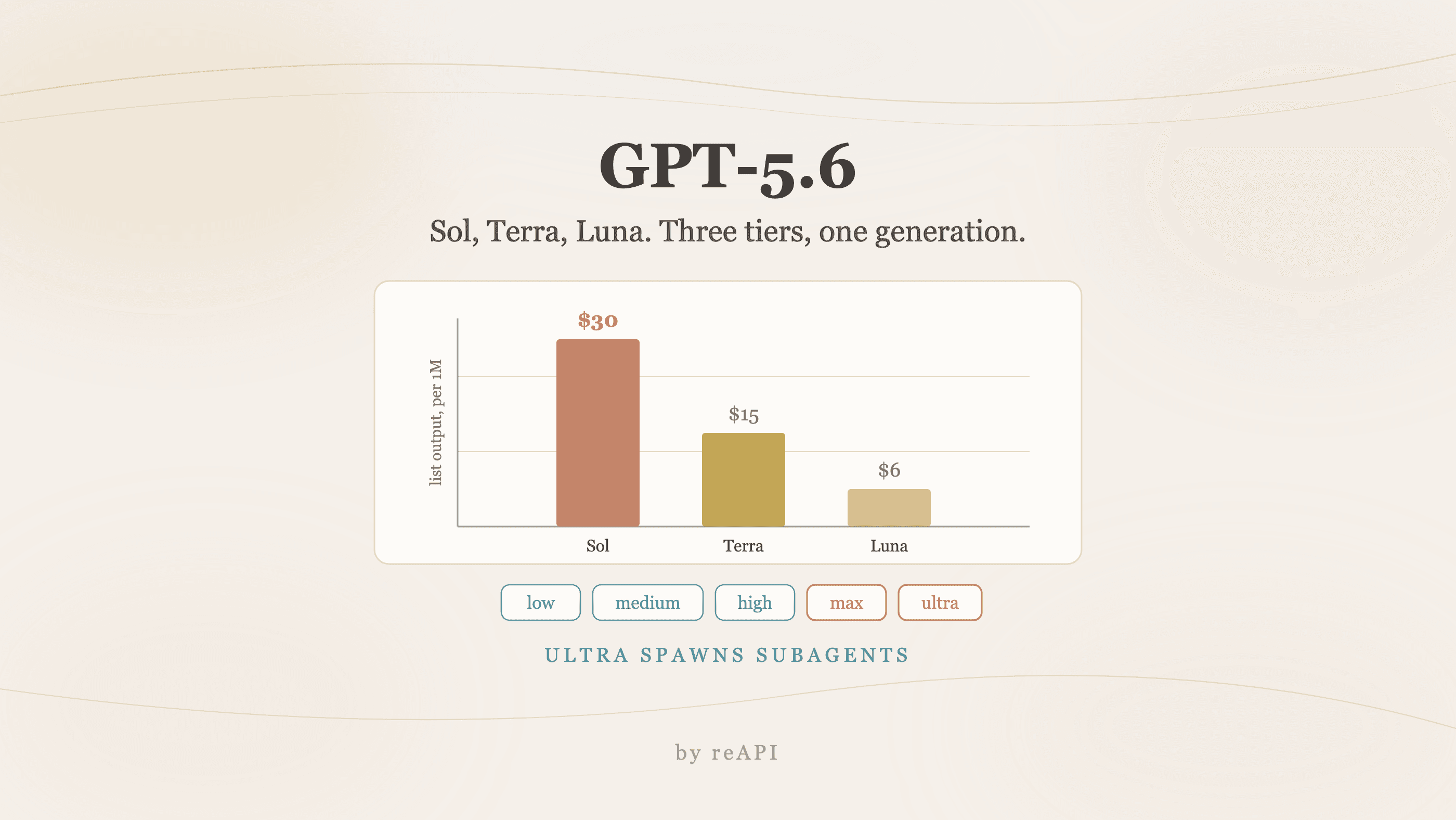
Cómo usar GPT-5.6: comparación de Sol, Terra y Luna
Guía de GPT-5.6: precios de Sol, Terra y Luna, la tabla Terminal-Bench y sus cuatro asteriscos, los modos max y ultra, y qué nivel conviene elegir.
Para decidir entre GPT-5.6 Sol vs Terra vs Luna, empieza por el nivel más barato que supere tus controles de calidad: Luna para volumen sensible al coste, Terra cuando los errores o reintentos de Luna justifiquen subir de nivel, y Sol para trabajo profesional difícil en el que la capacidad adicional compense. Las tarifas actuales Standard de OpenAI por millón de tokens de entrada/salida son $0.20/$1.20 para Luna, $2/$12 para Terra y $4/$20 para Sol, en solicitudes de hasta 272K tokens de entrada. Los tres comparten los mismos límites documentados de contexto y salida; pagar más no compra una ventana mayor.[3][4][5]
Los precios y límites actuales de API que siguen se comprobaron el 23 de octubre de 2026. La exposición del lanzamiento y de Terminal-Bench se conserva como contexto histórico; no es una nueva ejecución de benchmarks ni una promesa de que cada modo de evaluación del lanzamiento sea un parámetro de API.
OpenAI comenzó una vista previa limitada de GPT-5.6 el 26 de junio de 2026, y lo más extraño de ese lanzamiento fue que casi nadie podía usarlo. El acceso fue a aproximadamente veinte socios verificados a través de la API y Codex, en un lanzamiento gradual que OpenAI dice que el gobierno estadounidense solicitó[1].
Esa puerta se ha abierto desde entonces. Saber cómo usar GPT-5.6 es ahora una pregunta práctica en lugar de un juego de espera, y la respuesta es principalmente elegir uno de tres tiers: Sol el buque insignia, Terra el caballo de batalla equilibrado, y Luna el tier de presupuesto. Cada uno es un tier de capacidad duradero bajo un número de generación, no una variante temporal.
Esta guía cubre la elección actual entre los tres niveles, sus precios y límites, junto al benchmark del lanzamiento y sus cuatro asteriscos, la configuración histórica de evaluación ultra y la revisión de ciberseguridad que condicionó el despliegue.
TL;DR
- Tres niveles con límites compartidos. Sol es el buque insignia, Terra equilibra inteligencia y coste, y Luna apunta a volumen sensible al coste. Los tres admiten esfuerzo de razonamiento
max.[3][4][5] - En la tabla de lanzamiento de Terminal-Bench 2.1, Sol obtiene 88.8% como agente único o 91.9% en modo
ultra. Su ventaja de agente único frente a Claude Mythos 5 es de 0.8 puntos, dentro del margen de ruido[1]. ultrano es un agente. Orquesta subagentes en paralelo, por lo que su puntuación no es una comparación como la de línea de base de agente único[1].- Elige por tarea aceptada, no por nombre del nivel. Prueba primero Luna para volumen rutinario, compara Terra en las tareas donde falla y utiliza Sol cuando la mejora cubra su mayor coste.
- En reAPI, los precios de entrada/salida de contexto corto son el 80% de las tarifas Standard actuales de OpenAI: Sol $3.20 / $16.00, Terra $1.60 / $9.60, Luna $0.16 / $0.96 por millón de tokens (comprobados el 23 de octubre de 2026). Este porcentaje no describe todas las tarifas de contexto largo.[8]
- La ventana de evaluación fue deliberadamente estrecha. OpenAI publicó codificación, biología y ciberseguridad solo, reteniendo SWE-bench, GDPval, matemáticas y números de alucinación[1].
gpt 5.6 sol vs terra vs luna
GPT-5.6 sucede a GPT-5.5, el modelo agénico completamente reentrenado de abril de 2026. Donde GPT-5.5 fue un modelo con niveles de esfuerzo de razonamiento, GPT-5.6 es una familia de tres tiers bajo un número de generación. El marco de OpenAI es explícito: el número identifica una generación, mientras que Sol, Terra y Luna identifican tiers de capacidad duraderos que pueden avanzar a su propio ritmo[1].
Esa oración es la decisión de diseño más importante en el lanzamiento. Desacopla "cuán inteligente" de "cuán nuevo". Una generación futura podría enviar una Luna nueva sin tocar Sol, y una actualización de Sol no fuerza a todos en Terra a re-probar sus tuberías.
| Nivel | Posicionamiento |
|---|---|
| GPT-5.6 Sol | Buque insignia para trabajo profesional complejo; evalúalo cuando las tareas más difíciles justifiquen la tarifa mayor |
| GPT-5.6 Terra | Equilibrio de inteligencia y coste; evalúalo cuando Luna no cumpla los requisitos de la tarea |
| GPT-5.6 Luna | Rápido y asequible, orientado a tareas rutinarias de alto volumen |
gpt 5.6 context window
OpenAI documenta ahora los mismos límites para los tres niveles GPT-5.6: 1,050,000 tokens de ventana total de contexto, 922,000 tokens de entrada máxima y 128,000 tokens de salida máxima. El límite de entrada no es la ventana total de contexto. Cada modelo acepta texto e imágenes como entrada y produce texto; las páginas de modelos enumeran streaming, salidas estructuradas y llamadas a funciones. Sus listas de herramientas alojadas se etiquetan específicamente para la API Responses, por lo que no garantizan que todo endpoint compatible exponga las mismas herramientas.[3][4][5]
Los tres admiten none, low, medium, high, xhigh y max, con medium como valor predeterminado. Las referencias actuales no enumeran minimal ni ultra como valores de esfuerzo. Los tokens de razonamiento ocupan contexto y se facturan como salida; el margen de salida debe cubrir tanto el razonamiento oculto como la respuesta visible.[6]
Terminal-Bench 2.1 y sus cuatro asteriscos
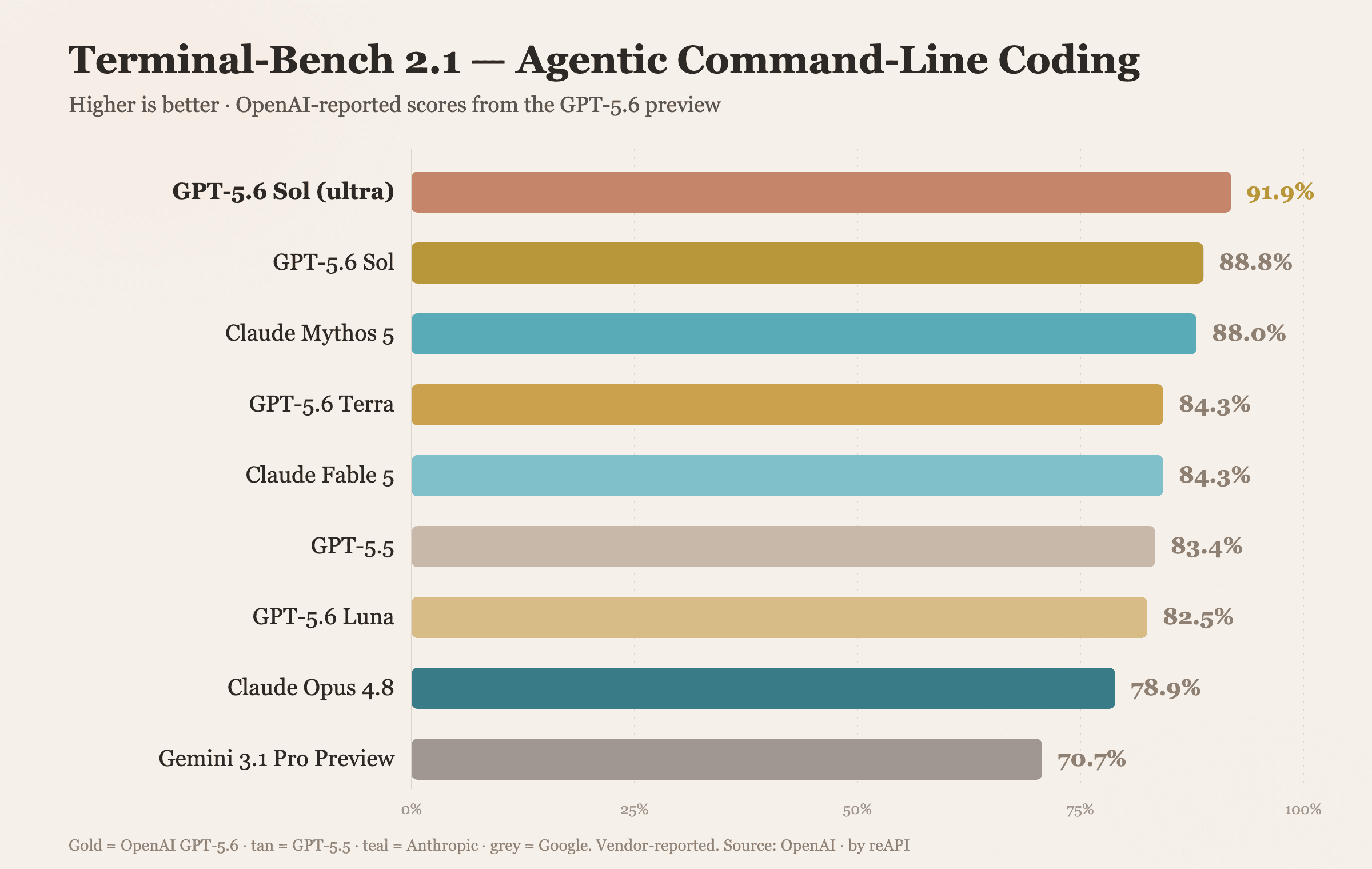
OpenAI publicó solo tres áreas de benchmark en la vista previa, codificación, biología y ciberseguridad, reteniendo explícitamente el resto para disponibilidad general[1]. La que quiere que recuerdes es Terminal-Bench 2.1, que prueba flujos de trabajo de agentes de línea de comandos que requieren planificación, iteración y coordinación de herramientas.
| Modelo | Terminal-Bench 2.1 |
|---|---|
GPT-5.6 Sol (modo ultra) | 91.9% |
| GPT-5.6 Sol | 88.8% |
| Claude Mythos 5 | 88.0% |
| GPT-5.6 Terra | 84.3% |
| Claude Fable 5 | 84.3% |
| GPT-5.5 | 83.4% |
| GPT-5.6 Luna | 82.5% |
| Claude Opus 4.8 | 78.9% |
| Gemini 3.1 Pro Preview | 70.7% |
Lee con atención, esta tabla es más honesta que lo que sugiere el titular "nuevo estado del arte", de cuatro maneras[1].
El registro de 91.9% usa ultra, que no es un agente único. Proviene de Sol orquestando subagentes. Contra líneas de base de agente único no es manzanas con manzanas. La comparación justa es el 88.8% de Sol.
Sol de agente único vence a Claude Mythos 5 por 0.8 puntos. Dos ejecuciones del mismo modelo pueden discrepar más que eso. OpenAI tiene una ventaja real en la parte superior de la curva de codificación, pero en este benchmark es estrecha, no una debacle.
Terra empata con Claude Fable 5 y apenas supera a GPT-5.5. El 84.3% coincide exactamente con Fable 5 y queda a menos de un punto del modelo al que sustituye. Unido a la reducción de precio, ese es el argumento comercial concreto: un resultado publicado similar en Terminal-Bench con menor precio de lanzamiento, no una prueba de igual capacidad de programación en todas las tareas.
Gemini 3.1 Pro Preview queda rezagado por aproximadamente 21 puntos. Esa brecha es real pero específica del benchmark. Gemini lidera en otro lado en recuperación de contexto largo y trabajo multimodal no mostrado aquí.
En biología, OpenAI reporta que Sol logra resultados más fuertes de GeneBench v1 que GPT-5.5 mientras usa menos tokens, sin publicar números crudos, así que eso es una afirmación direccional en lugar de una puntuación verificable[1].
max y ultra
La comparación del lanzamiento utilizó max y una configuración de evaluación multiagente ultra. Para una integración actual, separa esa etiqueta histórica del contrato documentado de parámetros: Sol, Terra y Luna admiten max, y ultra no figura entre sus seis valores actuales de esfuerzo de razonamiento.[3][4][5]
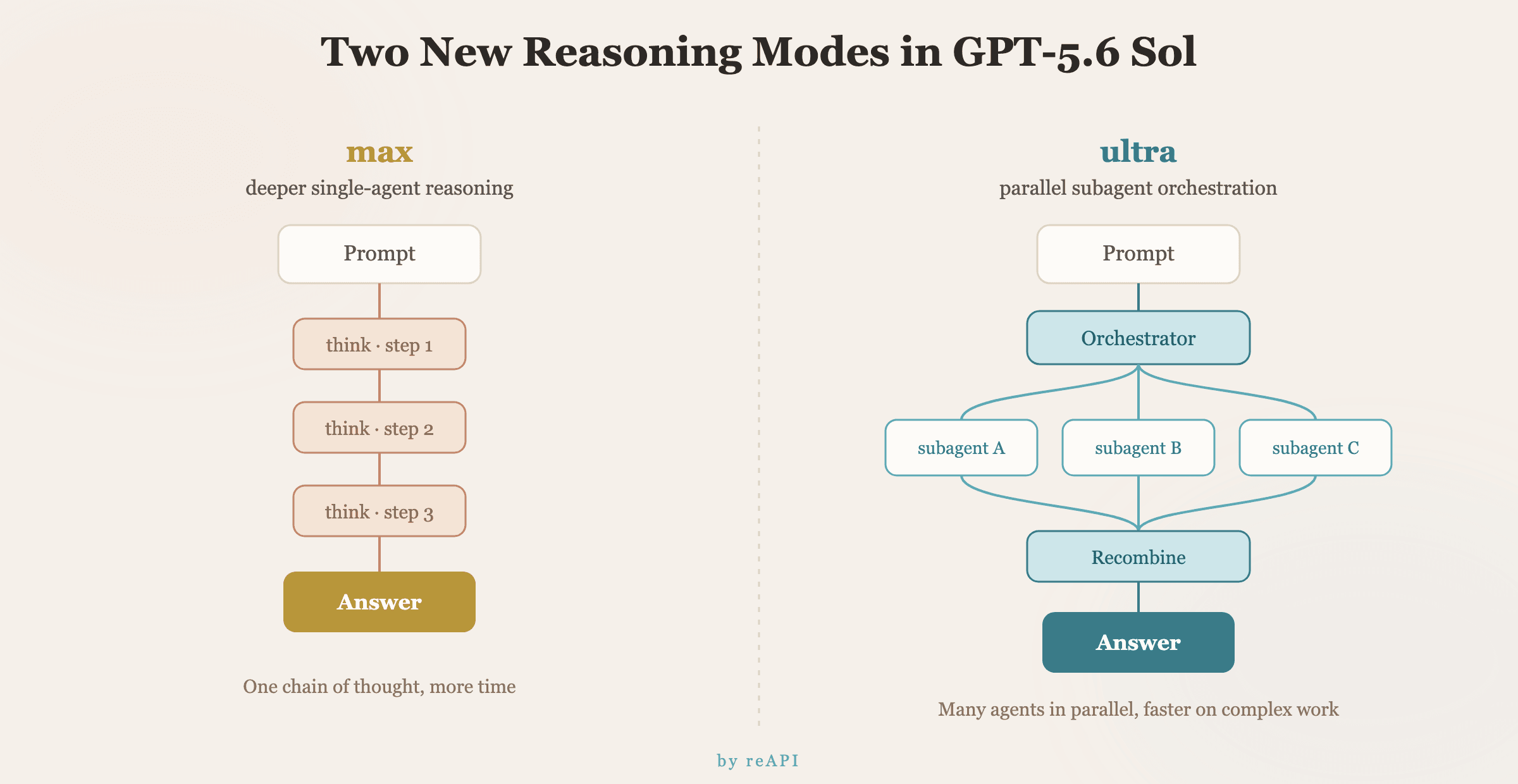
La ilustración describe la comparación del lanzamiento. Su puntuación ultra utiliza subagentes y no es directamente comparable con un resultado de agente único. No demuestra que exista un parámetro ultra invocable ni orquestación integrada mediante reAPI.
La API Responses actual de OpenAI documenta controles independientes de esfuerzo de razonamiento y modo de razonamiento. reasoning.mode selecciona standard o pro; el modo Pro realiza más trabajo con el modelo y factura los tokens resultantes a las tarifas estándar de ese modelo. Por tanto, puede costar más sin que cambie el precio por token. El esfuerzo predeterminado de GPT-5.6 es medium en ambos modos.[6]
La ruta pública de reAPI para estos modelos es Chat Completions. Expone reasoning_effort; no asumas que el modo exclusivo de Responses de OpenAI, el razonamiento persistente o sus funciones de agentes alojados se activan copiando campos en esa solicitud.
gpt 5.6 pricing
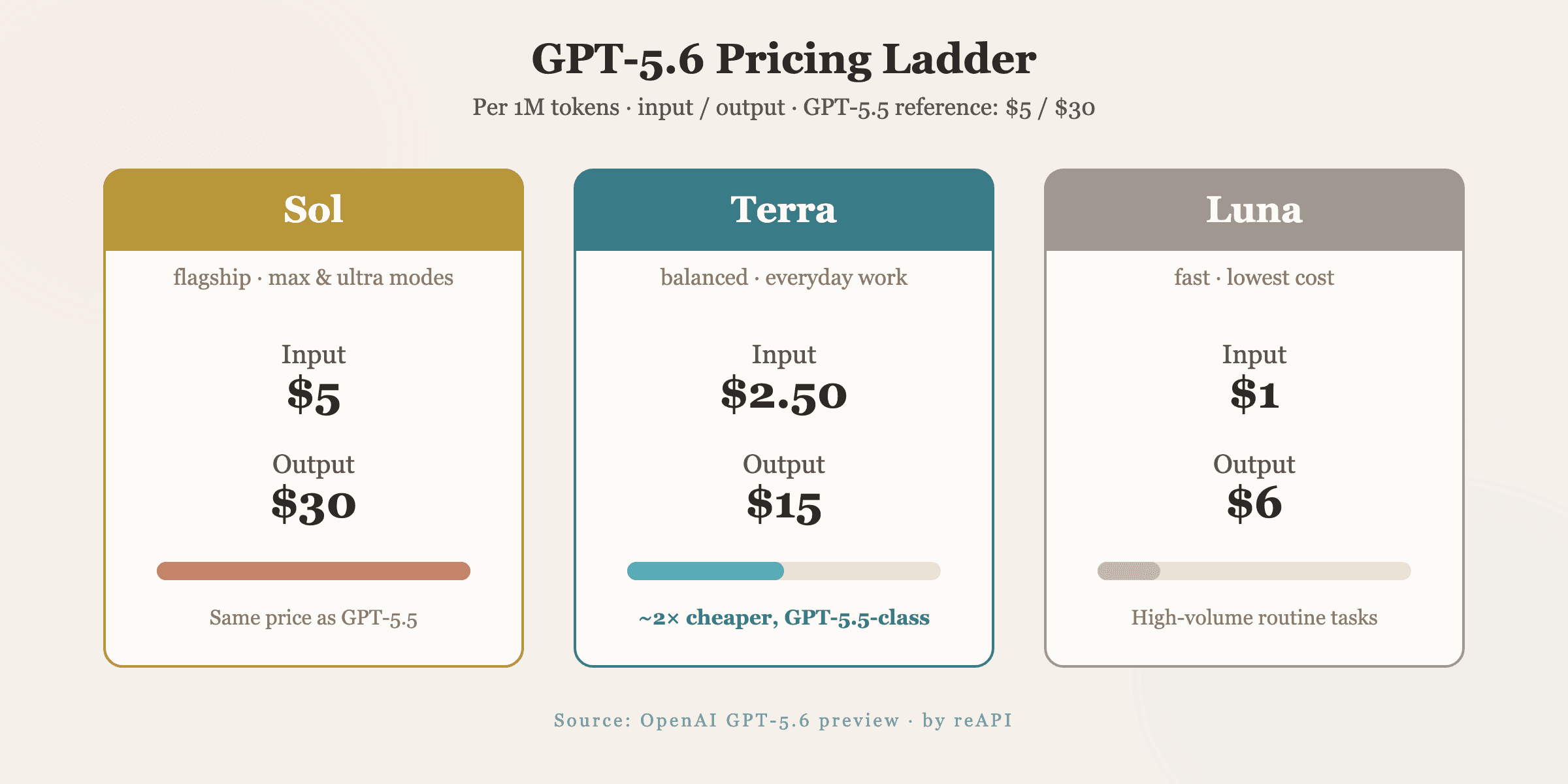
La imagen conserva los precios de lanzamiento. Las columnas actuales de abajo muestran precios de entrada/salida para contexto corto, por millón de tokens, no tarifas universales para todo tamaño de solicitud o modalidad de procesamiento.[2][8]
| Nivel | Tarifa OpenAI de lanzamiento (entrada / salida por 1M) | OpenAI Standard, 23 de octubre de 2026 | En reAPI, 23 de octubre de 2026 |
|---|---|---|---|
| GPT-5.6 Sol | $5 / $30 | $4 / $20 | $3.20 / $16.00 |
| GPT-5.6 Terra | $2.50 / $15 | $2 / $12 | $1.60 / $9.60 |
| GPT-5.6 Luna | $1 / $6 | $0.20 / $1.20 | $0.16 / $0.96 |
Dos aspectos destacaban en las cifras de lanzamiento de OpenAI. Sol mantuvo exactamente los $5 / $30 de GPT-5.5 y añadió capacidad y nuevos modos, un caso poco habitual de obtener más por el mismo precio. Terra publicó un resultado de lanzamiento en Terminal-Bench similar al de GPT-5.5 con precios de lanzamiento menores, lo que justificaba evaluarlo[1]. Si se suman las mejoras de eficiencia de tokens de Sol, que alcanza resultados comparables con menos tokens de salida, la reducción efectiva del coste por tarea supera lo que sugieren las tarifas nominales.
OpenAI ha reducido desde entonces las tres tarifas; la de Sol es una promoción que, según indica, dura al menos hasta el 21 de noviembre de 2026[2]. Sol está ahora por debajo de los $5 / $30 de GPT-5.5. Las tarifas actuales de entrada/salida de contexto corto de reAPI son el 80% de OpenAI Standard, pero los precios relativos entre niveles han cambiado: los $0.20/$1.20 de Luna son una décima parte de los $2/$12 de Terra, proporción que no tenían sus precios de lanzamiento. La fecha de noviembre de Sol es un periodo promocional mínimo, no una subida garantizada al día siguiente. Elige el nivel más barato que cumpla tus requisitos de calidad medidos, en lugar de convertir Terra en la opción automática.
Con más de 272K tokens de entrada, OpenAI cobra 2x por la entrada y 1.5x por la salida de toda la solicitud, no solo por los tokens que exceden el umbral. Sus tarifas Standard actuales de caché y contexto largo son:[2]
| Nivel | Caché corta: lectura / escritura 30m / escritura 12h | Entrada / salida larga | Caché larga: lectura / escritura 30m / escritura 12h |
|---|---|---|---|
| GPT-5.6 Sol | $0.40 / $5.00 / $10.00 | $8.00 / $30.00 | $0.80 / $10.00 / $20.00 |
| GPT-5.6 Terra | $0.20 / $2.50 / $5.00 | $4.00 / $18.00 | $0.40 / $5.00 / $10.00 |
| GPT-5.6 Luna | $0.02 / $0.25 / $0.50 | $0.40 / $1.80 | $0.04 / $0.50 / $1.00 |
OpenAI admite caché implícita y explícita. Las escrituras predeterminadas de 30 minutos cuestan 1.25x la entrada ordinaria; la API Responses también ofrece un mínimo de 12 horas a 2.5x. Son tarifas totales de escritura, no recargos que se suman a la entrada ordinaria. Las lecturas cuestan 0.1x en estos tres modelos. El prefijo mínimo que puede almacenarse en caché es de 1,024 tokens. Una configuración de 12 horas es una duración mínima, no un plazo de eliminación.[7]
Para un ejemplo de 20,000 tokens de entrada sin caché y 5,000 tokens de salida facturados, OpenAI Standard cuesta (20,000 × input rate + 5,000 × output rate) / 1,000,000: Sol $0.18, Terra $0.10 y Luna $0.01. Los precios de entrada/salida de contexto corto de reAPI dan $0.144, $0.08 y $0.008, respectivamente. Las cantidades fijas incluyen el razonamiento en la salida facturada y excluyen herramientas, impuestos y operaciones de caché; son cálculos, no costes medidos de completar tareas.
Con 300,000 tokens de entrada sin caché y 5,000 tokens de salida facturados, las tarifas largas de OpenAI para toda la solicitud dan Sol $2.55, Terra $1.29 y Luna $0.129. Las tarifas menores de contexto corto ya no se aplican. Para solicitudes con caché, separa entrada ordinaria, lecturas y escrituras de caché antes de multiplicarlas por sus respectivas tarifas; contar otra vez los tokens en caché como entrada ordinaria inflaría la factura.
Las tarifas renderizadas de entrada/salida de contexto largo de reAPI el 23 de octubre eran Sol $6.40/$24.00, Terra $3.20/$14.50 y Luna $0.320/$1.440 por millón de tokens. La tarifa mostrada de salida larga de Terra es $14.50, por lo que afirmar que todas las tarifas son el “80%” sería incorrecto. Comprueba la categoría exacta en la página del modelo; esta tabla no promete que reAPI permita seleccionar las duraciones de caché de OpenAI.[8]
Las cifras de OpenAI anteriores usan procesamiento Standard y excluyen las herramientas con precio separado y los recargos de procesamiento regional. Batch, Flex y Fast tienen tablas de precios propias; no compares la modalidad alternativa de un modelo con Standard de otro como si sus condiciones de servicio fueran idénticas.[2]
La revisión que moldeó el lanzamiento
Esta parte vale la pena entender incluso ahora que el acceso se ha abierto, porque es un precedente en lugar de una nota al pie.
OpenAI restringió el lanzamiento inicial a aproximadamente veinte socios verificados a solicitud del gobierno estadounidense, después de mostrar las capacidades de los modelos antes del lanzamiento[1]. El activador fue la capacidad de ciberseguridad. Sol avanza significativamente la investigación de vulnerabilidades, y en evaluaciones que involucran Chromium y Firefox identificó errores y primitivos de explotación, los bloques de construcción de un exploit, sin producir autónomamente un exploit de cadena completa funcional bajo las condiciones probadas. OpenAI afirma que Sol no cruza el umbral de Ciberseguridad Crítica en su Marco de Preparación, y esa distinción es toda la base para liberarlo[1].
Notablemente, OpenAI no respaldó el arreglo como permanente, diciendo que este tipo de proceso de acceso del gobierno no debería convertirse en el valor predeterminado a largo plazo porque mantiene las mejores herramientas lejos de los defensores que las necesitan[1].
La pila de seguridad enviada junto con ella vale la pena saber porque prevé cómo enviarán modelos de alta capacidad en general: rechazos entrenados, clasificadores reales de ciberseguridad y biología que pueden pausar la generación para revisión por un modelo más grande, revisión a nivel de cuenta de actividad marcada, y acceso diferenciado a las capacidades más sensibles. OpenAI dedicó más de 700,000 horas de GPU equivalentes a A100 al equipo rojo automatizado para jailbreaks universales[1].
OpenAI es franco en que estas protecciones fallan: investigadores de seguridad legítimos pueden encontrar rechazos en solicitudes de uso dual.
Dónde el caso es fuerte y dónde es débil
Sólido. Programación de agentes en línea de comandos, donde Sol de agente único encabeza el benchmark y ultra lo amplía. Eficiencia de tokens, que se acumula en agentes de alto volumen. Valor de la gama media, donde la reducción de precio de Terra es el cambio más ampliamente útil del lanzamiento. El resultado ultra del lanzamiento incluye orquestación multiagente; debe interpretarse como una configuración de evaluación, no como una promesa actual de funciones de reAPI[1].
Débil. El titular es una victoria de 0.8 puntos en un benchmark. La ventana de evaluación fue deliberadamente pequeña, sin SWE-bench, GDPval, matemáticas o números de alucinación publicados, por lo que no se sabe si GPT-5.6 arregló el problema de alucinación seguro de sí mismo que atormentó a GPT-5.5. Y todo es reportado por vendedores bajo el propio arnés de OpenAI[1].
Hasta que lleguen una suite expandida y puntuación independiente, el juicio sobre capacidad general debe mantenerse reservado.
Cómo usar GPT-5.6: qué tier elegir
Luna para volumen rutinario sensible al coste, cuando supere tus controles. Empieza con tareas representativas de clasificación, extracción o respuestas cortas y registra las salidas aceptadas, reintentos y esfuerzo de revisión. Su menor precio por token solo sirve si el resultado satisface la tarea.
Terra cuando la capacidad adicional mejore lo suficiente el resultado para justificar el precio. Compáralo en los casos donde Luna falla realmente, en lugar de asumir que toda solicitud de producción necesita la gama media. El benchmark de programación del lanzamiento aporta datos sobre esa evaluación, no demuestra capacidad equivalente en cualquier tarea.
Sol para trabajo profesional complejo cuando la mejora compense el coste adicional. Prueba programación difícil o tareas de largo alcance con las mismas herramientas y criterios de aceptación. Los tres niveles admiten max; ni ese mayor esfuerzo ni una ventana de contexto mayor son exclusivos de Sol. No elijas un nivel de reAPI suponiendo que ultra sea un valor de solicitud admitido.
Llamar a GPT-5.6 en reAPI
Los tres niveles están registrados en el endpoint compatible con OpenAI de reAPI https://reapi.ai/api/v1/chat/completions. Usa la clave de tu espacio de trabajo actual de reAPI y el ID exacto con sufijo, conservando los puntos de OpenAI:
from openai import OpenAI

client = OpenAI(
    api_key="YOUR_REAPI_KEY",
    base_url="https://reapi.ai/api/v1",
)

resp = client.chat.completions.create(
    model="gpt-5.6-terra",
    messages=[{"role": "user", "content": "Refactor this module and add tests."}],
    max_tokens=16000,
    stream=True,
)
Cambia gpt-5.6-terra por gpt-5.6-sol o gpt-5.6-luna para comparar niveles con el mismo formato Chat Completions. OpenAI documenta un alias simple gpt-5.6, pero reAPI registra actualmente los tres ID con sufijo; usa aquí esas cadenas exactas. El límite de salida configurado en reAPI es de 128,000 tokens para cada uno, y los valores de esfuerzo documentados son none, low, medium, high, xhigh y max.[8]
OpenAI admite Chat Completions y Responses para esta familia y recomienda Responses para sus flujos de razonamiento. reAPI no publica una ruta /v1/responses. Transmitir parámetros no establece equivalencia de funciones: no asumas que este endpoint Chat reproduce las herramientas alojadas de OpenAI, el modo de razonamiento Pro o el contrato de razonamiento persistente. Las referencias enlazadas de reAPI describen su integración; no se realizó generación en producción para esta actualización.[6][8]
Las tasas actuales están en reapi.ai/models/gpt-5-6-sol, reapi.ai/models/gpt-5-6-terra, y reapi.ai/models/gpt-5-6-luna.
FAQ
¿Cuál es la diferencia entre el modo max y ultra?
max es un valor actual de esfuerzo de razonamiento en los tres niveles GPT-5.6. El resultado histórico ultra utilizó subagentes y produjo el titular de 91.9% en Terminal-Bench; no es uno de los seis valores actuales de esfuerzo. El reasoning.mode: "pro" separado de OpenAI pertenece a Responses y no debe confundirse con un campo ultra ni con una función de Chat en reAPI.[1][3][6]
¿Es GPT-5.6 Sol mejor que Claude para codificar?
En Terminal-Bench 2.1, Sol de agente único 88.8% supera a Claude Mythos 5 88.0% por 0.8 puntos, una ventaja real pero estrecha. Con ultra Sol alcanza 91.9%, pero eso usa subagentes y no es una comparación de agente único[1].
¿Qué tier de GPT-5.6 debo usar?
Evalúa Luna para volumen rutinario, Terra cuando Luna no satisfaga tus requisitos y Sol para trabajo difícil en el que la calidad adicional justifique el coste. Los tres comparten la ventana de contexto, el límite de salida y los niveles de esfuerzo documentados; elige según el coste por tarea aceptada y tus propias pruebas, no según una integración ultra supuesta.
¿Por qué el gobierno estadounidense estuvo involucrado en el lanzamiento?
Sol avanza significativamente la capacidad de ciberseguridad, a solicitud del gobierno OpenAI ejecutó una vista previa gradual a aproximadamente veinte socios verificados mientras se desarrollaba un marco cibernético[1].
¿GPT-5.6 arregla el problema de alucinación de GPT-5.5?
Desconocido. OpenAI publicó solo evaluaciones de codificación, biología y ciberseguridad en la vista previa y retuvo números de alucinación y trabajo de conocimiento[1]. Empareja el modelo con verificación basada en fuentes para salida de alto riesgo.
¿Qué tan grande es la ventana de contexto de GPT-5.6 Sol?
OpenAI documenta ahora una ventana total de contexto de 1,050,000 tokens, un máximo de 922,000 tokens de entrada y un máximo de 128,000 tokens de salida. Terra y Luna tienen los mismos límites. La información anterior de 1.5 millones de tokens no es la especificación oficial actual.[3][4][5]
¿Qué cambió en el almacenamiento en caché de indicadores?
OpenAI admite caché implícita y puntos de corte explícitos de caché, con escrituras predeterminadas de 30 minutos a 1.25x la entrada ordinaria y un mínimo opcional de 12 horas en la API Responses a 2.5x. Las lecturas cuestan 0.1x en estos tres modelos. Las tarifas de escritura son totales y una duración mínima no es un plazo de eliminación; la ruta Chat de reAPI no promete los mismos controles configurables de caché.[7]
¿Cómo llamo a GPT-5.6 con el SDK de OpenAI?
Apunta el cliente OpenAI a https://reapi.ai/api/v1, utiliza la clave de tu espacio de trabajo reAPI y establece model en gpt-5.6-sol, gpt-5.6-terra o gpt-5.6-luna. Conserva los puntos y el sufijo del nivel; el alias simple de OpenAI no está registrado aquí.[8]
Leer un lanzamiento de tres tiers
GPT-5.6 reúne dos lanzamientos en un anuncio. Uno es una actualización convencional y bien ejecutada de la familia: nombres reorganizados con sentido, una gama media con precios de lanzamiento menores y un resultado publicado de Terminal-Bench similar al de GPT-5.5, y un benchmark de lanzamiento ultra con orquestación multiagente. El otro es un modelo de frontera cuya disponibilidad inicial se coordinó con un gobierno y que se lanzó con una estructura de seguridad de 700,000 horas de GPU.
Para una integración actual, empieza por el nivel más barato que supere tus controles, presupuesta el razonamiento y el umbral de contexto largo, y verifica las funciones de API que necesita tu flujo. El benchmark del lanzamiento sigue siendo evidencia histórica útil, pero las referencias actuales y las condiciones de precios determinan qué solicitar y qué presupuestar.
Para comparar generaciones, consulta GPT-6 Sol vs Luna y GPT-6 Luna vs GPT-5.6 Luna. Esos artículos responden a la migración a GPT-6; esta guía mantiene aparte la elección entre los tres niveles GPT-5.6.
Referencias
-
OpenAI. Models — the GPT-5.6 family, reasoning modes, and specifications. Retrieved July 2026 from platform.openai.com/docs/models
-
OpenAI. Precios: tarifas por token según modelo y nivel. Consultado en julio de 2026 y comprobado de nuevo el 23 de octubre de 2026. https://developers.openai.com/api/docs/pricing
-
OpenAI. Referencia del modelo GPT-5.6 Sol. Comprobado el 23 de octubre de 2026. https://developers.openai.com/api/docs/models/gpt-5.6-sol
-
OpenAI. Referencia del modelo GPT-5.6 Terra. Comprobado el 23 de octubre de 2026. https://developers.openai.com/api/docs/models/gpt-5.6-terra
-
OpenAI. Referencia del modelo GPT-5.6 Luna. Comprobado el 23 de octubre de 2026. https://developers.openai.com/api/docs/models/gpt-5.6-luna
-
OpenAI. Modelos de razonamiento: esfuerzo, modo y contabilidad de tokens. Comprobado el 23 de octubre de 2026. https://developers.openai.com/api/docs/guides/reasoning
-
OpenAI. Caché de prompts: duración mínima y precios de escritura/lectura. Comprobado el 23 de octubre de 2026. https://developers.openai.com/api/docs/guides/prompt-caching
-
reAPI. Precios renderizados en páginas de modelos y referencias de endpoints, comprobados el 23 de octubre de 2026. https://reapi.ai/models/gpt-5-6-sol — https://reapi.ai/models/gpt-5-6-terra — https://reapi.ai/models/gpt-5-6-luna — https://reapi.ai/docs/gpt-5-6-sol — https://reapi.ai/docs/gpt-5-6-terra — https://reapi.ai/docs/gpt-5-6-luna
Lectura adicional
- reAPI. How to use Claude Opus 5. reapi.ai/blog/how-to-use-claude-opus-5
- reAPI. How to use Claude Fable 5. reapi.ai/blog/how-to-use-claude-fable-5
- reAPI. Model catalog. reapi.ai/models
Autor

Categorías
max y ultragpt 5.6 pricingLa revisión que moldeó el lanzamientoDónde el caso es fuerte y dónde es débilCómo usar GPT-5.6: qué tier elegirLlamar a GPT-5.6 en reAPIFAQ¿Cuál es la diferencia entre el modo max y ultra?¿Es GPT-5.6 Sol mejor que Claude para codificar?¿Qué tier de GPT-5.6 debo usar?¿Por qué el gobierno estadounidense estuvo involucrado en el lanzamiento?¿GPT-5.6 arregla el problema de alucinación de GPT-5.5?¿Qué tan grande es la ventana de contexto de GPT-5.6 Sol?¿Qué cambió en el almacenamiento en caché de indicadores?¿Cómo llamo a GPT-5.6 con el SDK de OpenAI?Leer un lanzamiento de tres tiersReferenciasLectura adicionalMás publicaciones
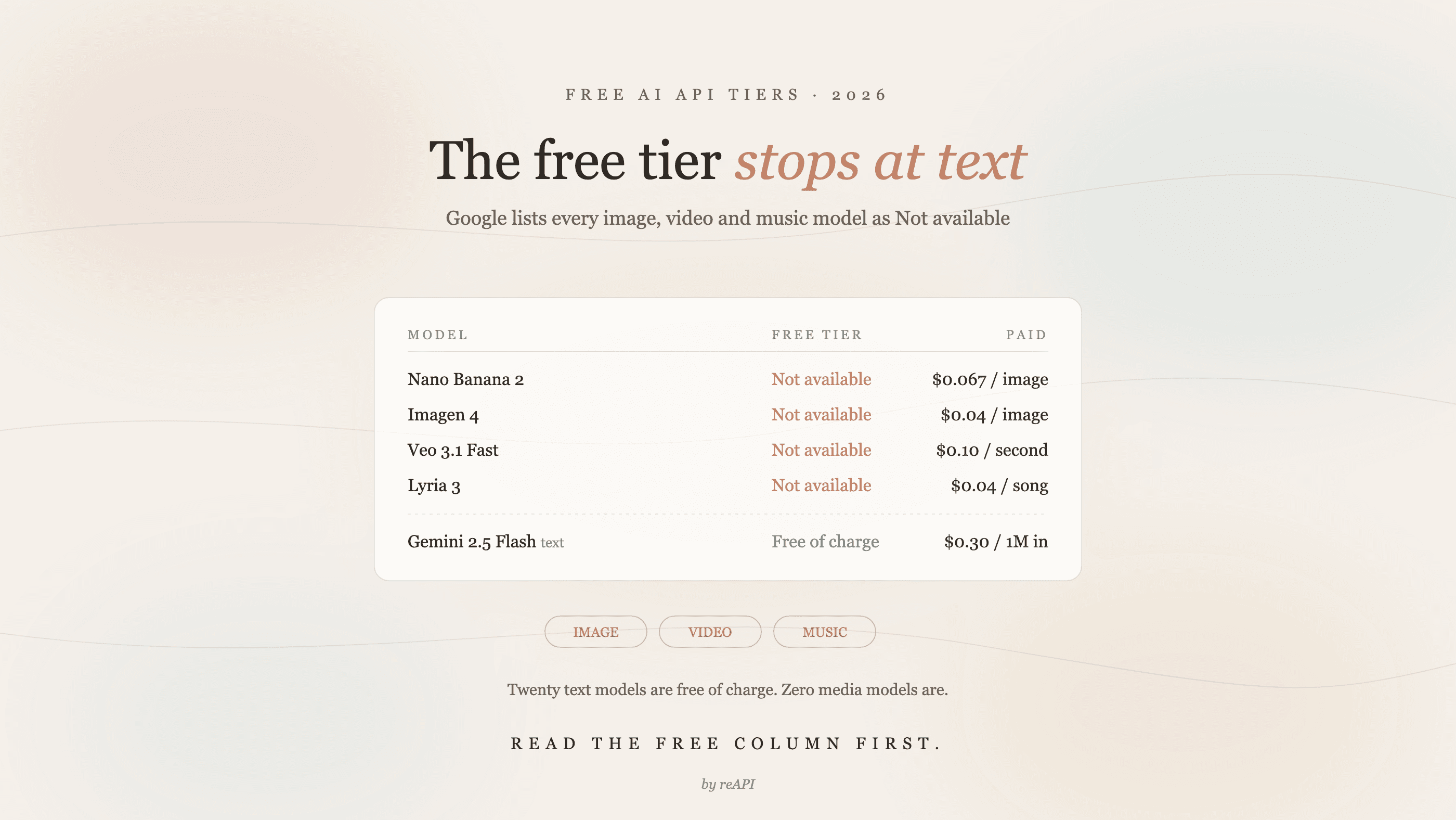
API de IA gratis 2026: los límites reales de cada proveedor
Google excluye imágenes, vídeos y música de su API gratuita. Aquí están los límites reales de cada proveedor en 2026, con sus precios oficiales.

Mejores alternativas a WaveSpeed en 2026: 5 opciones comparadas
¿Buscas una alternativa a WaveSpeed? Compara fal.ai, Replicate, Together AI, RunPod y reAPI por catálogo, precios, velocidad y diseño de API.

GPT-6 Luna API precios: tarifas por token y calculadora de costes
Precios de la GPT-6 Luna API según OpenAI: input, output, lecturas y escrituras de caché, el tramo de 272K, Batch y Fast, y ejemplos de coste resueltos.