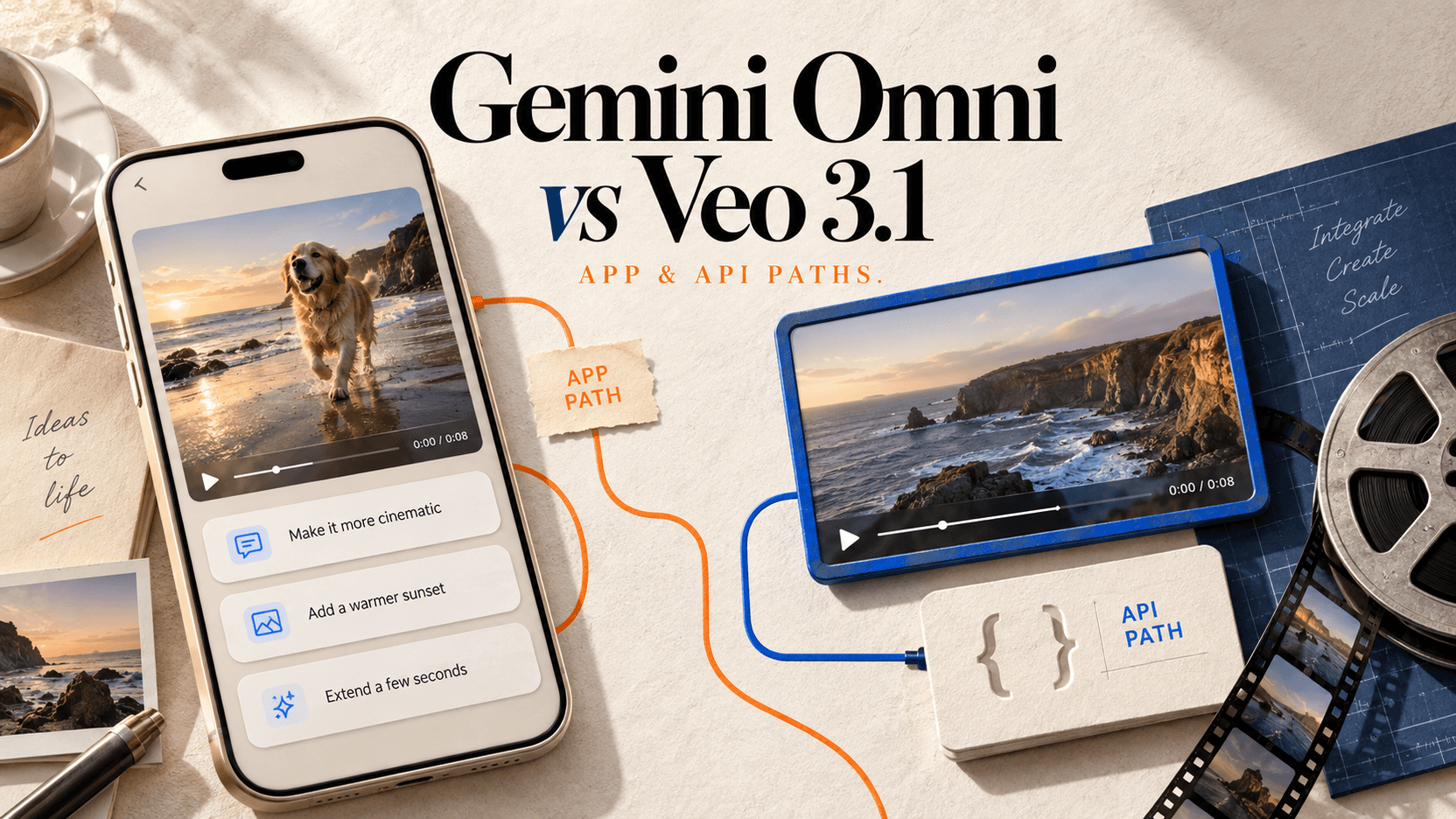
Gemini Omni vs Veo 3.1 : faut-il migrer en mai 2026 ?
Gemini Omni vs Veo 3.1 en mai 2026 : Google ne remplace Veo que dans l'app Gemini, pas dans l'API. Mapping des cinq canaux, diff de code et forces de chacun.
Sur sa page Gemini Omni, Google résume tout en cinq mots : « Gemini Omni will replace Veo in the Gemini app. »[3] Si vous ne lisez que le marketing, vous en déduirez que Veo 3.1 est abandonné. Il ne l'est pas. Veo 3.1 reste disponible sur Vertex AI, dans la Gemini API et chez tous les agrégateurs qui le référencent. La mise à jour publiée par Google le 28 avril 2026 sur la documentation Veo 3.1 de la Gemini API est plus récente que le lancement d'Omni[4].
Quand vous arbitrez entre Gemini Omni et Veo 3.1 en mai 2026, vous ne choisissez donc pas entre un modèle abandonné et son remplaçant. Vous choisissez entre un modèle de sept mois facturé à la seconde et décliné en cinq canaux, et un modèle de deux jours facturé à la génération et décliné en un seul. La bonne réponse dépend du canal Veo 3.1 que vous appelleriez autrement, et du besoin ou non d'audio, de 4K, de contrôle de la première et de la dernière image, ou d'édition multi-tours.
L'essentiel
- Le périmètre du « remplacement ». Google n'a remplacé Veo par Omni que dans l'app Gemini, dans Flow et dans YouTube Shorts[3]. Dans la Gemini API, Veo 3.1 reste le modèle vidéo documenté[4].
- Le calendrier d'accès API. Veo 3.1 dans la Gemini API : en service depuis octobre 2025. API publique de Gemini Omni : « dans les prochaines semaines » à compter du 19 mai 2026[5]. Via reAPI, les deux sont appelables dès aujourd'hui sur le même endpoint.
- La voie la moins chère sans audio. Veo 3.1 Lite à 0,05 $ le clip de 8 secondes en 720p/1080p[6] bat les 0,216 $ de Gemini Omni pour 8s en 1080p[7] d'un facteur d'environ 4.
- La voie la moins chère avec audio. Gemini Omni Flash à 0,216 $ pour 8s en 1080p[7] bat Veo 3.1 Fast Official à 1,20 $ (8s × 0,15 $/s)[6] d'un facteur 5,5.
- 4K. Veo 3.1 Fast alt à 0,30 $ le clip de 8s gagne sur le coût. Gemini Omni à 0,432 $ les 8s gagne grâce à l'audio inclus.
- Souplesse de durée. Gemini Omni accepte 4/6/8/10s[8]. Veo 3.1 alt verrouille la durée à 8s ; Veo 3.1 official accepte 4/6/8s.
- Interpolation première/dernière image. Uniquement Veo 3.1 Official. Gemini Omni n'expose aucun ancrage de première ou de dernière image.
- Édition conversationnelle multi-tours. Uniquement Gemini Omni[1].
- Le partage. Restez sur Veo 3.1 Lite pour les clips muets bon marché. Restez sur Veo 3.1 Official pour les chaînes première/dernière image. Passez à Gemini Omni pour toute charge avec audio en 1080p ou 4K, et pour tout flux où l'itération compte plus que la réussite du premier coup.
Ce que Google a réellement remplacé
L'affirmation « Gemini Omni remplace Veo » porte sur exactement trois surfaces grand public : l'app Gemini, Google Flow et YouTube Shorts[3]. À l'intérieur, Omni Flash est désormais le modèle vidéo par défaut. Veo 3.1 disparaît de l'interface de ces produits.
En dehors de ces surfaces, Veo 3.1 est le même produit que le 18 mai. La documentation vidéo de la Gemini API sur ai.google.dev liste toujours Veo 3.1 comme modèle texte-vers-vidéo et image-vers-vidéo pris en charge[4]. Vertex AI expose toujours Veo 3.1 avec person_generation, resize_mode et les autres réglages de production. Les agrégateurs qui routent vers les poids Veo 3.1 de Google ne sont pas concernés. L'annonce de Google elle-même, le 28 avril 2026, sur les nouvelles capacités de Veo 3.1 dans la Gemini API (filtres de sécurité ajoutés, prompts plus longs) a été publiée sur le blog public moins d'un mois avant la sortie d'Omni[4] : ce n'est guère le rythme d'un modèle que l'on retire.
Nicole Brichtova, directrice de la gestion produit chez Google DeepMind, a déclaré à TechCrunch qu'Omni est "more than a Veo update" et l'a décrit comme "the next step towards the progression of combining the intelligence of Gemini with the rendering capabilities of our media models."[5] La formulation est délibérée. Omni relève d'une autre catégorie de produit (raisonnement + édition), et non d'une montée de version directe de la synthèse vidéo à la seconde de Veo.
Pour le développeur qui arbitre entre Gemini Omni et Veo 3.1, la conclusion est la suivante : ne migrez pas parce que l'interface grand public l'a fait. Migrez quand la capacité ou le calcul de coût désignent Omni pour votre charge précise.
La matrice des capacités
| Capacité | Gemini Omni Flash | Veo 3.1 (5 canaux) |
|---|---|---|
| Texte vers vidéo | oui | oui |
| Image vers vidéo (unique) | oui (1 référence) | oui (Fast / Quality alt, paliers Official) |
| Plusieurs images de référence | jusqu'à 3 (mode fusion)[8] | jusqu'à 3 (Fast alt uniquement)[9] |
| Ancrage de la première image | non | oui (paliers Official)[9] |
| Interpolation première + dernière image | non | oui (paliers Official)[9] |
| Édition conversationnelle multi-tours | oui[1] | non |
| Sortie 4K | oui (0,432 $ les 8s avec audio)[7] | oui (palier 4K-audio sur Official ; forfait à la génération sur alt)[6] |
| Options de durée | 4 / 6 / 8 / 10s[8] | alt : 8s fixes ; Official : 4 / 6 / 8s[9] |
| Formats d'image | 16:9, 9:16[8] | 16:9, 9:16[9] |
| Longueur maximale du prompt | 2 000 caractères[8] | 4 000 caractères[9] |
| Contrôle de l'audio | inclus (toujours actif) | alt : pas d'audio ; Official : bascule generate_audio |
Contrôle person_generation | non exposé | Official : allow_adult / disallow[9] |
| Fonction avatar (grand public) | oui[1] | non |
| Filigrane | SynthID[1] | SynthID |
| Modèle de facturation | à la génération | alt : à la génération ; Official : à la seconde |
Trois asymétries font l'essentiel du travail dans la décision.
L'interpolation première/dernière image de Veo 3.1. Omni n'a pas d'équivalent. Si votre pipeline ancre les clips sur une image de départ et une image de fin connues (chaînage de storyboard, reprises de clips hero à composition verrouillée), Veo 3.1 Official est le seul des deux modèles à vous donner ce contrôle.
L'édition conversationnelle multi-tours d'Omni. Veo n'a pas d'équivalent. « Rends le violon invisible. Maintenant change l'angle de caméra. » Chaque instruction remodèle le clip existant sans perdre la scène[1]. Veo ne sait pas itérer sur sa propre sortie : vous devez régénérer avec un nouveau prompt à chaque fois.
La bascule audio de Veo 3.1 sur Official. Veo Official vous laisse générer de la vidéo muette à prix réduit. Omni intègre l'audio dans chaque génération à un prix unique. Si vous ne voulez pas d'audio, vous économisez 33 % sur Veo Fast Official en passant generate_audio: false ; Omni n'expose pas cet interrupteur.
Les cinq canaux Veo 3.1 qu'Omni ne remplace pas
Sur reAPI, Veo 3.1 représente cinq canaux et non un modèle, et chacun a une surface différente[6]. Chacun correspond à une raison différente de rester ou de migrer.
veo3.1-lite est le canal économique. À la génération, durée verrouillée à 8 secondes, pas d'audio, prompt seul (aucune entrée image). 0,05 $ le clip de 8s en 720p/1080p[6]. Gemini Omni, à 0,216 $ pour 8s en 1080p, revient environ quatre fois plus cher pour la même spécification de sortie. Si votre charge consiste à « brouillonner vite et jeter presque tout », Lite est imbattable.
veo3.1-fast est le canal de labeur côté alt. À la génération, accepte jusqu'à 3 images de référence, durée fixe de 8s. 0,10 $ les 8s en 720p/1080p, 0,30 $ les 8s en 4K. Le mode fusion à trois images d'Omni couvre une surface comparable, mais au double du prix pour une sortie 1080p.
veo3.1-quality est le canal haute fidélité côté alt. 0,75 $ les 8s en 720p/1080p, 2,40 $ les 8s en 4K. À utiliser quand le rendu des visages, la lisibilité du texte ou la cohérence des personnages sont déterminants. La qualité brute d'Omni n'est pas confirmée à ce palier de prix ; des testeurs écrivant le lendemain du lancement estimaient que la qualité globale d'Omni "trails" la frontière du classement[5].
veo3.1-fast-official débloque les réglages de niveau Vertex : ancrage première/dernière image, bascule generate_audio, enum person_generation, durées de 4 / 6 / 8s. À la seconde. 0,15 $/s en 720p/1080p avec audio. Aucun de ces réglages n'a d'équivalent chez Omni.
veo3.1-quality-official est le palier de production. 0,40 $/s en 720p/1080p avec audio. Même surface de contrôle que Fast Official, fidélité visuelle supérieure. À utiliser pour les plans hero et la création publicitaire.
Au moment de trancher entre Gemini Omni et Veo 3.1, la bonne question n'est pas « quel modèle gagne » mais « lequel des cinq canaux Veo 3.1 cette charge utilise-t-elle aujourd'hui, et la surface d'Omni couvre-t-elle ces réglages ? ».
Migrer le corps de la requête
Sur reAPI, les deux modèles passent par POST /api/v1/videos/generations. La migration est une modification du corps de la requête, pas un changement d'endpoint. Voici la traduction champ par champ, de la configuration Veo 3.1 la plus courante vers Omni.
Requête Veo 3.1 Fast (canal alt) :
{
  "model": "veo3.1-fast",
  "prompt": "A neon city street in the rain, slow camera pan",
  "image_urls": ["https://your-cdn.com/ref.jpg"],
  "generation_type": "frame",
  "aspect_ratio": "16:9",
  "resolution": "1080p"
}
La même requête, migrée vers Gemini Omni :
{
  "model": "gemini-omni",
  "prompt": "A neon city street in the rain, slow camera pan",
  "image_urls": ["https://your-cdn.com/ref.jpg"],
  "duration": 8,
  "aspect_ratio": "16:9",
  "resolution": "1080p"
}
Trois changements à connaître. Premièrement, generation_type n'existe pas chez Omni : le mode se déduit du nombre d'image_urls (0 texte vers vidéo, 1 image vers vidéo, 3 fusion)[8]. Deuxièmement, Omni accepte duration comme champ de premier ordre, là où Veo alt le fige à 8s. Troisièmement, Omni rejette image_urls de longueur 2 avec une 400 et le code d'erreur 20003[8] ; Veo Fast accepte 1, 2 ou 3.
Si votre requête d'origine venait de veo3.1-fast-official, la migration coûte davantage. Supprimez first_frame_image, last_frame_image, generate_audio, person_generation et resize_mode : Omni n'en expose aucun. Si l'un d'eux était structurant, ne migrez pas.
Le calcul de prix sur les canaux qui comptent
Pour un clip de 8 secondes en 1080p sur reAPI en mai 2026 :
| Canal | Avec audio | Sans audio |
|---|---|---|
veo3.1-lite | non pris en charge | 0,05 $ (alt, à la génération)[6] |
veo3.1-fast | non pris en charge | 0,10 $ (alt, à la génération)[6] |
veo3.1-quality | non pris en charge | 0,75 $ (alt, à la génération)[6] |
veo3.1-fast-official | 1,20 $ (8s × 0,15 $/s) | 0,80 $ (8s × 0,10 $/s)[6] |
veo3.1-quality-official | 3,20 $ (8s × 0,40 $/s) | 1,60 $ (8s × 0,20 $/s)[6] |
gemini-omni | 0,216 $ (à la génération, audio inclus)[7] | 0,216 $ (pas de bascule)[7] |
Deux observations. Premièrement : s'il vous faut de l'audio et que vous n'êtes pas sur Veo Official, Gemini Omni est la voie la moins chère sur reAPI. Le tarif avec audio d'Omni, 0,216 $, est 5,5 fois moins cher que les 1,20 $ de Veo Fast Official et 14,8 fois moins cher que les 3,20 $ de Veo Quality Official. Deuxièmement : si vous n'avez pas besoin d'audio, Veo Lite à 0,05 $ reste imbattable. Omni n'a pas de remise mode muet, parce que son prix ne dépend pas de l'audio.
Pour de la 4K avec audio sur 8s : Gemini Omni à 0,432 $ contre Veo Quality Official à 4,80 $ (8s × 0,60 $/s). Omni est 11 fois moins cher en 4K avec audio. C'est là que la facturation à la génération penche le plus nettement en faveur d'Omni.
Quand rester sur Veo 3.1
- Le flux de travail enchaîne les plans en une séquence plus longue via l'ancrage première et dernière image
- Le flux de travail exige
person_generationsurdisallowpour des raisons de conformité - La spécification de sortie est de la vidéo muette et le plancher de 0,05 $ de Veo Lite compte à grande échelle
- Le pipeline part en production aujourd'hui et une version d'Omni vieille de deux jours introduit un risque inconfortable
- La longueur du prompt dépasse régulièrement 2 000 caractères (Veo en autorise 4 000)
- L'équipe dispose d'un contrat Vertex AI aux conditions négociées
Quand migrer vers Gemini Omni
- Vous payez
veo3.1-fast-officialavec audio à 1,20 $ ou plus le clip de 8s et le flux d'édition itérative n'a pas besoin d'ancrage de la première image - Vous avez besoin de 4K avec audio (les 0,432 $ d'Omni les 8s battent les 4,80 $ de Veo Quality Official d'un facteur 11)
- Le flux de travail est intensif en édition : régénérer de zéro à chaque retouche brûle du budget et casse la cohérence des personnages
- La souplesse de durée (4 / 6 / 8 / 10s) compte et le verrou à 8 secondes côté alt vous pèse
- Vous voulez vous consolider sur un seul modèle derrière un seul endpoint et l'équipe peut encaisser la perte des réglages Official de Veo
FAQ
Veo 3.1 est-il en cours d'abandon ?
Non. Google a retiré Veo 3.1 des surfaces grand public que sont l'app Gemini, Flow et YouTube Shorts, et l'a remplacé par Gemini Omni Flash[3]. La documentation vidéo de la Gemini API continue de lister Veo 3.1 comme pris en charge, avec une mise à jour aussi récente que le 28 avril 2026[4]. La surface Veo 3.1 de Vertex AI est inchangée.
Quand l'API publique de Gemini Omni ouvre-t-elle ?
Google a indiqué, après l'annonce du 19 mai 2026, que l'accès API pour les développeurs et les entreprises arriverait « dans les prochaines semaines »[5]. À la date de cet article, aucun identifiant de modèle public de la Gemini API n'est documenté pour Omni. Sur reAPI, Gemini Omni est appelable dès aujourd'hui sous gemini-omni via l'endpoint vidéo standard, avant le déploiement direct de l'API de Google.
Puis-je utiliser les deux modèles derrière un seul endpoint ?
Oui. Les deux passent par POST /api/v1/videos/generations sur reAPI. Changer revient à modifier le champ "model". Les correspondances de champs ne sont pas identiques (voir la section migration ci-dessus) : Omni abandonne first_frame_image, last_frame_image, generate_audio, person_generation et resize_mode.
Gemini Omni prend-il en charge l'ancrage de la première et de la dernière image ?
Non. Omni n'expose que la fusion d'images avec une cardinalité de 0, 1 ou 3[8]. La notion d'image « première » ou « dernière » n'existe pas. Si votre pipeline dépend du verrouillage de la composition d'ouverture ou de fermeture, Veo 3.1 Official est le seul modèle à vous l'offrir.
Quel modèle revient le moins cher pour itérer ?
Cela dépend de votre besoin d'audio. Veo 3.1 Lite à 0,05 $ le clip muet de 8s est la voie la moins chère pour tout brouillon jetable[6]. Si vous voulez de l'audio dans chaque brouillon, Gemini Omni à 0,216 $ pour 8s en 1080p avec audio est le tarif avec audio le moins cher sur reAPI[7].
L'API Gemini Omni passera-t-elle sous le prix de reAPI à sa sortie ?
C'est possible. Des prévisionnistes indépendants situent Omni Flash entre 0,20 $ et 0,60 $ la seconde de vidéo produite en direct chez Google, auxquels s'ajoute une tarification d'entrée au token. Les 0,216 $ de reAPI pour un clip de 8s en 1080p équivalent à environ 0,027 $/s en forfait, ce qui reste sous la borne basse de la prévision pour Google en direct. L'écart réel ne sera connu qu'à la publication des tarifs officiels de Google.
Et la qualité de Gemini Omni face à Veo 3.1 ?
Omni Flash est sorti deux jours avant cet article et ne figure pas encore au classement Video Arena d'Artificial Analysis[10]. Veo 3.1 y est depuis des mois et se place derrière Seedance 2.0 mais devant Sora 2 en agrégé. Les premiers essais pratiques d'Omni ont jugé les démos grand public impressionnantes, tout en signalant que la qualité globale "trails" la frontière du classement[5]. Considérez Omni comme la surface d'édition la plus inédite, pas comme le leader de qualité avéré, tant que l'Arena n'a pas réuni assez de votes.
Router les deux pour le trimestre à venir
En mai 2026, vous ne tranchez pas Gemini Omni vs Veo 3.1 une fois pour toute la pipeline. Vous routez requête par requête. Envoyez les charges de brouillon, muettes et ancrées sur la première image vers le bon canal Veo 3.1. Envoyez les charges avec audio, en 4K et en édition multi-tours vers Gemini Omni Flash. Les deux derrière un même endpoint compatible OpenAI, ce routage tient dans une modification de configuration de 30 lignes.
S'il fallait me standardiser sur un seul modèle dès maintenant, je resterais sur Veo 3.1 pour toute pipeline qui sert des clients payants, forte de sept mois d'antécédents en production. Je laisserais à Gemini Omni les nouvelles charges, celles où son édition multi-tours et son audio inclus comptent. La formule « Gemini Omni remplace Veo » est vraie pour l'interface grand public de Google et trompeuse partout ailleurs. Lisez la question Gemini Omni vs Veo 3.1 comme « sur quoi chaque canal justifie-t-il encore son existence » et le plan de migration s'écrit tout seul.
References
- Google. Introducing Gemini Omni. Koray Kavukcuoglu, May 19, 2026. Retrieved May 2026 from blog.google/innovation-and-ai/models-and-research/gemini-models/gemini-omni
- Google DeepMind. Gemini Omni — Model page. Retrieved May 2026 from deepmind.google/models/gemini-omni
- Google. Gemini Omni — Video Generation overview. Retrieved May 2026 from gemini.google/overview/video-generation
- Google. Enhanced Veo 3.1 capabilities are now available in the Gemini API. April 28, 2026. blog.google/innovation-and-ai/technology/developers-tools/veo-3-1-gemini-api
- Rebecca Bellan. Google's Gemini Omni turns images, audio, and text into video — and that's just the start. TechCrunch, May 19, 2026. techcrunch.com/2026/05/19/googles-gemini-omni-turns-images-audio-and-text-into-video-and-thats-just-the-start
- reAPI. Veo 3.1 — Model page (live pricing across 5 channels). Retrieved May 2026 from reapi.ai/models/veo3-1
- reAPI. Gemini Omni — Model page (live pricing). Retrieved May 2026 from reapi.ai/models/gemini-omni
- reAPI. Gemini Omni — API reference. Retrieved May 2026 from reapi.ai/docs/gemini-omni
- reAPI. Veo 3.1 — API reference. Retrieved May 2026 from reapi.ai/docs/veo3-1
- Artificial Analysis. Video Arena Leaderboard. Retrieved May 2026 from artificialanalysis.ai/video/arena
Further reading
- Google. Generate videos with Veo 3.1 in the Gemini API. ai.google.dev/gemini-api/docs/video
- reAPI. Gemini Omni vs Seedance 2.0: The 2026 Video Model Split. reapi.ai/blog/gemini-omni-vs-seedance-2-0-2026
- reAPI. Veo 3.1 vs Seedance 2.0: Picking a Video Model in 2026. reapi.ai/blog/veo-3-1-vs-seedance-2-0-2026
- reAPI. Cheapest Veo 3.1 API in 2026. reapi.ai/blog/cheapest-veo-3-1-api-2026
Auteur

Catégories
Plus d'articles
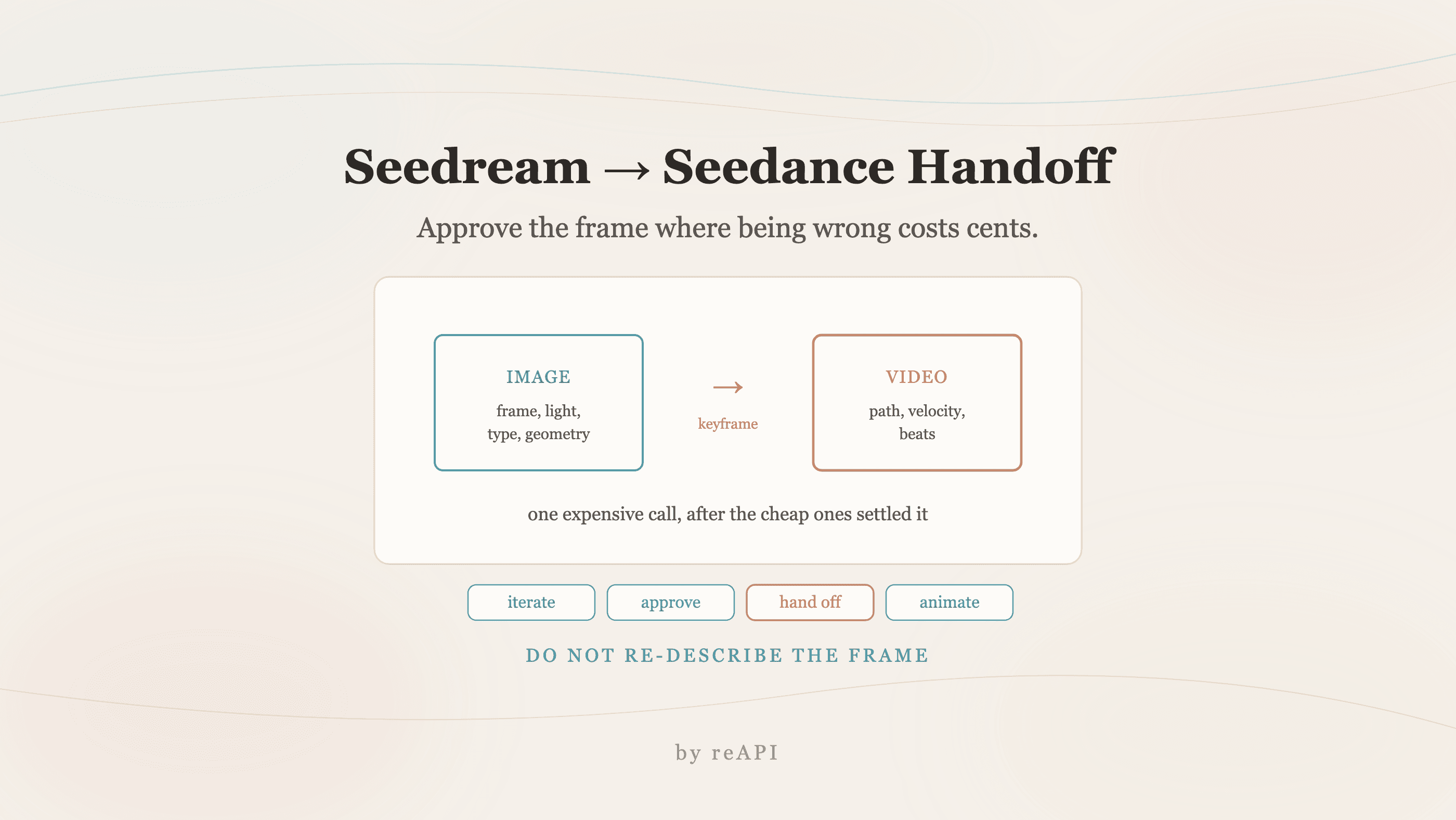
De Seedream à Seedance : flux du transfert de cadre clé
Le flux Seedream Seedance stabilise la composition par image, puis transfère le cadre à la vidéo. Répartition des tâches et pièges essentiels.

Gemini 4 Argon vs GPT-6 Astra vs Opus 5.5 : benchmarks
Gemini 4 Argon vs GPT-6 Astra vs Claude Opus 5.5 sur les 18 benchmarks du tableau de Google, plus limites de sortie, prix et quel modèle choisir selon la tâche.

Quel modèle Grok Imagine utiliser : 1.0 vs 1.5 vs Image 2.0
Trois modèles Grok Imagine en quatre mois pour la vidéo et l'image. Lequel possède une API, lequel coûte moins cher, et le piège de nomenclature.